



Bathyaethiops baka Moritz & Schliewen, 2016
Dwarf moon tetra
Hochladen Photos und videos
Google Bild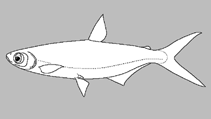 No image available for this species;
drawing shows typical species in Alestidae.
Google Bild
drawing shows typical species in Alestidae.
Klassifizierung / Names Namen | Synonyme | Catalog of Fishes(Gattung, Arten) | ITIS | CoL | WoRMS | Cloffa
> Characiformes (Characins) > Alestidae (African tetras)
Etymology: Bathyaethiops: Greek, bathys = deep + Greek, Aethiopia, an African country (Ref. 45335); baka: Named after the Baka people, the native hunter-gatherer tribe in southeastern Cameroon, where the species was found; a noun in aposition (Ref. 110423).
Eponymy: This species is named after the Baka people, a native hunter-gatherer tribe in Cameroon. (Ref. 128868), visit book page.
Etymology: Bathyaethiops: Greek, bathys = deep + Greek, Aethiopia, an African country (Ref. 45335); baka: Named after the Baka people, the native hunter-gatherer tribe in southeastern Cameroon, where the species was found; a noun in aposition (Ref. 110423).
Eponymy: This species is named after the Baka people, a native hunter-gatherer tribe in Cameroon. (Ref. 128868), visit book page.
Umwelt: Milieu / Klimazone / Tiefenbereich / Verbreitungsgebiet Ökologie
; süßwasser benthopelagisch; pH range: 7.1 - 7.1. Tropical; 28°C - ? (Ref. 110423)
Verbreitung Territorien | FAO Gebiete | Ökosysteme | Vorkommen | Punkt Karte | Einführungen | Faunafri
Africa: Ngoko River (Sangha drainage, middle Congo River basin) in Cameroon (Ref. 110423).
Größe / Gewicht / Alter
Kurzbeschreibung Bestimmungsschlüssel | Morphologie | Morphometrie
Rückenflossenstacheln (insgesamt) : 0; Rückenflossenweichstrahlen (insgesamt) : 10 - 11; Afterflossenstacheln: 0; Afterflossenweichstrahlen: 21 - 24; Wirbelzahl: 35 - 37. Diagnosis: Bathyaethiops baka is distinguished from all congeners by an incomplete squamation with the scale cover variably reduced to no pre-dorsal scales, usually no scales on caudal peduncle, and usually a scale-free patch on middle flank at about level of pelvic-fin origin; furthermore distinguished by a unique colour pattern, i.e., a combination of a humeral spot of about pupil-size and the absence of dark vertical bars along midlateral flanks (Ref. 110423). It is difficult to distinguish from juvenile Bathyaethiops caudomaculatus, from which it differs by the usually absence of unicuspid teeth in the second row of lower jaws vs. presence, and usually the absent or rudimentary supraneural between two neural spines directly in front of the first dorsal fin pterygiophore vs. well developed (Ref. 110423).
Body shape (shape guide): fusiform / normal.
Body shape (shape guide): fusiform / normal.
Found in the main river channel of Ngoko River, usually in or close to riparian vegetation over a substrate of fine particles and organic material (Ref. 110423).
Lebenszyklus und Paarungsverhalten Geschlechtsreife | Fortpflanzung | Ablaichen | Eier | Fruchtbarkeit | Larven
Hauptreferenz
Laden Sie Ihre Referenzen hoch | Referenzen | Koordinator | Partner
Moritz, T. and U.K. Schliewen, 2016. Description of two new Bathyaethiops species (Teleostei: Alestidae) from the Congo basin. Zootaxa 4117(4):476-490. (Ref. 110423)
CITES
Not Evaluated
Bedrohung für Menschen
Harmless
Nutzung durch Menschen
FAO - Publication: search | FishSource |
Mehr Information
Trophische Ökologie
Lebensmittel (Beutetiere)
Nahrungszusammensetzung
Nahrungsaufnahme
Lebensmittelrationen
Räuber
Lebensmittel (Beutetiere)
Nahrungszusammensetzung
Nahrungsaufnahme
Lebensmittelrationen
Räuber
Populationsdynamik
Wachstumsparameter
Max. Alter/Größen
Länge-Gewicht-Rel.
Länge-Länge-Verhältnis.
Längenhäufigkeiten
Massenkonvertierung
Rekrutierung
Dichte
Wachstumsparameter
Max. Alter/Größen
Länge-Gewicht-Rel.
Länge-Länge-Verhältnis.
Längenhäufigkeiten
Massenkonvertierung
Rekrutierung
Dichte
Lebenszyklus
Fortpflanzung
Geschlechtsreife
Reifung/Kiemen rel.
Fruchtbarkeit
Ablaichen
Laichaggregationen
Eier
Eientwicklung
Larven
Larven Pop.Dyn.
Fortpflanzung
Geschlechtsreife
Reifung/Kiemen rel.
Fruchtbarkeit
Ablaichen
Laichaggregationen
Eier
Eientwicklung
Larven
Larven Pop.Dyn.
Anatomie
Kiemenoberfläche
Gehirn
Otolith
Kiemenoberfläche
Gehirn
Otolith
Physiologie
Körperliche Zusammensetzung
Nährstoffe
Sauerstoffverbrauch
Schwimmart
Schwimmgeschwindigkeit
Visuelle Pigmente
Fischgeräusche
Krankheiten und Parasiten
Toxizität (LC50s)
Körperliche Zusammensetzung
Nährstoffe
Sauerstoffverbrauch
Schwimmart
Schwimmgeschwindigkeit
Visuelle Pigmente
Fischgeräusche
Krankheiten und Parasiten
Toxizität (LC50s)
Genetik
Genom
Genetik
Heterozygotie
Vererbbarkeit
Genetische Vielfalt
Genom
Genetik
Heterozygotie
Vererbbarkeit
Genetische Vielfalt
Menschenbezogen
Aquakultur-Systeme
Aquakultur Profile
Zuchtlinien
Ciguatera-Fälle
Briefmarken, Münzen, Verschiedenes.
Aquakultur-Systeme
Aquakultur Profile
Zuchtlinien
Ciguatera-Fälle
Briefmarken, Münzen, Verschiedenes.
Tools
Zusatzinformationen
Download XML
Zusammenfassung | Punktdaten | Namen | Photos
Internet Quellen
AFORO (otoliths) | Aquatic Commons | BHL | Cloffa | Websites from users | FishWatcher Einträge suchen | CISTI | Catalog of Fishes: Gattung, Arten | DiscoverLife | ECOTOX | FAO - Publication: search | Faunafri | Fishipedia | Fishtrace | GloBI | Google Books | Google Scholar | Google | IGFA World Record | OneZoom | Open Tree of Life | Otolith Atlas of Taiwan Fishes | PubMed | Reef Life Survey | Socotra Atlas | TreeBase | Tree of Life | Wikipedia: Gehe zu, Suchen | | Zoobank | Zoologischer Rekord
Schätzungen auf der Grundlage von Modellen
|
Phylogenetischer Diversitätsindex (Ref. 82804) |
PD50 = 0.5156 [Uniqueness, from 0.5 = low to 2.0 = high]. |
| Bayesian length-weight | a=0.00589 (0.00239 - 0.01452), b=3.13 (2.92 - 3.34), in cm total length, based on LWR estimates for this (Sub)family-body shape (Ref. 93245). |
|
Trophische Ebene (Ref. 69278) |
3.0 ±0.4 se; based on size and trophs of closest relatives |
|
Widerstandsfähigkeit (Ref. 120179) |
hoch, Verdopplung der Population dauert weniger als 15 Monate. (Preliminary K or Fecundity.). |
|
Anfälligkeit der Fischerei (Ref. 59153) |
Low vulnerability (10 of 100). 🛈 |