



Grammatonotus brianne Anderson, Greene & Rocha, 2016
Batangas groppo
Uploaden van uw Foto's en video's
Afbeeldingen | Google afbeelding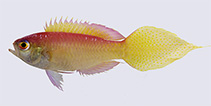 Grammatonotus brianne
Afbeelding van Rocha, L.A.
Afbeeldingen | Google afbeelding
Afbeelding van Rocha, L.A.
Classificatie / Namen Lokale namen | Synoniemen | Catalog of Fishes(Genus, Soort(en)) | ITIS | CoL | WoRMS | Cloffa
> Eupercaria/misc (Various families in series Eupercaria) > Callanthiidae (Splendid perches)
Etymology: Grammatonotus: Greek, gramma, atos = signal, mark + Greek, noton = back (Ref. 45335); brianne: Named for Brianne M. Atwood; noun in apposition.
Eponymy: Brianne M Greene née Atwood was the second author’s wife. (See above) (Ref. 128868), visit book page.
Etymology: Grammatonotus: Greek, gramma, atos = signal, mark + Greek, noton = back (Ref. 45335); brianne: Named for Brianne M. Atwood; noun in apposition.
Eponymy: Brianne M Greene née Atwood was the second author’s wife. (See above) (Ref. 128868), visit book page.
Milieu: milieu / Klimaatzone / Diepte / verspreidingsgebied Ecologie
marien pelagic-neritic; diepte ? - 150 m (Ref. 111873). Tropical
Verspreiding Gebieden | FAO regio's | Ecosystemen | Voorkomen | Verspreidingskaart | Introducties | Faunafri
Western Pacific: Philippines.
Grootte / Gewicht / Leeftijd
Korte beschrijving Determinatiesleutels | Morfologie | Morfometrie
Dorsale stekels (totaal) : 11; Dorsale zachte stralen (totaal) : 9; Anale stekels: 3; Anale zachte stralen: 9; Wervels: 24. This species is distinguished from the its congeners by the following set of characters: the caudal fin is rhomboid in shape with mid-caudal rays produced; lateral-line usually disjunct (7 of 8 lateral lines disjunct, counts made on both sides); spines of anal-fin short. Colouration: dorsal head and body rosy to red; ventral head and area below base of pectoral fin pale yellow to silvery; mid-body is pink to pale rose above dull yellow; ventral body is pale yellow to faint purplish; iris of eye yellow centrally with dark red to rose peripherally (widest ventrally) and with a short band of blue at dorsal most part of iris; dorsal fin yellow to yellow orange proximally and light to dark purple distally (distal ends of dorsal spines yellow); anal fin is light purple; pectoral fin pale yellow; pelvic fin light purple; caudal fin pale to bright yellow proximally, pale yellow distally; presence of numerous bright yellow spots superimposed on ground coloration of proximal part of dorsal fin and all or most of caudal fin (Ref. 111873).
Body shape (shape guide): fusiform / normal; Cross section: compressed.
Body shape (shape guide): fusiform / normal; Cross section: compressed.
Levenscyclus en paargedrag Maturiteit | Voortplanting | Paaien | Eieren | Fecunditeit | Larven
Hoofdreferentie
Upload uw referenties | Referenties | Coördinator | Medewerkers
Anderson, W.D. Jr., B.D. Greene and L.A. Rocha, 2016. Grammatonotus brianne, a new callanthiid fish from Philippine waters, with short accounts of two other Grammatonotus from the Coral Triangle. Zootaxa 4173(3):289-295. (Ref. 111873)
Status op de Rode Lijst van het IUCN (Ref. 130435: Version 2025-2 (Global))
Niet bedreigd (LC) ; Date assessed: 13 May 2024
CITES
Not Evaluated
Gevaar voor de mens
Harmless
Gebruik door de mens
FAO - Publication: search | FishSource |
Meer informatie
Trofische ecologie
Voedsel (prooien)
Dieetsamenstelling
Voedselconsumptie
Voedselrantsoenen
Predatoren
Voedsel (prooien)
Dieetsamenstelling
Voedselconsumptie
Voedselrantsoenen
Predatoren
Ecologie
Ecologie
Ecologie
Populatiedynamica
Groeiparameters
Max. leeftijden / maten
Lengte-gewicht rel.
Lengte-lengte rel.
Lengtefrequenties
Massaconversie
Rekrutering
Abundantie
Groeiparameters
Max. leeftijden / maten
Lengte-gewicht rel.
Lengte-lengte rel.
Lengtefrequenties
Massaconversie
Rekrutering
Abundantie
Levenscyclus
Voortplanting
Maturiteit
Rijpheid/kieuwen rel.
Fecunditeit
Paaien
Paaibestanden
Eieren
Ontwikkeling van de eieren
Larven
Larvale populatiedynamiek
Voortplanting
Maturiteit
Rijpheid/kieuwen rel.
Fecunditeit
Paaien
Paaibestanden
Eieren
Ontwikkeling van de eieren
Larven
Larvale populatiedynamiek
Anatomie
Kieuwoppervlak
Hersenen
Otoliet
Kieuwoppervlak
Hersenen
Otoliet
Fysiologie
Lichaamssamenstelling
Voedingsstoffen
Zuurstofverbruik
Type zwemmen
Zwemsnelheid
Visuele pigmenten
Vis geluid
Ziekten en parasieten
Toxiciteit (LC50)
Lichaamssamenstelling
Voedingsstoffen
Zuurstofverbruik
Type zwemmen
Zwemsnelheid
Visuele pigmenten
Vis geluid
Ziekten en parasieten
Toxiciteit (LC50)
Genetica
genoom
Genetica
Heterozygositeit
Erfelijkheid
Genetische diversiteit
genoom
Genetica
Heterozygositeit
Erfelijkheid
Genetische diversiteit
Menselijk gerelateerd
Aquacultuursystemen
Aquacultuurprofielen
Kweeklijnen
Ciguatera gevallen
Postzegels, munten, diversen.
Aquacultuursystemen
Aquacultuurprofielen
Kweeklijnen
Ciguatera gevallen
Postzegels, munten, diversen.
Tools
Speciale rapporten
Bekijk gegevens voor het houden in een aquarium | Bekijk Fact Sheets voor de soort | Bekijk Aquacultuur Fact Sheets
Download XML
Internetbronnen
AFORO (otoliths) | Aquatic Commons | BHL | Cloffa | Websites from users | Bekijk FishWatcher | CISTI | Catalog of Fishes: Genus, Soort(en) | DiscoverLife | ECOTOX | FAO - Publication: search | Faunafri | Fishipedia | Fishtrace | GloBI | Google Books | Google Scholar | Google | IGFA World Record | OneZoom | Open Tree of Life | Otolith Atlas of Taiwan Fishes | PubMed | Reef Life Survey | Socotra Atlas | TreeBase | Tree of Life | Wikipedia: ga naar, zoek | World Records Freshwater Fishing | Zoobank | Zoological Record
Schattingen op basis van modellen
Fylogenetische diversiteitsindex (Ref. 82804): PD50 = 0.5010 [Uniqueness, from 0.5 = low to 2.0 = high].
Bayesian length-weight: a=0.00977 (0.00377 - 0.02533), b=3.07 (2.85 - 3.29), in cm total length, based on LWR estimates for this (Sub)family-body shape (Ref. 93245).
Trofisch niveau (Ref. 69278): 3.3 ±0.4 se; based on size and trophs of closest relatives