This website uses cookies to enhance your browsing experience and ensure the functionality of our site. For more detailed information about the types of cookies we use and how we protect your privacy, please visit our Privacy Information page.
×
Cookie Settings
This website uses different types of cookies to enhance your experience. Please select your preferences below:
> Gobiiformes (Gobies) > Gobiidae (Gobies) > Gobiinae
Etymology: Eviota:No etymology given, suggested by Christopher Scharpt: from Latin 'eu' for 'true' and 'iota' for anything very small, in combination 'truly very small' referring to it as being the smallest vertebrate at the time it has benn described by Jenkins (thus, making the suggestion by Scharpt plausible; teresae:Named for Teresa Arámbula; in genitive case. Eponymy: Teresa ‘Terry’ Greenfield is the senior author’s wife. She assisted in collecting the type material of the goby, and was thanked for providing field, editorial, and moral support to her husband over many years. (Ref. 128868), visit book page.
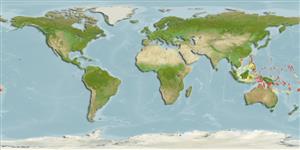
Environnement : milieu / zone climatique / profondeur / gamme de distribution Écologie
marin récifal; profondeur 0 - 26 m (Ref. 107299). Tropical
This species is distinguished by the following characters: complete cephalic sensory-canal pore pattern (pattern 1); dorsal/anal fin formula usually 9/8; pectoral-fin rays usually 18; spot lateral to pelvic-fin base absent; dark occipital spot absent; pectoral-fin base with no distinct dark pigmentation; without a dark spot on mid caudal peduncle; without transverse bars on head and nape; anal fin darker than other fins; in life, orange scale margins; presence of distinct dark spots on ventral side of head; iris reddish with scattered small light spots on dorsal surface; red blotches on sides are deeper than wide; some pectoral-fin rays are branched; fifth pelvic-fin ray about 10-15% of length of fourth ray; no membranes in pelvic fins and the branches are elongate and slender with 2 segments between branches (Ref. 107299). Body shape (shape guide): elongated; Cross section: oval.
Cycle de vie et comportement reproducteur Maturité | Reproduction | Frai | Œufs | Fécondité | Larves
Greenfield, D.W. and J.E. Randall, 2016. A review of the dwarfgobies of Fiji, including descriptions of five new species (Teleostei: Gobiidae: Eviota). J. Ocean Sci. Found. 20:25-75. (Ref. 107299)
Statut dans la liste rouge de l'IUCN (Ref. 130435: Version 2025-2 (Global))
Dynamique des populations Paramètres de croissance Âges / tailles maximales Longueur-poids rel. Rel. longueur-longueur. Fréquences de longueurs Conversion de masse Recrutement Abondance
Cycle de vie Reproduction Maturité Maturité/épines rel. Fécondité Frai Agrégats de frai Œufs Développement de l'œuf Larves Dynamique des populations larvaires
Physiologie Composition corporelle Nutriments Consommation d'oxygène Type de natation Vitesse de nage Pigments visuels Son de poisson Maladies et parasites Toxicité (CL50)
Indice de diversité phylogénétique (Réf. 82804): PD50 = 0.5000 [Uniqueness, from 0.5 = low to 2.0 = high].
Bayesian length-weight: a=0.00692 (0.00281 - 0.01706), b=3.09 (2.92 - 3.26), in cm total length, based on LWR estimates for this Genus-body shape (Ref. 93245).
Niveau trophique (Réf. 69278): 3.1 ±0.3 se; based on size and trophs of closest relatives
Résilience (Réf. 120179): Haut, temps minimum de doublement de population inférieur à 15 mois (Preliminary K or Fecundity.).
Vulnérabilité de la pêche (Ref. 59153): Low vulnerability (10 of 100). 🛈