This website uses cookies to enhance your browsing experience and ensure the functionality of our site. For more detailed information about the types of cookies we use and how we protect your privacy, please visit our Privacy Information page.
×
Cookie Settings
This website uses different types of cookies to enhance your experience. Please select your preferences below:
> Gobiiformes (Gobies) > Gobiidae (Gobies) > Gobiinae
Etymology: Eviota:No etymology given, suggested by Christopher Scharpt: from Latin 'eu' for 'true' and 'iota' for anything very small, in combination 'truly very small' referring to it as being the smallest vertebrate at the time it has benn described by Jenkins (thus, making the suggestion by Scharpt plausible; mimica:Named for its superficial similarity to Eviota minuta; Latin word 'mimicus' for imitative.
Environnement : milieu / zone climatique / profondeur / gamme de distribution Écologie
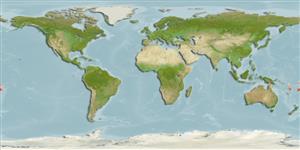
marin récifal; profondeur 1 - 20 m (Ref. 107299). Tropical
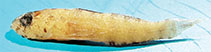
Épines dorsales (Total) : 7; Rayons mous dorsaux (Total) : 8; Épines anales: 1; Rayons mous anaux: 8. This species is distinguished by the following characters: complete cephalic sensory-canal pore system (pattern 1); some branched pectoral-fin rays; dorsal/anal-fin formula is 8/8; in males the first dorsal spine is filamentous; the fifth pelvic-fin ray may be absent or rudimentary; male urogenital papilla is a flat rounded plate; there are 3 bars extending down from lower half of eye; with a dark mark on the lower portion of the preopercular margin; dark bars angling down posteroventrally at the upper and lower portions of pectoral-fin base; there are a number of dark marks on underside of head (Ref. 107299). Body shape (shape guide): elongated; Cross section: oval.
Specimens often collected from reef face or spur-and-groove habitat (Ref. 107299).
Cycle de vie et comportement reproducteur Maturité | Reproduction | Frai | Œufs | Fécondité | Larves
Greenfield, D.W. and J.E. Randall, 2016. A review of the dwarfgobies of Fiji, including descriptions of five new species (Teleostei: Gobiidae: Eviota). J. Ocean Sci. Found. 20:25-75. (Ref. 107299)
Statut dans la liste rouge de l'IUCN (Ref. 130435: Version 2025-2 (Global))
Dynamique des populations Paramètres de croissance Âges / tailles maximales Longueur-poids rel. Rel. longueur-longueur. Fréquences de longueurs Conversion de masse Recrutement Abondance
Cycle de vie Reproduction Maturité Maturité/épines rel. Fécondité Frai Agrégats de frai Œufs Développement de l'œuf Larves Dynamique des populations larvaires
Distribution Territoires Zones FAO Écosystèmes Occurrences Introductions BRUVS - Vidéos
Anatomie Surface branchiale Cerveau Otolithe
Physiologie Composition corporelle Nutriments Consommation d'oxygène Type de natation Vitesse de nage Pigments visuels Son de poisson Maladies et parasites Toxicité (CL50)
Indice de diversité phylogénétique (Réf. 82804): PD50 = 0.5000 [Uniqueness, from 0.5 = low to 2.0 = high].
Bayesian length-weight: a=0.00692 (0.00281 - 0.01706), b=3.09 (2.92 - 3.26), in cm total length, based on LWR estimates for this Genus-body shape (Ref. 93245).
Niveau trophique (Réf. 69278): 3.0 ±0.3 se; based on size and trophs of closest relatives
Résilience (Réf. 120179): Haut, temps minimum de doublement de population inférieur à 15 mois (Preliminary K or Fecundity.).
Vulnérabilité de la pêche (Ref. 59153): Low vulnerability (10 of 100). 🛈