



Salmo multipunctatus Doadrio, Perea & Yahyaoui, 2015
Draa trout
Envoyez vos Photos et vidéos
Images Google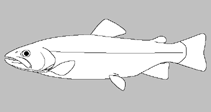 No image available for this species;
drawing shows typical species in Salmonidae.
Images Google
drawing shows typical species in Salmonidae.
Classification / Noms Noms communs | Synonymes | Catalog of Fishes(Genre, Espèce) | ITIS | CoL | WoRMS | Cloffa
> Salmoniformes (Salmons) > Salmonidae (Salmonids) > Salmoninae
Etymology: Salmo: Latin, salmo, Plinius = salmon (Ref. 45335); multipunctatus: The species name multipunctata [to be corrected in multipunctatus refers to its diagnostic pigmentation pattern, which is consttuted by numerous spots and marks along the body (Ref. 107622).
Etymology: Salmo: Latin, salmo, Plinius = salmon (Ref. 45335); multipunctatus: The species name multipunctata [to be corrected in multipunctatus refers to its diagnostic pigmentation pattern, which is consttuted by numerous spots and marks along the body (Ref. 107622).
Environnement : milieu / zone climatique / profondeur / gamme de distribution Écologie
; eau douce pélagique. Subtropical
Distribution Territoires | Zones FAO | Écosystèmes | Occurrences | Carte par point | Introductions | Faunafri
Africa: Draa basin in southern Morocco (Ref. 107622).
Taille / Poids / Âge
Description synthétique Clés d'identification | Morphologie | Morphométrie
Vertèbres: 53 - 55. Diagnosis: It differs from other known species of the genus Salmo in the numerous irregular narrow parr marks, usually more than or equal to 14, in the lateral line; upper row of parr marks more than or equal to 10; lower row of parr marks variable, usually more than or equal to 5; two conspicuous black spots placed at the right and left sides of the iris and two less visible spots at the upper and lower sides of the iris; numerous black, small spots at the upper side of the body and several red ocellated and non-ocellated spots placed in the middle of the body; black spots sometimes extended to the opercular region and the caudal fin; ethmoid bone with a characteristic T shape; premaxilla bone with small and inclined upper process; from 14-16 scales from base of adipose fin to lateral line; from 12-14 dorsal fin pterygophores; and 9 molecular autopomorphies in MT-CYTB gene in the nucleotide positions 60, 216,474, 504, 732, 849, 915, 990, 1090 (Ref. 107622).
Body shape (shape guide): fusiform / normal; Cross section: oval.
Body shape (shape guide): fusiform / normal; Cross section: oval.
This species inhabits small and shallow streams with clear and cold waters (Ref. 107622). The habitat of this species suffers catastrophic seasonal floods that influence dramatically the demography of the population; the continuous deforestation of the Atlas Mountains and the disappearance of the riparian vegetation, increase the adverse effect of the overflows over the small Atlas rivers; overfishing is also a problem for a small population ; therefore this species should be included in the IUCN category of endangered (Ref. 107622).
Cycle de vie et comportement reproducteur Maturité | Reproduction | Frai | Œufs | Fécondité | Larves
Référence principale
Téléchargez vos références | Références | Coordinateur | Collaborateurs
Doadrio, I., S. Perea and A. Yahyaoui, 2015. Two new species of Atlantic trout (Actinopterygii, Salmonidae) from Morocco. Graellsia 71(2,e039):1-26. (Ref. 107622)
CITES
Not Evaluated
Menace pour l'homme
Harmless
Utilisations par l'homme
Pêcheries: commercial
FAO - Publication: search | FishSource |
Plus d'informations
Écologie trophique
Aliments (proies)
Composition du régime alimentaire
Consommation alimentaire
Rations alimentaires
Prédateurs
Aliments (proies)
Composition du régime alimentaire
Consommation alimentaire
Rations alimentaires
Prédateurs
Dynamique des populations
Paramètres de croissance
Âges / tailles maximales
Longueur-poids rel.
Rel. longueur-longueur.
Fréquences de longueurs
Conversion de masse
Recrutement
Abondance
Paramètres de croissance
Âges / tailles maximales
Longueur-poids rel.
Rel. longueur-longueur.
Fréquences de longueurs
Conversion de masse
Recrutement
Abondance
Cycle de vie
Reproduction
Maturité
Maturité/épines rel.
Fécondité
Frai
Agrégats de frai
Œufs
Développement de l'œuf
Larves
Dynamique des populations larvaires
Reproduction
Maturité
Maturité/épines rel.
Fécondité
Frai
Agrégats de frai
Œufs
Développement de l'œuf
Larves
Dynamique des populations larvaires
Anatomie
Surface branchiale
Cerveau
Otolithe
Surface branchiale
Cerveau
Otolithe
Physiologie
Composition corporelle
Nutriments
Consommation d'oxygène
Type de natation
Vitesse de nage
Pigments visuels
Son de poisson
Maladies et parasites
Toxicité (CL50)
Composition corporelle
Nutriments
Consommation d'oxygène
Type de natation
Vitesse de nage
Pigments visuels
Son de poisson
Maladies et parasites
Toxicité (CL50)
Génétique
génôme
Génétique
Hétérozygotie
Héritabilité
Diversité génétique
génôme
Génétique
Hétérozygotie
Héritabilité
Diversité génétique
Liées à l'homme
Systèmes d'aquaculture
Profils d'aquaculture
Souches
Cas de ciguatera
Timbres, pièces de monnaie, divers
Systèmes d'aquaculture
Profils d'aquaculture
Souches
Cas de ciguatera
Timbres, pièces de monnaie, divers
Outils
E-book | Guide de terrain | Générateur de fréquences de longueur | Outil de dynamique de population | Carte par point |
Capture-MSY |
Articles particuliers
Télécharger en XML
Sources Internet
AFORO (otoliths) | Aquatic Commons | BHL | Cloffa | Websites from users | FishWatcher | CISTI | Catalog of Fishes: Genre, Espèce | DiscoverLife | ECOTOX | FAO - Publication: search | Faunafri | Fishipedia | Fishtrace | GloBI | Google Books | Google Scholar | Google | IGFA World Record | OneZoom | Open Tree of Life | Otolith Atlas of Taiwan Fishes | PubMed | Reef Life Survey | Socotra Atlas | TreeBase | Arbre de Vie | Wikipedia: aller à, chercher | World Records Freshwater Fishing | Zoological Record
Estimations basées sur des modèles
Indice de diversité phylogénétique (Réf. 82804): PD50 = 0.5000 [Uniqueness, from 0.5 = low to 2.0 = high].
Bayesian length-weight: a=0.01047 (0.00486 - 0.02255), b=3.03 (2.86 - 3.20), in cm total length, based on LWR estimates for this Genus-body shape (Ref. 93245).
Niveau trophique (Réf. 69278): 3.4 ±0.4 se; based on size and trophs of closest relatives
Résilience (Réf. 120179): Haut, temps minimum de doublement de population inférieur à 15 mois (Preliminary K or Fecundity.).