



Callionymus omanensis Fricke, Jawad & Al-Mamry, 2014
Oman dragonet
อัพโหลดของคุณ ภาพถ่าย และ วิดีโอ
รูปภาพหลายรูป | Google image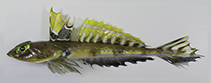 Callionymus omanensis
Male ภาพโดย Marine Science and Fisheries Centre, Muscat
รูปภาพหลายรูป | Google image
Male ภาพโดย Marine Science and Fisheries Centre, Muscat
การจำแนกประเภท / ชื่อ ชื่อสามัญ | ชื่อพ้อง | Catalog of Fishes(สกุล, ชนิด) | ITIS | CoL | WoRMS | Cloffa
> Callionymiformes (Dragonets) > Callionymidae (Dragonets)
Etymology: Callionymus: Greek, kallion, comparative of kallos = beautiful + Greek, onyma = name; with a better name; omanensis: Named for its type locality, Oman.
Etymology: Callionymus: Greek, kallion, comparative of kallos = beautiful + Greek, onyma = name; with a better name; omanensis: Named for its type locality, Oman.
สิ่งแวดล้อม : สิ่งแวดล้อม / เขตภูมิอากาศ / ระดับความลึก / ระยะการกระจายสินค้า นิเวศวิทยา
เกี่ยวกับทะเล,น้ำเค็ม สัตว์น้ำหน้าดิน; ระดับความลึก ? - 500 m (Ref. 96973). Deep-water
การแพร่กระจาย อาณาเขต | พื้นที่จำแนกตาม FAO | ระบบนิเวศหลายระบบ | การปรากฏขึ้น,การเกิดขึ้น,พบ | ตำแหน่งบนแผนที่ | การแนะนำ | Faunafri
NW Indian Ocean, Arabian Sea, Oman.
ขนาด / น้ำหนัก / อายุ
คำอธิบายสั้นๆ เครื่องมือที่ใช้ในการแยกชนิดสัตว์,สิ่งมีชีวิตออกจากกัน | สัณฐานวิทยา | ความยาวต่างๆ
เงี่ยงครีบหลัง (รวม) : 4; ก้านครีบอ่อนที่หาง (รวม) : 8; ก้านครีบอ่อนที่ก้น: 8. This species within the subgenus Bathycallionymus is distinguished from its congeners under this by the following characters: small branchial opening; short head short (3.9 in LS); large eye (2.4 in head length); preopercular spine with a long, upcurved main tip, a small antrorse barb and a larger antrorse spine, and a strong antrorse spine at its base, smooth ventral margin; first dorsal fin is slightly higher than the second (in male); second dorsal fin distally straight; pectoral fin rays 17; caudal fin slightly pointed distally, with 2 median unbranched rays with short filaments; first dorsal fin with basal black spot reaching from first to fourth membranes, the third membrane with an ocellated distal black blotch; second dorsal fin with dark grey vertical bars; distal three-fourths of anal fin is black; upper half of caudal fin with dark grey oblique bars; pelvic fin dark grey, second ray basally with a black blotch. This species differs from the similar C. profundus (characters in parentheses) in a more slender preopercular spine with the distance of the two dorsal points more than the length of the longest point (vs. stouter, distance less than the longest point); pectoral fin rays 17 (vs. 18-20); the dark pelvic fin with a black blotch basally on second ray (vs. pale, with a few dark spots); first dorsal fin with a basal black blotch reaching from first to fourth membranes, and a distal ocellate black blotch on third membrane (vs. basal black blotch only reaching from second to third membranes, and third membrane distally dark but not ocellate); distal three-fourths of anal fin dark grey (vs. only distal one-fourth of the anal fin dark); thorax of male plain white (vs. dark grey); snout dorsally with an oblique dark band (vs. without a band, but with a few dark spots); dorsal part of the pectoral fin base pale but with a dark streak behind the pectoral fin (vs. dorsal part black, no dark streak behind pectoral fin); dorsal half of the caudal fin with 4 oblique dark streaks (vs. pale, with a few dark spots). This species differs from Callionymus bentuviai in having just a single dorsal point on the preopercular spine (vs. additional to the small antrorse barb and the main tip; 2 points in C. bentuviai); pectoral fin rays 17 (vs. 19-22); median filaments of the caudal fin short (vs. very long); anal fin with the distal three-fourths dark grey (vs. distal one-fourth dark); dorsal half of the caudal fin with 4 oblique dark streaks (vs. 1 horizontal dark streak); second membrane of the first dorsal fin of the male not deeply incised (vs. deeply incised). This species is distinguished from Callionymus africanus in having just a single dorsal point on the preopercular spine (vs. additional to the small antrorse barb and the main tip; 2 points); first dorsal fin with the basal dark blotch reaching from first to fourth membranes, and a distal black ocellus on third membrane (vs. basal black blotch reaching from second to third membranes, no distal ocellus on third membrane); colouration of the second dorsal fin, with vertical dark grey bars (vs. 2 horizontal rows of dark spots and 3 rows of white spots); anal fin with the distal three-fourths dark grey (vs. distal one-fourth dark); dorsal half of the caudal fin with 4 oblique dark streaks (vs. pale, with a scattered dark spots); depressed body (Ref. 96973).
Body shape (shape guide): elongated; Cross section: other (see remarks).
Body shape (shape guide): elongated; Cross section: other (see remarks).
วงจรชีวิตและพฤติกรรมการผสมพันธุ์ วัยเจริญพันธุ์ | การสืบพันธุ์ | การวางไข่ | เซลสืบพันธ์ของเพศเมีย(ไข่) | ความดกของไข่ | ตัวอ่อน
อ้างอิงหลัก
อัพโหลดข้อมูลอ้างอิงของคุณ | อ้างอิง | ผู้ประสานงาน : Fricke, Ronald | ผู้ร่วมมือ
Fricke, R., L.A. Jawad and J.M. Al-Mamry, 2014. Callionymus omanensis, a new species of dragonet from Oman, north-western Indian Ocean (Teleostei: Callionymidae). J. Fish Biol. 85(5):1303-1319. (Ref. 96973)
CITES
Not Evaluated
ภัยคุกคามต่อมนุษย์
Harmless
การใช้ของมนุษย์
FAO - Publication: search | FishSource |
ข้อมูลเพิ่มเติม
นิเวศวิทยาเขตร้อน
รายการอาหาร (เหยื่อ)
องค์ประอบของอาหาร
การบริโภคอาหาร
การจัดสรรอาหาร
ผู้ล่า
รายการอาหาร (เหยื่อ)
องค์ประอบของอาหาร
การบริโภคอาหาร
การจัดสรรอาหาร
ผู้ล่า
นิเวศวิทยา
นิเวศวิทยา
นิเวศวิทยา
พลวัตของประชากร
พารามิเตอร์การเจริญเติบโต
อายุสูงสุด / ขนาด
ความยาว-น้ำหนักสัมพันธ์
ความยาว-ความยาวสัมพันธ์
ความยาว-ความถี่
การแปลงมวล
การทดแทนที่
อุดมสมบรูณ์
พารามิเตอร์การเจริญเติบโต
อายุสูงสุด / ขนาด
ความยาว-น้ำหนักสัมพันธ์
ความยาว-ความยาวสัมพันธ์
ความยาว-ความถี่
การแปลงมวล
การทดแทนที่
อุดมสมบรูณ์
วงจรชีวิต
การสืบพันธุ์
วัยเจริญพันธุ์
ความสมบูรณ์พันธุ์/เหงือกที่เกี่ยวข้อง
ความดกของไข่
การวางไข่
การรวมตัวของสปอน
เซลสืบพันธ์ของเพศเมีย(ไข่)
การพัฒนาไข่
ตัวอ่อน
พลวัตของสัตว์น้ำวัยอ่อน
การสืบพันธุ์
วัยเจริญพันธุ์
ความสมบูรณ์พันธุ์/เหงือกที่เกี่ยวข้อง
ความดกของไข่
การวางไข่
การรวมตัวของสปอน
เซลสืบพันธ์ของเพศเมีย(ไข่)
การพัฒนาไข่
ตัวอ่อน
พลวัตของสัตว์น้ำวัยอ่อน
การแพร่กระจาย
อาณาเขต
พื้นที่จำแนกตาม FAO
ระบบนิเวศหลายระบบ
การปรากฏขึ้น,การเกิดขึ้น,พบ
การแนะนำ
BRUVS - วิดีโอ
อาณาเขต
พื้นที่จำแนกตาม FAO
ระบบนิเวศหลายระบบ
การปรากฏขึ้น,การเกิดขึ้น,พบ
การแนะนำ
BRUVS - วิดีโอ
กายวิภาคศาสตร์
พื้นที่เหงือก
สมอง
หินโสต
พื้นที่เหงือก
สมอง
หินโสต
สรีรวิทยา
องค์ประกอบของร่างกาย
สารอาหาร
การใช้ออกซิเจน
ประเภทการว่ายน้ำ
ระดับความเร็วในการว่ายน้ำ
เม็ดสีที่มองเห็นได้
เสียงปลา
โรคและปรสิต
ความเป็นพิษ (LC50s)
องค์ประกอบของร่างกาย
สารอาหาร
การใช้ออกซิเจน
ประเภทการว่ายน้ำ
ระดับความเร็วในการว่ายน้ำ
เม็ดสีที่มองเห็นได้
เสียงปลา
โรคและปรสิต
ความเป็นพิษ (LC50s)
พันธุศาสตร์
จีโนม
พันธุศาสตร์
ความไม่สมดุลทางเชื้อชาติ
อัตราพันธุกรรม
ความหลากหลายทางพันธุกรรม
จีโนม
พันธุศาสตร์
ความไม่สมดุลทางเชื้อชาติ
อัตราพันธุกรรม
ความหลากหลายทางพันธุกรรม
เกี่ยวข้องกับมนุษย์
ระบบการเพาะเลี้ยงสัตว์น้ำ
ประวัติการเพาะเลี้ยงสัตว์น้ำ
สายพันธุ์
กรณีซิเกวเทอรา
แสตมป์ เหรียญ อื่นๆ
ระบบการเพาะเลี้ยงสัตว์น้ำ
ประวัติการเพาะเลี้ยงสัตว์น้ำ
สายพันธุ์
กรณีซิเกวเทอรา
แสตมป์ เหรียญ อื่นๆ
เครื่องมือ
หนังสืออิเล็กทรอนิกส์ | คู่มือภาคสนาม | ผู้มีความชำนาญในเรื่องความถี่ของความยาว | เครื่องมือในการศึกษาชีวประวัติ | ตำแหน่งบนแผนที่ |
จับ-MSY |
รายงานพิเศษ
ตรวจสอบการบำรุงรักษาตู้ปลา | ตรวจสอบเอกสารข้อเท็จจริงเกี่ยวกับสายพันธุ์ | ตรวจสอบเอกสารข้อเท็จจริงเกี่ยวกับการเพาะเลี้ยงสัตว์น้ำ
ดาวน์โหลด XML
หน้าสรุป | ข้อมูลสำคัญ | ชื่อสามัญ | ภาพถ่าย
แหล่งที่มาจากอินเตอร์เน็ต
AFORO (otoliths) | Aquatic Commons | BHL | Cloffa | Websites from users | Check FishWatcher | CISTI | Catalog of Fishes: สกุล, ชนิด | DiscoverLife | ECOTOX | FAO - Publication: search | Faunafri | Fishipedia | Fishtrace | GloBI | Google Books | Google Scholar | Google | IGFA World Record | OneZoom | Open Tree of Life | Otolith Atlas of Taiwan Fishes | PubMed | Reef Life Survey | Socotra Atlas | TreeBase | แผนภูมิชีวิตแบบต้นไม้ | Wikipedia: Go, ค้นหา | World Records Freshwater Fishing | Zoobank | บันทึกทางด้านสัตววิทยา
การประมาณค่าตามแบบจำลอง
ดัชนีความหลากหลายทางวิวัฒนาการ (อ้างอิง 82804): PD50 = 0.5000 [Uniqueness, from 0.5 = low to 2.0 = high].
Bayesian length-weight: a=0.00871 (0.00397 - 0.01910), b=2.78 (2.61 - 2.95), in cm total length, based on LWR estimates for this Genus-body shape (Ref. 93245).
ระดับชั้นอาหาร (อ้างอิง 69278): 3.3 ±0.4 se; based on size and trophs of closest relatives
ความสามารถในการกลับคืนสู่ปกติ (อ้างอิง 120179): ความสูง, เวลาต่ำสุดที่จะทำให้ประชากรเพิ่มขึ้นเป็น 2 เท่าใช้เวลาน้อยกว่า 15 เดือน (Preliminary K or Fecundity.).