



Saurida lessepsianus Russell, Golani & Tikochinski, 2015
把你的觀察加入 Fish Watcher
| Native range | All suitable habitat | Point map | Year 2050 |

|
| This map was computer-generated and has not yet been reviewed. |
| Saurida lessepsianus AquaMaps Data sources: GBIF OBIS |
上傳你的 相片 和 影像
照片 | Google 影像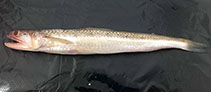 Saurida lessepsianus
拍攝者 Samaha, Z.
照片 | Google 影像
拍攝者 Samaha, Z.
分類 / 名稱 俗名 | 同種異名 | Catalog of Fishes(屬, 種) | ITIS | CoL | WoRMS | Cloffa
Teleostei > Aulopiformes (Grinners) 仙女魚目 (Grinners) > Synodontidae (Lizardfishes) 合齒魚科 (Lizardfishes) > Harpadontinae
Etymology: Saurida: Derived from Greek, sauros = lizard (Ref. 45335); lessepsianus: Name referring to its distribution in both the Red Sea and eastern Mediterranean Sea, it having migrated from the Red Sea to the Mediterranean via the Suez Canal, known as 'Lessepsian migration'.
Etymology: Saurida: Derived from Greek, sauros = lizard (Ref. 45335); lessepsianus: Name referring to its distribution in both the Red Sea and eastern Mediterranean Sea, it having migrated from the Red Sea to the Mediterranean via the Suez Canal, known as 'Lessepsian migration'.
環境: 環境 / 氣候帶 / 深度上下限 / 配送範圍 生態學
海洋 底中水層性; 深度上下限 20 - 200 m (Ref. 101631), usually 20 - 30 m (Ref. 101631). ; 30°N - 12°N, 32°E - 73°E
分布 領土 | FAO區域 | 生態系 | 發現紀錄 | 分布圖 | 簡介 | Faunafri
Western Indian Ocean: widespread in the Red Sea, including the Gulf of Suez where it is very common. Lessepsian migrant in the Mediterranean Sea.
大小 / 重量 / 年齡
簡短描述 檢索表 | 型態特徵 | 形態測量圖
背的軟條 (總數) : 11 - 12; 臀鰭軟條: 10 - 12; 脊椎骨: 44 - 47. This species is distinguished by the following set of characters: 11-12 dorsal fin-rays; 13-15 pectoral fin-rays; 47-51 lateral-line scales; 4½ transverse scale rows above lateral line, 5½ below lateral line; moderately long pectoral fins (tip of fin extending to between just before or just beyond a line from origin of pelvic fins to origin of dorsal fin); outer palatines with 2 rows of teeth; vomer with 0-2 teeth; tongue with 3-6 rows of teeth posteriorly; slightly compressed caudal peduncle (depth a little more than width); upper margin of caudal fin has a row of 3-8 (usually 6 or 7) distinct blackish spots; color of stomach pale grey to blackish anteriorly; intestine whitish (Ref. 101631).
Body shape (shape guide): elongated; Cross section: circular.
Body shape (shape guide): elongated; Cross section: circular.
The species is found mainly on sandy or muddy substrates to about 100 m, but observed to be more common inshore close to islands or coasts in depths of 20-30 m. Mainly piscivorous. Spawning season prolonged and occurs nearly all the year round, in the Gulf of Suez with two peaks in December and May (El-Halfawy et al. 2007). In the Mediterranean, spawning season off the coast of Israel lasts from March to December (Golani 1993), whereas at Iskenderun Bay, Turkey, spawning occurs mainly in two seasons (May-July and September-November) (İşmen 2003). Reported to be important in the trawl fishery of the Gulf of Suez and the Mediterranean coast of Egypt, where it is in a state of high overfishing and severe overexploitation. In the Mediterranean, it was rather uncommon until 1955, when it started to appear in large quantities in bottom trawl catches (according to Ben-Yami & Glaser 1974, Ref. 1289; Bilecenoğlu 2010, Ref. 94612); catches have since remained high, with some fluctuations (Golani 1993, Ref. 38081). Also reported to be an economically important fish in the Mersin and Iskenderun Gulfs, Turkey and is among the most common species caught in the trawl fishery, comprising almost one-third of the commercial trawl catch in the north-eastern Levant (Ref. 101631).
生命週期和交配行為 成熟度 | 繁殖 | 產卵場 | 卵 | 孕卵數 | 仔魚
主要參考資料
上傳您的推薦信 | 參考文獻 | 合作者 | 合作者
Russell, B.C., D. Golani and Y. Tikochinski, 2015. Saurida lessepsianus a new species of lizardfish (Pisces: Synodontidae) from the Red Sea and Mediterranean Sea, with a key to Saurida species in the Red Sea. Zootaxa 3956(4):559-568. (Ref. 101631)
CITES
Not Evaluated
對人類具威脅
人類使用
漁業: bycatch
FAO - Publication: search | FishSource |
更多資訊
解剖學
鰓區
腦部
耳石
鰓區
腦部
耳石
生理學
身體成分
營養素
耗氧量
游泳類型
游泳速度
視覺色素
魚聲
疾病與寄生蟲
毒性 (LC50s)
身體成分
營養素
耗氧量
游泳類型
游泳速度
視覺色素
魚聲
疾病與寄生蟲
毒性 (LC50s)
遺傳學
基因組
遺傳學
異種性
遺傳率
遺傳多樣性
基因組
遺傳學
異種性
遺傳率
遺傳多樣性
工具
特別的報告
下載 XML
網路資源
AFORO (otoliths) | Aquatic Commons | BHL | Cloffa | Websites from users | 檢查 FishWatcher | CISTI | Catalog of Fishes: 屬, 種 | DiscoverLife | ECOTOX | FAO - Publication: search | Faunafri | Fishipedia | Fishtrace | GloBI | Google Books | Google Scholar | Google | IGFA World Record | 國家資料庫 | OneZoom | Open Tree of Life | Otolith Atlas of Taiwan Fishes | PubMed | Reef Life Survey | Socotra Atlas | TreeBase | 樹狀分類階層 | Wikipedia: 去, 搜尋 | World Records Freshwater Fishing | Zoobank | 動物學的記錄
基於模型的估計
系統發育多樣性指數 (參考文獻 82804): PD50 = 0.5000 [Uniqueness, from 0.5 = low to 2.0 = high].
Bayesian length-weight: a=0.00513 (0.00245 - 0.01075), b=3.10 (2.93 - 3.27), in cm total length, based on LWR estimates for this Genus-body shape (Ref. 93245).
營養階層 (參考文獻 69278): 4.0 ±0.67 se; based on food items.
回復力 (參考文獻 120179): 高度, 族群倍增時間少於 15個月 (Preliminary K or Fecundity.).