



Hymenocephalus yamasakiorum Nakayama, Endo & Schwarzhans, 2015
Black-tailed membranehead
Hochladen Photos und videos
Google Bild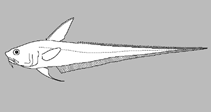 No image available for this species;
drawing shows typical species in Macrouridae.
Google Bild
drawing shows typical species in Macrouridae.
Klassifizierung / Names Namen | Synonyme | Catalog of Fishes(Gattung, Arten) | ITIS | CoL | WoRMS | Cloffa
> Gadiformes (Cods) > Macrouridae (Grenadiers or rattails)
Etymology: Hymenocephalus: Named for its transparent membrane-like head covering (‘‘hymen head’’) and fragile nature of head bones (Ref. 100825); yamasakiorum: Named for Ms. Yasuko Yamasaki and her family; a fishing trawler operator in Tosa Bay and adjacent waters and provider of a large number of fish specimens to the BSKU collection.
Eponymy: Yasuko Yamasaki and her family operate a fishing trawler in Tosa Bay, Japan and nearby waters. They provide a large number of fish specimens to Kochi University. (Ref. 128868), visit book page.
Etymology: Hymenocephalus: Named for its transparent membrane-like head covering (‘‘hymen head’’) and fragile nature of head bones (Ref. 100825); yamasakiorum: Named for Ms. Yasuko Yamasaki and her family; a fishing trawler operator in Tosa Bay and adjacent waters and provider of a large number of fish specimens to the BSKU collection.
Eponymy: Yasuko Yamasaki and her family operate a fishing trawler in Tosa Bay, Japan and nearby waters. They provide a large number of fish specimens to Kochi University. (Ref. 128868), visit book page.
Umwelt: Milieu / Klimazone / Tiefenbereich / Verbreitungsgebiet Ökologie
seewasser bathydemersal; tiefenbereich 380 - 420 m (Ref. 100825). Temperate
Verbreitung Territorien | FAO Gebiete | Ökosysteme | Vorkommen | Punkt Karte | Einführungen | Faunafri
Northwest Pacific: Japan.
Größe / Gewicht / Alter
Kurzbeschreibung Bestimmungsschlüssel | Morphologie | Morphometrie
This species is distinguished by the following characters: 9 pelvic-fin rays; chin barbel 55 % HL, its tip extending beyond vertical through hind margin of orbit when laid back; moderately high snout, not depressed, length 28 % HL; orbit diameter 33 % HL; interorbital width 24 % HL; preopercular supporter broad, short (5 % HL); D1 II,10; pectoral-fin rays i16-i17; gill rakers on first arch (outer/inner) 14/20, on second arch 20/19; pyloric caeca 15; when fresh the ventral two-thirds of head and body are silvery; dorsal half of posterior part of tail prominently dark; ventral half of tail completely immaculate; OL:OH = 1.15; ostial and caudal colliculi not fused; TCL:PCL = 2.3 (Ref. 100825).
Body shape (shape guide): elongated; Cross section: compressed.
Body shape (shape guide): elongated; Cross section: compressed.
Lebenszyklus und Paarungsverhalten Geschlechtsreife | Fortpflanzung | Ablaichen | Eier | Fruchtbarkeit | Larven
Hauptreferenz
Laden Sie Ihre Referenzen hoch | Referenzen | Koordinator : Iwamoto, Tomio | Partner
Nakayama, N., H. Endo and W. Schwarzhans, 2015. A new grenadier of the genus Hymenocephalus from Tosa Bay, southern Japan (Actinopterygii: Gadiformes: Macrouridae). Ichthyol. Res. (Ref. 100825)
CITES
Not Evaluated
Bedrohung für Menschen
Harmless
Nutzung durch Menschen
FAO - Publication: search | FishSource |
Mehr Information
Trophische Ökologie
Lebensmittel (Beutetiere)
Nahrungszusammensetzung
Nahrungsaufnahme
Lebensmittelrationen
Räuber
Lebensmittel (Beutetiere)
Nahrungszusammensetzung
Nahrungsaufnahme
Lebensmittelrationen
Räuber
Ökologie
Ökologie
Ökologie
Populationsdynamik
Wachstumsparameter
Max. Alter/Größen
Länge-Gewicht-Rel.
Länge-Länge-Verhältnis.
Längenhäufigkeiten
Massenkonvertierung
Rekrutierung
Dichte
Wachstumsparameter
Max. Alter/Größen
Länge-Gewicht-Rel.
Länge-Länge-Verhältnis.
Längenhäufigkeiten
Massenkonvertierung
Rekrutierung
Dichte
Lebenszyklus
Fortpflanzung
Geschlechtsreife
Reifung/Kiemen rel.
Fruchtbarkeit
Ablaichen
Laichaggregationen
Eier
Eientwicklung
Larven
Larven Pop.Dyn.
Fortpflanzung
Geschlechtsreife
Reifung/Kiemen rel.
Fruchtbarkeit
Ablaichen
Laichaggregationen
Eier
Eientwicklung
Larven
Larven Pop.Dyn.
Anatomie
Kiemenoberfläche
Gehirn
Otolith
Kiemenoberfläche
Gehirn
Otolith
Physiologie
Körperliche Zusammensetzung
Nährstoffe
Sauerstoffverbrauch
Schwimmart
Schwimmgeschwindigkeit
Visuelle Pigmente
Fischgeräusche
Krankheiten und Parasiten
Toxizität (LC50s)
Körperliche Zusammensetzung
Nährstoffe
Sauerstoffverbrauch
Schwimmart
Schwimmgeschwindigkeit
Visuelle Pigmente
Fischgeräusche
Krankheiten und Parasiten
Toxizität (LC50s)
Genetik
Genom
Genetik
Heterozygotie
Vererbbarkeit
Genetische Vielfalt
Genom
Genetik
Heterozygotie
Vererbbarkeit
Genetische Vielfalt
Menschenbezogen
Aquakultur-Systeme
Aquakultur Profile
Zuchtlinien
Ciguatera-Fälle
Briefmarken, Münzen, Verschiedenes.
Aquakultur-Systeme
Aquakultur Profile
Zuchtlinien
Ciguatera-Fälle
Briefmarken, Münzen, Verschiedenes.
Tools
Zusatzinformationen
Download XML
Zusammenfassung | Punktdaten | Namen | Photos
Internet Quellen
AFORO (otoliths) | Aquatic Commons | BHL | Cloffa | Websites from users | FishWatcher Einträge suchen | CISTI | Catalog of Fishes: Gattung, Arten | DiscoverLife | ECOTOX | FAO - Publication: search | Faunafri | Fishipedia | Fishtrace | GloBI | Google Books | Google Scholar | Google | IGFA World Record | OneZoom | Open Tree of Life | Otolith Atlas of Taiwan Fishes | PubMed | Reef Life Survey | Socotra Atlas | TreeBase | Tree of Life | Wikipedia: Gehe zu, Suchen | World Records Freshwater Fishing | Zoobank | Zoologischer Rekord
Schätzungen auf der Grundlage von Modellen
Phylogenetischer Diversitätsindex (Ref. 82804): PD50 = 0.5000 [Uniqueness, from 0.5 = low to 2.0 = high].
Bayesian length-weight: a=0.00219 (0.00111 - 0.00432), b=3.20 (3.03 - 3.37), in cm total length, based on LWR estimates for this (Sub)family-body shape (Ref. 93245).
Trophische Ebene (Ref. 69278): 3.3 ±0.4 se; based on size and trophs of closest relatives
Widerstandsfähigkeit (Ref. 120179): mittel, Verdopplung der Population dauert 1,4 - 4,4 Jahre. (Preliminary K or Fecundity.).