



Cyphocharax aninha Wosiacki & Miranda, 2014
muatnaik fotos/gambar dan video
imej Google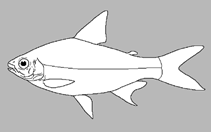 No image available for this species;
drawing shows typical species in Curimatidae.
imej Google
drawing shows typical species in Curimatidae.
klasifikasi / Nama Nama-nama umum | Sinonim (persamaan) | Catalog of Fishes(Marga, Jenis) | ITIS | CoL | WoRMS | Cloffa
> Characiformes (Characins) > Curimatidae (Toothless characins)
Etymology: Cyphocharax: Greek, kyphos = curved, humpback + Greek, charax = a marine fish without identification (Ref. 45335); aninha: The specific name refers to the nickname of Ana Prudente (MPEG), wife of the first authors and pays tribute to her contributions towards the understanding of the Neotropical fauna, specifically the systematics of snakes.
Etymology: Cyphocharax: Greek, kyphos = curved, humpback + Greek, charax = a marine fish without identification (Ref. 45335); aninha: The specific name refers to the nickname of Ana Prudente (MPEG), wife of the first authors and pays tribute to her contributions towards the understanding of the Neotropical fauna, specifically the systematics of snakes.
Lingkungan: lingkungan / zona iklim / kisaran kedalaman / jangkauan distribusi Ekologi
; air tawar bentopelagis. Tropical
Penyebaran Wilayah | Daerah-daerah FAO | Ekosistem | Kemunculan | peta titik | Introduksi | Faunafri
South America: Rio Mopeco, a left tributary of the Rio Parui in Pará, Brazil.
Ukuran / Berat / umur
deskripsi pendek Kunci identifiaksi (pengenalan) | Morfologi | Morfometrik
duri punggung lunak (Keseluruhan (total)) : 11 - 12; Sirip dubur lunak: 9 - 10; vertebrata, bertulang belakang: 29 - 30. Cyphocharax aninha is distinguished from its congeners with the exception of C. vexillapinnus, C. gangamon, C. signatus, and C. punctatus, by the absence of or having extremely reduce infraorbital sensory canal, when present, in largest specimens (30.0 mm SL), to a fleshy or osseous canal in the fifth infraorbital (vs. canal always present and complete). It further differs from its congeners (except C. saladensis, C. vexillapinnus, C. signatus, C. punctatus, and juveniles of C. gangamon) by the possession of four to nine, modally seven, pored scales on lateral line (vs. more than ten). It can be further distinguished from its congeners, except C. santacatarinae, by having a large, ellipsoid, vertically oriented spot almost forming a bar at the rear of the caudal peduncle and over the base of the caudal-fin rays (vs. absence of a spot in C. abramoides, C. aspilos, C. derhami, C. festivus, C. leucostictus, C. magdalenae, C. microcephalus, C. multilineatus, C. nagelii, C. nigripinnis, C. notatus, C. platanus, C. pinnileps, C. plumbeus, C. stilboleps, C. vexillapinnus, or circular or lozenge-shaped, horizontally oriented, spot typically concentrated on the center of the caudal peduncle and not reaching the dorsal and ventral margins of the peduncle in C. biocellatus, C. gangamon, C. gilbert, C. gillii, C. gouldingi, C. helleri, . laticlavius, C. meniscaprorus, C. mestomyllon, C. modestus, C. oenas, C. pantostictos, C. punctatus, C. signatus, C. spilotus, C. piluropisis, C. spilurus, C. vanderi, and C. voga). It is also distinguished from C. helleri, C. laticlavius, C. multilineatus, and C. pantostictos by the absence of series of longitudinal dark continuous or discontinuous lines on the body (vs. presence of such pigmentation). It is can be separated from C. notatus and . vexillapinnus by the absence of a spot on the dorsal fin (vs. presence); and from C. biocellatus, C. punctatus, C. vanderi, and C. voga by the absence of circular or ellipsoid spots on the flanks (vs. presence). It can be diagnosed from its congeners, except C. signatus, in having 10-12, rarely 13 or 14 branched pectoral-fin rays (vs. 13 -17). It can be further distinguished from C. signatus by the tip of last branched ray of anal fin not reaching the base of the caudal-fin rays (vs. reaching). It further differs from C. saladensis by the caudal-peduncle height 10.4-14.4% SL (vs. 15.0-17.0)% SL), and the interorbital width 33.1-43.8% HL (vs. 44.0-50.0)% HL); from C. spilotus by the distance from snout to anus 67.2-77.7% CP (vs. 78.0-82.0% CP); from C. santacatarinae in the orbital diameter 32.2-43.3% HL (vs. 26.0-30.0% HL) and by having 30 or 31 total vertebrae (vs. 32-34); and from C. pinnilepis by having 9 or 10 middorsal scales from the supraoccipital process to the dorsal-fin origin (vs. 11-13) (Ref. 94769).
Body shape (shape guide): elongated.
Body shape (shape guide): elongated.
Siklus hidup dan perilaku kawin Kematangan | Reproduksi, perkembang biakan | Pemijahan | telur-telur | Fekunditas | Larva
rujukan utama
Unggah referensi Anda | Acuan | Koordinator : Vari, Richard P. | mitra
Wosiacki, W.B. and D.P. da Silva Miranda, 2013. Description of a new small species of the genus Cyphocharax (Characiformes: Curimatidae) from the Lower Amazon basin. Copeia 2013(4):627-633. (Ref. 94769)
Status IUCN Red List (Ref. 130435: Version 2025-2 (Global))
kurang bimbang (LC) ; Date assessed: 15 June 2020
CITES
Not Evaluated
ancaman kepada manusia
Harmless
penggunaan manusia
FAO - Publication: search | FishSource |
informasi lanjut
Ekologi trofik
Item makanan (mangsa)
Komposisi makanan
Konsumsi makanan
Ransum makanan
Pemangsa
Item makanan (mangsa)
Komposisi makanan
Konsumsi makanan
Ransum makanan
Pemangsa
Dinamika populasi
Parameter pertumbuhan
Maks. usia / ukuran
Panjang-berat rel.
Panjang-panjang rel.
ukuran frekuensi
Konversi massa
pemulihan
Kelimpahan
Parameter pertumbuhan
Maks. usia / ukuran
Panjang-berat rel.
Panjang-panjang rel.
ukuran frekuensi
Konversi massa
pemulihan
Kelimpahan
Siklus hidup
Reproduksi, perkembang biakan
Kematangan
Kedewasaan / insang rel.
Fekunditas
Pemijahan
Agregasi pemijahan
telur-telur
pekembangan telor
Larva
Dinamika larva
Reproduksi, perkembang biakan
Kematangan
Kedewasaan / insang rel.
Fekunditas
Pemijahan
Agregasi pemijahan
telur-telur
pekembangan telor
Larva
Dinamika larva
Anatomi
Area insang
Otak
Otolith
Area insang
Otak
Otolith
Fisiologi
Komposisi tubuh
Nutrisi
Konsumsi oksigen
Jenis renang
Kecepatan berenang
Pigmen visual
Suara ikan
Penyakit & Parasit
Toksisitas (LC50)
Komposisi tubuh
Nutrisi
Konsumsi oksigen
Jenis renang
Kecepatan berenang
Pigmen visual
Suara ikan
Penyakit & Parasit
Toksisitas (LC50)
Genetika
genom
Genetika
Heterozigositas
Diturunkan
Keanekaragaman Genetik
genom
Genetika
Heterozigositas
Diturunkan
Keanekaragaman Genetik
Yang berhubungan dengan manusia
Sistem akuakultur
profil budidaya air
Strain
Kasus Ciguatera
Perangko, koin, dll.
Sistem akuakultur
profil budidaya air
Strain
Kasus Ciguatera
Perangko, koin, dll.
Alat, peralatan
E-book | Penuntun lapangan | tanda freqkuenci panjang | peringkat sejarah hidup | peta titik |
Tangkap-MSY |
laporan khas
muat turun XML
Sumber internet
AFORO (otoliths) | Aquatic Commons | BHL | Cloffa | Websites from users | semak peneliti ikan | CISTI | Catalog of Fishes: Marga, Jenis | DiscoverLife | ECOTOX | FAO - Publication: search | Faunafri | Fishipedia | Fishtrace | GloBI | Google Books | Google Scholar | Google | IGFA World Record | OneZoom | Open Tree of Life | Otolith Atlas of Taiwan Fishes | PubMed | Reef Life Survey | Socotra Atlas | TreeBase | Tree of Life | Wikipedia: pergi, Cari | World Records Freshwater Fishing | Zoobank | Catatan Zoologi
Estimasi berdasarkan model
Indeks keanekaragaman filogenetik (Acuan 82804): PD50 = 0.5000 [Uniqueness, from 0.5 = low to 2.0 = high].
Bayesian length-weight: a=0.01445 (0.00642 - 0.03257), b=3.02 (2.84 - 3.20), in cm total length, based on LWR estimates for this Genus-body shape (Ref. 93245).
Daya lenting (Acuan 120179): Tinggi, Waktu penggandaan populasi minimum kurang dari 15 bulan (Preliminary K or Fecundity.).