



分類 / 名前 共通名の | 類義語 | Catalog of Fishes(部類, 種) | ITIS | CoL | WoRMS | Cloffa
> Cypriniformes (Carps) > Cyprinidae (Minnows or carps) > Smiliogastrinae
Etymology: Pethia: Pethia is the generic vernacular name for small cyprinids in Sinhala; striata: The specific name is from a Latin adjective 'striata', meaning striped, in reference to the unique pattern of this fish.
Etymology: Pethia: Pethia is the generic vernacular name for small cyprinids in Sinhala; striata: The specific name is from a Latin adjective 'striata', meaning striped, in reference to the unique pattern of this fish.
環境:環境 / 気候帯 / 深さの範囲 / 分布範囲 生態学
; 新鮮な水 底生の漂泳性; pH range: 6.1 - ?. Tropical; 26°C - ? (Ref. 104010)
分布 領土 | 国連食糧農業機関の区域 | エコシステム | 事件 | 目的のマップ | 導入 | Faunafri
Asia: Tunga River basin in Kudremukh National Park, Karnataka State, India.
サイズ / 重さ / 年齢
簡単な記述 検索表 | 形態学 | 形態計測学
背鰭 (合計) : 9; 臀鰭: 8. Pethia striata can be diagnosed from other species of the genus Pethia by the combination of the following characters: lateral line complete, with 20-21 pored scales up to tail fin base; upper half of body dark brown; outer edges of body scales dark, forming oblique bars, giving a distinct striped pattern along the side in both sexes; dorsal fin dark with a pale outer margin; dorsal, pectoral, pelvic, and anal fins tinged with black; caudal fin hyaline; black humeral spot one scale below the 4th lateral-line scales, a larger black blotch 3-4 scales high covering the 17th to 19th lateral-line scales, and only 2 scales between this blotch and the hypural notch. Other characters useful to distinguish from other congeners include the following: fewer transverse scales, 3 scales between lateral-line scale row and ventral fin; ½ 4+1+3 transverse scales; eight predorsal scales; a smaller humeral spot, restricted to a single scale; lacking a gray patch below the dorsal fin; two spots, a humeral spot and a caudal-peduncle blotch; 2+3-4 gill rakers on the first gill arch; a single blotch on the caudal peduncle; dark longitudinal band absent; and dorsal fin of
male is black (Ref. 104010).
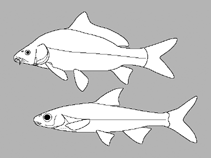
Body shape (shape guide): elongated.
Body shape (shape guide): elongated.
Formed small groups of three or four individuals in shallow pools beneath dense riparian canopy. Usually found together with other cyprinid species such as Puntius sahyadriensis and Dawkinsia arulius. A few juveniles were also observed with Pethia setnai in shallow pools (Ref. 104010).
The type locality was a pool-riffle sequence in a small gently flowing clear water stream with a pH of 6.1 and water temperature of 25.5°C. The stream at the type locality has a width of 7 m and a depth of 0.6 m. The run-riffle sequence just below the type locality has a flow velocity of 0.2 m/s. This species was collected in an altitude range between 660-910 m ASL. Ochlandra sp., Ficus sp., and Elaeocarpus tuberculatus dominated the land vegetation, providing 80% shade. The substrate was composed of leaf litter mostly with Lagenandra sp., bamboo leaves, and clay. Other fishes commonly found at the type locality included the following: Devario malabaricus, Salmophasia boopis, Garra mullya, Barilius canarensis, Barbodes wynaadensis, Tor khudree, Dawkinsia arulius, Puntius sahyadriensis, Osteochilus nashii (Cyprinidae), Batasio sharavatiensis (Bagridae), and Nemacheilus denisoni (Nemacheilidae) (Ref. 104010).
ライフサイクルと交尾行動 成熟 | 繁殖 | 放精 | 卵 | 生産力 | 幼生
主な参考文献
参考文献のアップロード | 参考文献 | コーディネーター | 協力者
Atkore, V.M., J.D.M. Knight, K. Rema Devi and J. Krishnaswamy, 2015. A new species of Pethia from the Westen Ghats, India (Teleostei: Cyprinidae). Copeia 103(2):290-296. (Ref. 104010)
IUCNのレッドリストの状況は (Ref. 130435: Version 2025-2 (Global))
絶滅危惧 (EN) (B1ab(iii)); Date assessed: 28 March 2021
CITES
Not Evaluated
人間に対する脅威
Harmless
人間の用途
水産業: 興味がない
FAO - Publication: search | FishSource |
より多くの情報
ライフサイクル
繁殖
成熟
成熟度/エラ
生産力
放精
産卵群
卵
卵の開発
幼生
幼生の動力
繁殖
成熟
成熟度/エラ
生産力
放精
産卵群
卵
卵の開発
幼生
幼生の動力
解剖学
カマ
脳
オトリス
カマ
脳
オトリス
生理学
体組成
栄養素
酸素消費
水泳タイプ
泳ぐ速さ
視覚色素
フィッシュ・サウンド
病気と寄生虫
毒性(LC50)
体組成
栄養素
酸素消費
水泳タイプ
泳ぐ速さ
視覚色素
フィッシュ・サウンド
病気と寄生虫
毒性(LC50)
遺伝子の
ゲノム
遺伝子の
ヘテロ接合性
遺伝
遺伝的多様性
ゲノム
遺伝子の
ヘテロ接合性
遺伝
遺伝的多様性
用具
特記事項
XMLをダウンロードして下さい
インターネットの情報源
AFORO (otoliths) | Aquatic Commons | BHL | Cloffa | Websites from users | Check FishWatcher | CISTI | Catalog of Fishes: 部類, 種 | DiscoverLife | ECOTOX | FAO - Publication: search | Faunafri | Fishipedia | Fishtrace | GloBI | Google Books | Google Scholar | Google | IGFA World Record | OneZoom | Open Tree of Life | Otolith Atlas of Taiwan Fishes | PubMed | Reef Life Survey | Socotra Atlas | TreeBase | 生命の木 | Wikipedia: 行く, 検索する | World Records Freshwater Fishing | Zoobank | 動物に関する記録
モデルに基づく推定値
系統多様性指数 (参照 82804): PD50 = 0.5000 [Uniqueness, from 0.5 = low to 2.0 = high].
Bayesian length-weight: a=0.01047 (0.00454 - 0.02413), b=3.00 (2.83 - 3.17), in cm total length, based on LWR estimates for this Genus-body shape (Ref. 93245).
栄養段階 (参照 69278): 2.8 ±0.2 se; based on size and trophs of closest relatives
回復力 (参照 120179): 高い, 15か月以下の倍増期間の最小個体群 (Preliminary K or Fecundity.).