



Characidium litorale Leitão & Buckup, 2014
Envoyez vos Photos et vidéos
Images Google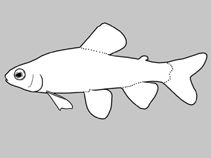 No image available for this species;
drawing shows typical species in Crenuchidae.
Images Google
drawing shows typical species in Crenuchidae.
Classification / Noms Noms communs | Synonymes | Catalog of Fishes(Genre, Espèce) | ITIS | CoL | WoRMS | Cloffa
> Characiformes (Characins) > Crenuchidae (South American darters) > Characidiinae
Etymology: Characidium: Diminutive of Charax, -akos = a fish without identification (Ref. 45335); litorale: From the Latin litoralis, meaning of seashore, in allusion to the geographic distribution in coastal drainages located between the Serra do Mar and the Atlantic Ocean. Used in adjectival form to agree with the diminutive neutral form of the generic name.
Etymology: Characidium: Diminutive of Charax, -akos = a fish without identification (Ref. 45335); litorale: From the Latin litoralis, meaning of seashore, in allusion to the geographic distribution in coastal drainages located between the Serra do Mar and the Atlantic Ocean. Used in adjectival form to agree with the diminutive neutral form of the generic name.
Environnement : milieu / zone climatique / profondeur / gamme de distribution Écologie
; eau douce benthopélagique. Tropical
Distribution Territoires | Zones FAO | Écosystèmes | Occurrences | Carte par point | Introductions | Faunafri
South America: Rio São João, Rio Macaé , and Rio Imbé drainages in Brazil.
Taille / Poids / Âge
Description synthétique Clés d'identification | Morphologie | Morphométrie
Rayons mous dorsaux (Total) : 14 - 15; Vertèbres: 34 - 36. Characidium litorale is distinguished from other congeners by the combination of the following characters: complete lateral line (vs. incomplete in C. interruptum, C. laterale, and C. rachovii); greater body depth at dorsal-fin origin 20.9-24.6% SL (vs. 9.3-15.8% SL in C. longum, 13.7-17.2% SL in C. pteroides, 14.2-18.9% SL in C. steindachneri); fewer lateral line scales 34-36 (vs. 38-40 in C. longum, and 37-40 in C. steindachneri); and fewer scales in the series between the anus and anal-fin origin 4-5 (vs. 8-10 in C. longum, and 6-8 in C. steindachneri); absence of a large blotch on caudal peduncle (vs. presence in C. bimaculatum); and absence of bands in distal part of anal fin (vs. presence in C. heinianum); and deeper caudal peduncle depth 10.6-12.1% SL (vs. 6.7-10.0% SL in C. heinianum). C. litorale of size ranges 2.65-3.27 cm SL differs from C. xanthopterum of size ranges 2.24-3.15 cm SL by having lower body depth (20.9-24.2% SL vs. 24.2-27.6% SL in C. xanthopterum), and from C. zebra of size ranges 2.46-3.22 cm SL by having fewer scales around caudal peduncle (12 vs. 14 in C. zebra), greater body depth at dorsal-fin (20.9-24.6% SL vs. 16.1-19.6% SL in C. zebra) and anal-fin origin (15.6-18.1% SL vs. 12.3-14.6% SL in C. zebra), deeper caudal peduncle (depth 10.6-12.1% SL vs. 8.9-10.6% SL in C. zebra), and by the shape of the longitudinal midlateral stripe (thin and restricted to the posterior half of the body versus wide and extending throughout the flank in C. zebra). Other conspicuous non-unique external characters useful in distinguishing C. litorale include the following: isthmus completely covered with scales; basicaudal spot well defined and isolated by a bright area; and markedly reticulated pigmentation pattern at upper half of body. There are slight differences in morphology among populations from the São João, Macaé and Imbé drainages: specimens from Rio São João frequently possess more secondary bars, and individuals from the Rio Macaé usually have a lower body depth. The secondary bars may be less evident or lacking in few specimens (13.6%) from Rio Imbé (Ref. 96085).
Inhabits streams and rivers, mainly over sandy bottom at medium-slow water flow. Occasionally occurs associated with grassy marginal vegetation. The type locality is a stretch of the Córrego Aldeia Velha, that runs through a deforested area (pasture), and is characterized by clear waters with moderate flow, less than 50 cm depth, and substratum composed predominately of sand, clay, and gravel (Ref. 96085).
Cycle de vie et comportement reproducteur Maturité | Reproduction | Frai | Œufs | Fécondité | Larves
Référence principale
Téléchargez vos références | Références | Coordinateur | Collaborateurs
Leitão, R.P. and P.A. Buckup, 2014. A new species of Characidium (Characiformes: Crenuchidae) from coastal basins of Serra do Mar, southeastern Brazil. Copeia 2014(1):14-22. (Ref. 96085)
Statut dans la liste rouge de l'IUCN (Ref. 130435: Version 2025-2 (Global))
Préoccupation mineure (LC) ; Date assessed: 07 November 2018
CITES
Not Evaluated
Menace pour l'homme
Harmless
Utilisations par l'homme
Pêcheries: sans intérêt
FAO - Publication: search | FishSource |
Plus d'informations
Écologie trophique
Aliments (proies)
Composition du régime alimentaire
Consommation alimentaire
Rations alimentaires
Prédateurs
Aliments (proies)
Composition du régime alimentaire
Consommation alimentaire
Rations alimentaires
Prédateurs
Dynamique des populations
Paramètres de croissance
Âges / tailles maximales
Longueur-poids rel.
Rel. longueur-longueur.
Fréquences de longueurs
Conversion de masse
Recrutement
Abondance
Paramètres de croissance
Âges / tailles maximales
Longueur-poids rel.
Rel. longueur-longueur.
Fréquences de longueurs
Conversion de masse
Recrutement
Abondance
Cycle de vie
Reproduction
Maturité
Maturité/épines rel.
Fécondité
Frai
Agrégats de frai
Œufs
Développement de l'œuf
Larves
Dynamique des populations larvaires
Reproduction
Maturité
Maturité/épines rel.
Fécondité
Frai
Agrégats de frai
Œufs
Développement de l'œuf
Larves
Dynamique des populations larvaires
Anatomie
Surface branchiale
Cerveau
Otolithe
Surface branchiale
Cerveau
Otolithe
Physiologie
Composition corporelle
Nutriments
Consommation d'oxygène
Type de natation
Vitesse de nage
Pigments visuels
Son de poisson
Maladies et parasites
Toxicité (CL50)
Composition corporelle
Nutriments
Consommation d'oxygène
Type de natation
Vitesse de nage
Pigments visuels
Son de poisson
Maladies et parasites
Toxicité (CL50)
Génétique
génôme
Génétique
Hétérozygotie
Héritabilité
Diversité génétique
génôme
Génétique
Hétérozygotie
Héritabilité
Diversité génétique
Liées à l'homme
Systèmes d'aquaculture
Profils d'aquaculture
Souches
Cas de ciguatera
Timbres, pièces de monnaie, divers
Systèmes d'aquaculture
Profils d'aquaculture
Souches
Cas de ciguatera
Timbres, pièces de monnaie, divers
Outils
E-book | Guide de terrain | Générateur de fréquences de longueur | Outil de dynamique de population | Carte par point |
Capture-MSY |
Articles particuliers
Télécharger en XML
Sources Internet
AFORO (otoliths) | Aquatic Commons | BHL | Cloffa | Websites from users | FishWatcher | CISTI | Catalog of Fishes: Genre, Espèce | DiscoverLife | ECOTOX | FAO - Publication: search | Faunafri | Fishipedia | Fishtrace | GloBI | Google Books | Google Scholar | Google | IGFA World Record | OneZoom | Open Tree of Life | Otolith Atlas of Taiwan Fishes | PubMed | Reef Life Survey | Socotra Atlas | TreeBase | Arbre de Vie | Wikipedia: aller à, chercher | World Records Freshwater Fishing | Zoobank | Zoological Record
Estimations basées sur des modèles
Indice de diversité phylogénétique (Réf. 82804): PD50 = 0.5000 [Uniqueness, from 0.5 = low to 2.0 = high].
Bayesian length-weight: a=0.01023 (0.00452 - 0.02316), b=3.07 (2.89 - 3.25), in cm total length, based on LWR estimates for this Genus-body shape (Ref. 93245).
Niveau trophique (Réf. 69278): 3.4 ±0.3 se; based on size and trophs of closest relatives