



Macrognathus fasciatus Plamoottil & Abraham, 2014
Yellow banded spiny eel
Ladda upp din foton och Videor
Bilder | Google image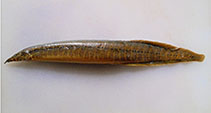 Macrognathus fasciatus
Bild av Plamoottil, M.
Bilder | Google image
Bild av Plamoottil, M.
Klassificering / Namn Populärnamn | synonymer | Catalog of Fishes(Släkte, Arter) | ITIS | CoL | WoRMS | Cloffa
> Synbranchiformes (Spiny eels) > Mastacembelidae (Spiny eels)
Etymology: Macrognathus: Greek, makros = great + Greek, gnathos = jaw (Ref. 45335).
Etymology: Macrognathus: Greek, makros = great + Greek, gnathos = jaw (Ref. 45335).
Miljö: miljö / Klimatzon / djupintervall / distributionsområde Ekologi
; sötvatten bottenlevande; djupintervall 0 - 8 m (Ref. 95044). Tropical
Utbredning Territorier | FAO områden | Ekosystem | Förekomster | Prickkarta | Utplanteringar | Faunafri
Asia: India.
Storlek / Vikt / Ålder
Kort beskrivning Bestämningsnycklar | Morfologi | Morfometri
Taggstrålar i ryggfenan (totalt) : 28 - 30; Mjukstrålar i ryggfenan (totalt) : 60 - 72; Taggstrålar i analfenan: 3; Mjukstrålar i analfenan: 65 - 67. This species is distinguished from its congeners by the following characters: D XXVIII-XXX; A 65-67; vertical lateral lines on the body 26-27; whitish yellow round spots 8-9, present in a row in between every two vertical lines and first dorsal spine originate at the level or a little behind the end of pectoral fin; comparatively greater body width (7.5-8.3 % SL), shorter dorsal (10.5- 13.0 % HL) and anal spines (13.2- 16.7 % HL), smaller eyes (3.7- 4.8 % HL), interorbital width 10.0-10.9 % HL, shorter width of gape of mouth (7.7- 9.7 % HL) and shorter lower jaw (9.1- 10.9 % HL); dorsal (2.2- 2.9 % SL), pectoral (28.6- 32.1) and anal fins (1.7- 2.6) are also
comparatively shorter in Macrognathus fasciatus (Ref. 95044). Further differs with relative species by the presence of pre-orbital spine; spinous part of dorsal fin originating at vertical through the level of or slightly behind the end of pectoral fin; head length 14.8-16.5 % SL; head depth 36.8-41.8 % HL; pre-dorsal length 22.2-26.1 % SL; height of dorsal fin 2.2-2.9 % SL; height of anal fin 1.7-2.6 %SL; pre-anal length 53.0-59.4 % SL. Colouration: body dark brown; presence of distinct vertical bands on the body (Ref. 97143).
Cross section: oval.
Cross section: oval.
The substrate of type locality of this species is generally sand or sandy gravel with occasional presence of bed rock or black clays. The area has a width of 45.0-125.0 m and a depth of 0.3- 8 m; bank height is 4.0- 5.0 m above the general water level in summer season. Moderate to dense riparian vegetation covers the area, with intermittent occurrence of low riparian vegetation noticed at certain places. Some of the major plants observed were Ochreinauclea missionis, Hydnocarpus pentandra, Aporosa lindleyana, Tribulus terretris, Tamarindus indica, Bombax ceiba. Associated fish species include Anguilla bengalensis, A. bicolor, Barilius bakeri, Dayella malabarica, Danio malabaricus, Puntius amphibius, Systomus subnasutus, Dawkinsia filamentosa, Haludaria fasciata, Pethia ticto, Mystus oculatus, Ompok malabaricus, Wallago attu,
Pseudotropius mitchelli, Batasio travancoria, Nandus nandus, Etroplus maculatus, Etroplus suratensis, Anabas testeudineus, Mastacembelus armatus, Channa striatus, C. marulius, C. gachua, C. micropeltes among others (Ref. 95044).
Livscykel och parningsbeteende Könsmognad | Reproduktion | Lek | Ägg | Fekunditet | Larver
Huvudreferens
Ladda upp dina referenser | referenser | Koordinator | Medarbetare
Plamoottil, M. and N.P. Abraham, 2014. Macrognathus fasciatus (Synbranchiformes; Mastacembelidae) - a new fish species from Kerala India. Journal of Experimental Zoology, India 17(1):49-54. (Ref. 95044)
CITES
Not Evaluated
Hot mot människor
Harmless
Mänskliga användningsområden
FAO - Publication: search | FishSource |
Ytterligare information
Trofisk ekologi
Livsmedelsartiklar (preys)
Födosammansättning
Födointag
Matransoner
Predatorer
Livsmedelsartiklar (preys)
Födosammansättning
Födointag
Matransoner
Predatorer
Populationsdynamik
Tillväxtparametrar
Max. åldrar / storlekar
Längd-vikt rel.
Längd-längd rel.
Längd-frekvenser
Massakonvertering
Rekrytering
Abundans
Tillväxtparametrar
Max. åldrar / storlekar
Längd-vikt rel.
Längd-längd rel.
Längd-frekvenser
Massakonvertering
Rekrytering
Abundans
Livscykel
Reproduktion
Könsmognad
Mognad/Gills rel.
Fekunditet
Lek
Lekande aggregat
Ägg
Utveckling av ägg
Larver
Larvdynamik
Reproduktion
Könsmognad
Mognad/Gills rel.
Fekunditet
Lek
Lekande aggregat
Ägg
Utveckling av ägg
Larver
Larvdynamik
Anatomi
Gälyta
Hjärna
Otolit
Gälyta
Hjärna
Otolit
Fysiologi
Kroppssammansättning
Näringsämnen
Syreförbrukning
Typ av simning
Simhastighet
Visuella pigment
Ljud från fisk
Sjukdomar & Parasiter
Toxicitet (LC50)
Kroppssammansättning
Näringsämnen
Syreförbrukning
Typ av simning
Simhastighet
Visuella pigment
Ljud från fisk
Sjukdomar & Parasiter
Toxicitet (LC50)
Genetik
Genom
Genetik
Heterozygositet
Ärftlighet
Genetisk mångfald
Genom
Genetik
Heterozygositet
Ärftlighet
Genetisk mångfald
Människorelaterad
Vattenbrukssystem
Vattenbruksprofiler
Avelslinjer
Ciguatera-fall
Frimärken, mynt, diverse.
Vattenbrukssystem
Vattenbruksprofiler
Avelslinjer
Ciguatera-fall
Frimärken, mynt, diverse.
Verktyg
Särskilda rapporter
Kontrollera för underhåll av akvarium | Kontrollera om det finns faktablad om arter | Kontrollera om det finns faktablad om vattenbruk
Ladda ner XML
Internet-källor
AFORO (otoliths) | Aquatic Commons | BHL | Cloffa | Websites from users | Check FishWatcher | CISTI | Catalog of Fishes: Släkte, Arter | DiscoverLife | ECOTOX | FAO - Publication: search | Faunafri | Fishipedia | Fishtrace | GloBI | Google Books | Google Scholar | Google | IGFA World Record | OneZoom | Open Tree of Life | Otolith Atlas of Taiwan Fishes | PubMed | Reef Life Survey | Socotra Atlas | TreeBase | Tree of Life | Wikipedia: Go, sök | World Records Freshwater Fishing | Zoobank | Zoologiskt register
Uppskattningar baserade på modeller
Index för fylogenetisk mångfald (Ref. 82804): PD50 = 0.5000 [Uniqueness, from 0.5 = low to 2.0 = high].
Bayesian length-weight: a=0.00427 (0.00189 - 0.00961), b=3.02 (2.81 - 3.23), in cm total length, based on LWR estimates for this (Sub)family-body shape (Ref. 93245).
Trofisk nivå (Ref. 69278): 3.3 ±0.4 se; based on size and trophs of closest relatives
Resiliens (Ref. 120179): Mellan, lägsta populationsfördubblingstid 1,4-4,4 år (Preliminary K or Fecundity.).