



Uploaden van uw Foto's en video's
Google afbeelding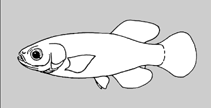 No image available for this species;
drawing shows typical species in Valenciidae.
Google afbeelding
drawing shows typical species in Valenciidae.
Classificatie / Namen Lokale namen | Synoniemen | Catalog of Fishes(Genus, Soort(en)) | ITIS | CoL | WoRMS | Cloffa
> Cyprinodontiformes (Rivulines, killifishes and live bearers) > Valenciidae (Toothcarps)
Etymology: Valencia: After Valenciennes, the ichthyologist?; robertae: Named for Roberta Barbieri (Athens), who has studied the Greek Valencia species for many years and has been involved in the conservation of the two species.
Eponymy: Roberta Barbieri is an ichthyologist and fish biologist who is Research Associate at the Hellenic Centre for Marine Research, Athens. [...] (Ref. 128868), visit book page.
Etymology: Valencia: After Valenciennes, the ichthyologist?; robertae: Named for Roberta Barbieri (Athens), who has studied the Greek Valencia species for many years and has been involved in the conservation of the two species.
Eponymy: Roberta Barbieri is an ichthyologist and fish biologist who is Research Associate at the Hellenic Centre for Marine Research, Athens. [...] (Ref. 128868), visit book page.
Milieu: milieu / Klimaatzone / Diepte / verspreidingsgebied Ecologie
; zoet water benthopelagisch. Subtropical
Verspreiding Gebieden | FAO regio's | Ecosystemen | Voorkomen | Verspreidingskaart | Introducties | Faunafri
Europe: Lower Pinios River and lower Mornos River in Greece.
Grootte / Gewicht / Leeftijd
Maturiteit: Lm ? range ? - ? cm
Max length : 3.1 cm SL mannelijk / geslacht onbekend; (Ref. 95526); 4.3 cm SL (female)
Max length : 3.1 cm SL mannelijk / geslacht onbekend; (Ref. 95526); 4.3 cm SL (female)
Korte beschrijving Determinatiesleutels | Morfologie | Morfometrie
Dorsale zachte stralen (totaal) : 7 - 9; Anale zachte stralen: 10 - 13. Valencia robertae can be diagnosed from V. letourneuxi by having short lateral bars or small vertically elongated blotches along flanks in females (vs. lateral bars or blotches absent) and an almost triangular anal fin with straight posterior margin (vs. anal fin almost rounded, posterior margin convex) and anal fin depth, measured from anal-fin origin to tip of third branched ray, 1.4-1.5 times in caudal peduncle depth (vs. 1.2-1.3). Males of V. robertae are distinguished by having the following characters; prominent bars on flank between the axial blotch and the base of the caudal fin (vs. bars absent or very faint anterior to vertical of pelvic-fin origin); neck and back bluish brown (vs. yellowish); and a long anal fin, reaching to or almost to the base of the caudal fin in individuals longer than 3.0 cm SL (vs. to middle of caudal peduncle). It differs from V. hispanica by having a hyaline to bluish caudal fin (vs. yellow to orange) with a bold black posterior margin in males (vs. reddish-brown) (Ref. 95526).
Levenscyclus en paargedrag Maturiteit | Voortplanting | Paaien | Eieren | Fecunditeit | Larven
Hoofdreferentie
Upload uw referenties | Referenties | Coördinator | Medewerkers
Freyhof, J., H. Kärst and M. Geiger, 2014. Valencia robertae, a new killifish from southern Greece (Cyprinodontiformes: Valenciidae). Ichthyol. Explor. Freshwat. 24(4):289-298. (Ref. 95526)
Status op de Rode Lijst van het IUCN (Ref. 130435: Version 2025-2 (Global))
Ernstig bedreigd (CR) (A2ace); Date assessed: 30 June 2023
CITES
Not Evaluated
Gevaar voor de mens
Harmless
Gebruik door de mens
FAO - Publication: search | FishSource |
Meer informatie
Trofische ecologie
Voedsel (prooien)
Dieetsamenstelling
Voedselconsumptie
Voedselrantsoenen
Predatoren
Voedsel (prooien)
Dieetsamenstelling
Voedselconsumptie
Voedselrantsoenen
Predatoren
Populatiedynamica
Groeiparameters
Max. leeftijden / maten
Lengte-gewicht rel.
Lengte-lengte rel.
Lengtefrequenties
Massaconversie
Rekrutering
Abundantie
Groeiparameters
Max. leeftijden / maten
Lengte-gewicht rel.
Lengte-lengte rel.
Lengtefrequenties
Massaconversie
Rekrutering
Abundantie
Levenscyclus
Voortplanting
Maturiteit
Rijpheid/kieuwen rel.
Fecunditeit
Paaien
Paaibestanden
Eieren
Ontwikkeling van de eieren
Larven
Larvale populatiedynamiek
Voortplanting
Maturiteit
Rijpheid/kieuwen rel.
Fecunditeit
Paaien
Paaibestanden
Eieren
Ontwikkeling van de eieren
Larven
Larvale populatiedynamiek
Anatomie
Kieuwoppervlak
Hersenen
Otoliet
Kieuwoppervlak
Hersenen
Otoliet
Fysiologie
Lichaamssamenstelling
Voedingsstoffen
Zuurstofverbruik
Type zwemmen
Zwemsnelheid
Visuele pigmenten
Vis geluid
Ziekten en parasieten
Toxiciteit (LC50)
Lichaamssamenstelling
Voedingsstoffen
Zuurstofverbruik
Type zwemmen
Zwemsnelheid
Visuele pigmenten
Vis geluid
Ziekten en parasieten
Toxiciteit (LC50)
Genetica
genoom
Genetica
Heterozygositeit
Erfelijkheid
Genetische diversiteit
genoom
Genetica
Heterozygositeit
Erfelijkheid
Genetische diversiteit
Menselijk gerelateerd
Aquacultuursystemen
Aquacultuurprofielen
Kweeklijnen
Ciguatera gevallen
Postzegels, munten, diversen.
Aquacultuursystemen
Aquacultuurprofielen
Kweeklijnen
Ciguatera gevallen
Postzegels, munten, diversen.
Tools
Speciale rapporten
Bekijk gegevens voor het houden in een aquarium | Bekijk Fact Sheets voor de soort | Bekijk Aquacultuur Fact Sheets
Download XML
Internetbronnen
AFORO (otoliths) | Aquatic Commons | BHL | Cloffa | Websites from users | Bekijk FishWatcher | CISTI | Catalog of Fishes: Genus, Soort(en) | DiscoverLife | ECOTOX | FAO - Publication: search | Faunafri | Fishipedia | Fishtrace | GloBI | Google Books | Google Scholar | Google | IGFA World Record | OneZoom | Open Tree of Life | Otolith Atlas of Taiwan Fishes | PubMed | Reef Life Survey | Socotra Atlas | TreeBase | Tree of Life | Wikipedia: ga naar, zoek | World Records Freshwater Fishing | Zoobank | Zoological Record
Schattingen op basis van modellen
Fylogenetische diversiteitsindex (Ref. 82804): PD50 = 0.7500 [Uniqueness, from 0.5 = low to 2.0 = high].
Bayesian length-weight: a=0.01122 (0.00514 - 0.02450), b=3.04 (2.87 - 3.21), in cm total length, based on all LWR estimates for this body shape (Ref. 93245).
Trofisch niveau (Ref. 69278): 3.1 ±0.4 se; based on size and trophs of closest relatives
Weerstandsvermogen (Ref. 120179): Hoog, minimale populatieverdubbelingstijd minder dan 15 maanden (Preliminary K or Fecundity.).