



Stenorynchoacrum xijiangensis Huang, Yang & Chen, 2014
Sube tu fotos y Vídeos
Google image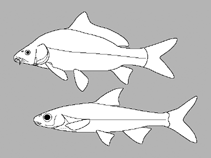 No image available for this species;
drawing shows typical species in Cyprinidae.
Google image
drawing shows typical species in Cyprinidae.
Clasificación / Nombres Nombres comunes | Sinónimos | Catalog of Fishes(Género, Especie) | ITIS | CoL | WoRMS | Cloffa
> Cypriniformes (Carps) > Cyprinidae (Minnows or carps) > Labeoninae
Etymology: Stenorynchoacrum: Sten is derived from Green stenos, means narrow; ryncho from Greek rhynchos, means snout; and from Greek acr, means the extremities of the body (snout, ears or trotters). Thus, rynchoacrum means ventral margin of rostral cap. Stenorynchoacrum alludes to the narrow and undeveloped rostral cap of this genus; xijiangensis: Name alludes Xi Jiang, the drainage of the type locality.
Etymology: Stenorynchoacrum: Sten is derived from Green stenos, means narrow; ryncho from Greek rhynchos, means snout; and from Greek acr, means the extremities of the body (snout, ears or trotters). Thus, rynchoacrum means ventral margin of rostral cap. Stenorynchoacrum alludes to the narrow and undeveloped rostral cap of this genus; xijiangensis: Name alludes Xi Jiang, the drainage of the type locality.
Entorno: milieu / zona climática / rango de profundidad / gama de distribución Ecología
; agua dulce bentopelágico. Subtropical
Distribución Territorios | Áreas FAO | Ecosistemas | Ocurrencias, apariciones | Mapa de puntos | Introducciones | Faunafri
Asia: Xiangsi Jiang, a tributary of Li Jiang draining to Xi Jiang of Zhu Jiang Drainage (Pearl River Drainage) in Guangxi Province, China.
Tamaño / Peso / Edad
Descripción breve Claves de identificación | Morfología | Morfometría
Radios blandos dorsales (total) : 11; Radios blandos anales: 8; Vértebra: 35 - 37. Stenorynchoacrum xijiangensis differs from all species belonging to Labeoninae by the following characters: middle part of rostral cap undeveloped, narrow, only covering the base of the upper jaw, both sides of rostral cap well developed and extending upward, rostral cap connected the lower lip, both lateral part of which free, as the result of a long postlabial groove separating the posterior margin of lateral part of lower lip and the isthmus, the median part of lower lip protrudes to form a round fleshy pad, whose posterior margin continuous with the mental region, no crescentic fold surrounding the fleshy pad (Fig. 2). Other diagnostic characters include: ventral margin of rostral cap unfringed, upper lip regresses to form a row of thin, tiny lobes adnated to upper jaw, the posterior margin of lower jaw connected the anterior part of lower lip, lower lip well developed, variable papillae scattered on rostral cap and lower lip, the anterior margin of upper and lower jaws born flexible, cornified sheath, two pairs of barbels, pharyngeal teeth in 3 rows, and dorsal fin with eight branched rays (Ref. 95674).
Inhabits underground caves connected to the surface river in the Karst area. Remains in
the underground caves in the dry season and swims upward into the rivers during the flood season (Ref. 95674).
Ciclo vital y comportamiento de apareamiento Madurez | Reproducción | Puesta | Huevos | Fecundidad | Larva
Referencia principal
Suba sus referencias | Referencias | Coordinador | Colaboradores
Huang, Y., J. Yang and X. Chen, 2014. Sternorynchoacrum xijiangensis, a new genus and a new species of Labeoninae fish from Guangxi, China (Teleostei: Cyprinidae). Zootaxa 3793(3):379-386. (Ref. 95674)
CITES
Not Evaluated
Amenaza para el ser humano
Harmless
Usos humanos
FAO - Publication: search | FishSource |
Más información
Ecología Trófica
Alimentos (presas)
Composición de la dieta
consumo de alimento
Raciones de comida
Despredadores
Alimentos (presas)
Composición de la dieta
consumo de alimento
Raciones de comida
Despredadores
Dinámica de la población
Coeficiente del crecimiento para
Edades / tallas máximas
Longitud-peso rel.
Longitud-longitud rel.
Longitud-frecuencias
Conversión de masas
Reclutamiento
Abundancia
Coeficiente del crecimiento para
Edades / tallas máximas
Longitud-peso rel.
Longitud-longitud rel.
Longitud-frecuencias
Conversión de masas
Reclutamiento
Abundancia
Ciclo de vida
Reproducción
Madurez
Madurez/Gills rel.
Fecundidad
Puesta
Agregaciones de desove
Huevos
Desarrollo de los huevos
Larva
Dinámica larvaria
Reproducción
Madurez
Madurez/Gills rel.
Fecundidad
Puesta
Agregaciones de desove
Huevos
Desarrollo de los huevos
Larva
Dinámica larvaria
Distribución
Territorios
Áreas FAO
Ecosistemas
Ocurrencias, apariciones
Introducciones
BRUVS - Vídeos
Territorios
Áreas FAO
Ecosistemas
Ocurrencias, apariciones
Introducciones
BRUVS - Vídeos
Anatomía
Superficie branquial
Cerebro
Otolito
Superficie branquial
Cerebro
Otolito
Fisiología
Composición corporal
Nutrientes
Consumo del oxígeno
Tipo de natación
Velocidad de natación
Pigmentos visuales
Sonido de peces
Enfermedades y parásitos
Toxicidad (CL50)
Composición corporal
Nutrientes
Consumo del oxígeno
Tipo de natación
Velocidad de natación
Pigmentos visuales
Sonido de peces
Enfermedades y parásitos
Toxicidad (CL50)
Genética
Genoma
Genética
Heterocigosidad
heritabilidad
Diversidad genética
Genoma
Genética
Heterocigosidad
heritabilidad
Diversidad genética
Relacionados con el ser humano
Sistemas de acuicultura
Perfiles de acuicultura
Razas
Ciguatera cases
Sellos, monedas, varios
Sistemas de acuicultura
Perfiles de acuicultura
Razas
Ciguatera cases
Sellos, monedas, varios
Herramientas
Libro electrónico | Guía de campo | Asistente para frecuencias de tallas | Herramienta de ciclo de vida | Mapa de puntos |
Catch-MSY |
Informes especiales
Comprobar el mantenimiento del acuario | Buscar fichas sobre especies | Consulte las hojas informativas sobre acuicultura
Descargar XML
Fuentes de Internet
AFORO (otoliths) | Aquatic Commons | BHL | Cloffa | Websites from users | Check FishWatcher | CISTI | Catalog of Fishes: Género, Especie | DiscoverLife | ECOTOX | FAO - Publication: search | Faunafri | Fishipedia | Fishtrace | GloBI | Google Books | Google Scholar | Google | IGFA World Record | OneZoom | Open Tree of Life | Otolith Atlas of Taiwan Fishes | PubMed | Reef Life Survey | Socotra Atlas | TreeBase | Árbol de la vida | Wikipedia: Go, búsqueda | World Records Freshwater Fishing | Zoobank | Expediente Zoológico
Estimaciones basadas en modelos
Índice de diversidad filogenética (Referencia 82804): PD50 = 1.0000 [Uniqueness, from 0.5 = low to 2.0 = high].
Bayesian length-weight: a=0.00933 (0.00435 - 0.02001), b=3.05 (2.88 - 3.22), in cm total length, based on LWR estimates for this (Sub)family-body shape (Ref. 93245).
Resiliencia (Referencia 120179): Alto, población duplicada en un tiempo mínimo inferior a 15 meses (Preliminary K or Fecundity.).