



Trichomycterus steindachneri DoNascimiento, Prada-Pedreros & Guerrero-Kommritz, 2014
Ανεβάστε το φωτογραφίες και Βίντεο
Google image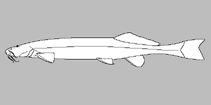 No image available for this species;
drawing shows typical species in Trichomycteridae.
Google image
drawing shows typical species in Trichomycteridae.
Ταξινόμηση / Ονόματα Κοινά ονόματα | Συνώνυμα | Catalog of Fishes(Γένος, Είδη) | ITIS | CoL | WoRMS | Cloffa
> Siluriformes (Catfishes) > Trichomycteridae (Pencil or parasitic catfishes) > Trichomycterinae
Etymology: Trichomycterus: Greek, thrix = hair + Greek, mykter, -eros = nose (Ref. 45335); steindachneri: Named for Austrian zoologist Franz Steindachner (1834-1919) in recognition of his dedicated life and significant work in documenting the fish biodiversity, especially that from South America. His profuse morphological descriptions mainly contributed to settle the current standard in ichthyological taxonomic works.
Eponymy: Franz Steindachner (1834–1919) was an Austrian zoologist who specialised in herpetology and ichthyology. [...] (Ref. 128868), visit book page.
Etymology: Trichomycterus: Greek, thrix = hair + Greek, mykter, -eros = nose (Ref. 45335); steindachneri: Named for Austrian zoologist Franz Steindachner (1834-1919) in recognition of his dedicated life and significant work in documenting the fish biodiversity, especially that from South America. His profuse morphological descriptions mainly contributed to settle the current standard in ichthyological taxonomic works.
Eponymy: Franz Steindachner (1834–1919) was an Austrian zoologist who specialised in herpetology and ichthyology. [...] (Ref. 128868), visit book page.
Περιβάλλον: περιβάλλον / κλιματική ζώνη / εύρος βάθους / εύρος διανομής Οικολογία
; Γλυκού νερού βενθοπελαγικό. Tropical
Κατανομή Εδάφη | Περιοχές FAO | Οικοσυστήματα | Παρουσίες | Σημειακός χάρτης | Εισαγωγές | Faunafri
South America: Colombia.
Μέγεθος / Βάρος / Ηλικία
Γεννητική Ωρίμανση: Lm ? range ? - ? cm
Max length : 14.4 cm SL αρσενικό/απροσδιόριστο; (Ref. 102659)
Max length : 14.4 cm SL αρσενικό/απροσδιόριστο; (Ref. 102659)
Σύντομη περιγραφή Κλείδες προσδιορισμού | Μορφολογία | Μορφομετρία
Μαλακές ραχιαίες ακτίνες (συνολικά) : 9; Σπόνδυλοι: 40 - 41. Trichomycterus steindachneri is diagnosed from most of its congeners, with the exception of T. cachiraensis, by having several broad foramina on cleithrum lamina (vs. cleithrum not pierced). It differs from most congeners except T. cachiraensis and T. brachykechenos by having a small posterior cranial fontanel, restricted to the parieto-supraoccipital (vs. a long somewhat rectangular fontanel extending anteriorly between frontal bones and posteriorly into anteromedian region of parietosupraoccipital). It can be distinguished from T. cachiraensis by having 40 or 41 free vertebrae (vs. 37-39), 14-18 ribs (vs. 12), a single upper hypural plate: 3+4+5 (vs. two hypural plates: 3,4+5), and by its coloration pattern consisting of ground color dark brown with a thin mid-lateral dark stripe (vs. ground colorlight brown with three lateral rows of small dark spots). It differs from T. brachykechenos by the possession of four rows of premaxillary and dentary teeth (vs. three), 13-14 opercular odontodes (vs. 8-11), 41-43 interopercular odontodes (vs. 22-30), 6-7 branchiostegal rays (vs. 8), anterior portion of sphenotic anterolaterally directed in dorsal view (vs. directed anteriorly), autopalatine with mesial margin straight(vs. concave), 12-16 teeth on ceratobranchial 5 (vs. 21-22), 11-14 teeth on upper dentigerous plate (vs. 22-25), infraorbital sensory pores i1 and i3 present (vs. absent), 40 or 41 free vertebrae (vs. 37 or 38), 14-18 ribs (vs. 12), first ray of pectoral fin slightly projected as a short filament(vs. not prolonged as a filament), pectoral fin with 7-8 branched rays (vs. 5-6), dorsal-fin origin at same level of pelvic-fin insertion (vs. at vertical through last third of pelvic fin), anal-fin origin posterior to dorsal-fin base(vs. at vertical through middle of dorsal-fin base), anal fin with seven basal radials (vs. six), procurrent caudal-fin rays 16-21 dorsally and 14-17 ventrally (vs. 15-16 and 10-13, respectively), and by the color pattern of lateral surface of body consisting of background dark brown with a thin mid-lateral dark stripe (vs. background light yellow with superficial layer of densely mottled dark brown). It further differs from T. dorsostriatus, which is also found in the río Meta system, by having 40 or 41 free vertebrae (vs. 37), dorsal fin inserted just posterior to neural spine of vertebrae 18 or 19 (vs. vertebra 16), anal-fin origin behind posterior end of dorsal-fin base, inserted just posterior to hemal spine of vertebrae 22-24 (vs. under posterior portion of dorsal-fin base, just posterior to vertebra 20), a single upper hypural plate (vs. two upper hypural plates), and by the color pattern consisting of a thin mid-lateral dark stripe (vs. a dark band or row of spots from just above the gill-opening to the base of the upper caudal-fin rays). It differs from T. migrans, the only other species described from western tributaries of the Orinoco (río Guaviare system) in Colombia, by its maxillary barbel reaching beyond pectoral-fin origin(vs. scarcely reaching this point), anal-fin origin entirely behind dorsal-fin base (vs. at vertical through base of last dorsal-fin ray), and caudal-fin margin slightly rounded (vs. deeply emarginated). It is readily distinguished from remaining species of Trichomycterus described or recorded from Colombia, except T. retropinnis, by having relatively rare pigmentation pattern composed of background dark brown with a single thin dark stripe along middle of side of body (vs. background light; either plain, with more than one stripe on lateral surface of body, with a single but wide mid-lateral band, or variably spotted or dotted). It differs from T. retropinnis by its pectoral-fin ray slightly projected beyond margin of fin as a short filament of less than 20% length of adjacent branched ray (vs. projecting as a long filament of ca. 40% length of adjacent branched ray), pectoral fin with 7-8 branched rays (vs. 6 branched rays), pelvic fin covering anus (vs. not reaching anus), relative position of the dorsal fin, expressed as dorsal-fin origin at same level of pelvic-fin insertion (vs. dorsal-fin origin behind distal margin of pelvic fin), and anal-fin origin entirely behind of dorsal-fin base (vs. anal-fin origin under anterior third of dorsal-fin base) (Ref. 102659).
Body shape (shape guide): elongated.
Body shape (shape guide): elongated.
Collected in a typical lotic environment of high altitude (2700 m), about 50 cm wide, with small pools and falls (not higher than 40 cm). Stream banks of the collection site have dense riparian vegetation, composed of shrubs and grasses, and dominated by the chusque Chusquea scandens (Ref. 102659).
Κύκλος ζωής και συμπεριφορά ζευγαρώματος Γεννητική Ωρίμανση | Αναπαραγωγή | Γεννοβολία | Αβγά | Γονιμότητα | Προνύμφες
Κύρια αναφορά
Ανεβάστε τις αναφορές σας | Αναφορές | Συντονιστής : Pinna, Mário de | Συνεργάτες
DoNascimiento, C., S. Prada-Pedreros and J. Guerrero-Kommritz, 2014. A new catfish species of the genus Trichomycterus (Siluriformes: Trichomycteridae) from the río Orinoco versant of Páramo de Cruz Verde, Eastern Cordillera of Colombia. Neotrop. Ichthyol. 12(4:717-728. (Ref. 102659)
Κατάσταση Κόκκινου Καταλόγου IUCN (Ref. 130435: Version 2025-2 (Global))
Data deficient (DD) ; Date assessed: 07 October 2020
CITES
Not Evaluated
Απειλή για τον άνθρωπο
Harmless
Ανθρώπινες χρήσεις
FAO - Publication: search | FishSource |
Περισσότερες πληροφορίες
Τροφική Οικολογία
Τρόφιμα (θηράματα)
Σύσταση δίαιτας
Κατανάλωση τροφής
Μερίδες τροφίμων
Θηρευτές
Τρόφιμα (θηράματα)
Σύσταση δίαιτας
Κατανάλωση τροφής
Μερίδες τροφίμων
Θηρευτές
Πληθυσμιακή δυναμική
Παράμετροι Αύξησης
Μέγιστες ηλικίες / μεγέθη
Μήκος-βάρος σχετ.
Μήκος-μήκος rel.
Μήκος-συχνότητες
Μετατροπή μάζας
Στρατολόγηση
Αφθονία
Παράμετροι Αύξησης
Μέγιστες ηλικίες / μεγέθη
Μήκος-βάρος σχετ.
Μήκος-μήκος rel.
Μήκος-συχνότητες
Μετατροπή μάζας
Στρατολόγηση
Αφθονία
Κύκλος ζωής
Αναπαραγωγή
Γεννητική Ωρίμανση
Ωριμότητα / Gills rel.
Γονιμότητα
Γεννοβολία
Συγκεντρώσεις αναπαραγωγής
Αβγά
Ανάπτυξη αυγών
Προνύμφες
Δυναμική προνυμφών
Αναπαραγωγή
Γεννητική Ωρίμανση
Ωριμότητα / Gills rel.
Γονιμότητα
Γεννοβολία
Συγκεντρώσεις αναπαραγωγής
Αβγά
Ανάπτυξη αυγών
Προνύμφες
Δυναμική προνυμφών
Ανατομία
Επιφάνεια βραγχίων
Εγκέφαλος
Ωτόλιθος
Επιφάνεια βραγχίων
Εγκέφαλος
Ωτόλιθος
Φυσιολογία
Σύνθεση σώματος
Θρεπτικά συστατικά
Κατανάλωση οξυγόνου
Τύπος κολύμβησης
Ταχύτητα κολύμβησης
Οπτικές χρωστικές ουσίες
Ήχος ψαριών
Ασθένειες & παράσιτα
Τοξικότητα (LC50)
Σύνθεση σώματος
Θρεπτικά συστατικά
Κατανάλωση οξυγόνου
Τύπος κολύμβησης
Ταχύτητα κολύμβησης
Οπτικές χρωστικές ουσίες
Ήχος ψαριών
Ασθένειες & παράσιτα
Τοξικότητα (LC50)
Γενετική
Γονιδίωμα
Γενετική
Ετεροζυγωτία
Κληρονομικότητα
Γενετική ποικιλομορφία
Γονιδίωμα
Γενετική
Ετεροζυγωτία
Κληρονομικότητα
Γενετική ποικιλομορφία
Ανθρώπινη σχέση
Συστήματα υδατοκαλλιέργειας
Προφίλ υδατοκαλλιεργειών
Στελέχοι
Περιπτώσεις Ciguatera
Γραμματόσημα, νομίσματα, διάφορα.
Συστήματα υδατοκαλλιέργειας
Προφίλ υδατοκαλλιεργειών
Στελέχοι
Περιπτώσεις Ciguatera
Γραμματόσημα, νομίσματα, διάφορα.
Εργαλεία
Ηλεκτρονικό βιβλίο | Οδηγός πεδίου | Ανάλυση κατά μήκος συνθέσεων | Εργαλείο ιστορίας ζωής | Σημειακός χάρτης |
Catch-MSY |
Ειδικές εκθέσεις
Έλεγχος για συντήρηση ενυδρείου | Ελέγξτε για ενημερωτικά δελτία ειδών | Ελέγξτε για ενημερωτικά δελτία υδατοκαλλιέργειας
Λήψη XML
Διαδικτυακές πηγές
AFORO (otoliths) | Aquatic Commons | BHL | Cloffa | Websites from users | Check FishWatcher | CISTI | Catalog of Fishes: Γένος, Είδη | DiscoverLife | ECOTOX | FAO - Publication: search | Faunafri | Fishipedia | Fishtrace | GloBI | Google Books | Google Scholar | Google | IGFA World Record | OneZoom | Open Tree of Life | Otolith Atlas of Taiwan Fishes | PubMed | Reef Life Survey | Socotra Atlas | TreeBase | Δέντρο Ζωής | Wikipedia: Go, αναζήτηση | World Records Freshwater Fishing | Zoobank | Zoological Record
Εκτιμήσεις βάσει μοντέλων
Δείκτης φυλογενετικής ποικιλότητας (Αναφ. 82804): PD50 = 0.5000 [Uniqueness, from 0.5 = low to 2.0 = high].
Bayesian length-weight: a=0.00912 (0.00396 - 0.02102), b=2.97 (2.79 - 3.15), in cm total length, based on LWR estimates for this Genus-body shape (Ref. 93245).
Τροφικό Επίπεδο (Αναφ. 69278): 3.3 ±0.4 se; based on size and trophs of closest relatives