



Trygonorrhina dumerilii (Castelnau, 1873)
Southern fiddler ray
Uploaden van uw Foto's en video's
Google afbeelding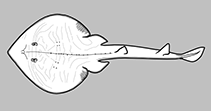 No image available for this species;
drawing shows typical species in Trygonorrhinidae.
Google afbeelding
drawing shows typical species in Trygonorrhinidae.
Classificatie / Namen Lokale namen | Synoniemen | Catalog of Fishes(Genus, Soort(en)) | ITIS | CoL | WoRMS | Cloffa
Elasmobranchii (haaien en roggen) (sharks and rays) > Rhinopristiformes (Shovelnose rays) > Trygonorrhinidae (Banjo rays, Fiddler rays)
Etymology: Trygonorrhina: Greek, trygon = a sting ray + Greek, rhinos = nose (Ref. 45335).
Eponymy: Auguste Henri André Duméril (1812–1870), was a physician and zoologist like his father (see next entry) and followed much in his father’s footsteps. [...] (Ref. 128868), visit book page.
Etymology: Trygonorrhina: Greek, trygon = a sting ray + Greek, rhinos = nose (Ref. 45335).
Eponymy: Auguste Henri André Duméril (1812–1870), was a physician and zoologist like his father (see next entry) and followed much in his father’s footsteps. [...] (Ref. 128868), visit book page.
Milieu: milieu / Klimaatzone / Diepte / verspreidingsgebied Ecologie
marien demersaal; diepte 5 - 205 m (Ref. 114953). Subtropical; 31°S - 41°S, 114°E - 148°E (Ref. 114953)
Verspreiding Gebieden | FAO regio's | Ecosystemen | Voorkomen | Verspreidingskaart | Introducties | Faunafri
Eastern Indian Ocean: endemic to southern Australia.
Lengte bij maturiteit / Grootte / Gewicht / Leeftijd
Maturiteit: Lm 94.6 range ? - ? cm
Max length : 146 cm TL mannelijk / geslacht onbekend; (Ref. 114953)
Max length : 146 cm TL mannelijk / geslacht onbekend; (Ref. 114953)
Korte beschrijving Determinatiesleutels | Morfologie | Morfometrie
This large shovelnose ray is distinguished by the following characters: suboval disc, short and broadly rounded snout with nostrils partly covered with a large nasal curtain; ridges of small thorns present on mid-line of disc and shoulders; behind interorbital space is an ornate pattern of dark-edged bands without the distinct triangular or diamond-shaped marking (Ref. 114953).
Body shape (shape guide): other; Cross section: flattened.
Body shape (shape guide): other; Cross section: flattened.
A benthic species that occurs on continental shelf, mainly found on soft bottoms and seagrasses. Feeds on bottom crustaceans, worms, molluscs and small fishes. Produces litters of 2-5 pups. Maturity size of males at ca. 70 cm TL, females at 89 cm TL; birth size at 21-25 cm TL (Ref. 114953).
Levenscyclus en paargedrag Maturiteit | Voortplanting | Paaien | Eieren | Fecunditeit | Larven
Hoofdreferentie
Upload uw referenties | Referenties | Coördinator | Medewerkers
Last, P.R. and J.D. Stevens, 2009. Sharks and rays of Australia. CSIRO, Australia. 656 p. (Ref. 109431)
Status op de Rode Lijst van het IUCN (Ref. 130435: Version 2025-2 (Global))
Niet bedreigd (LC) ; Date assessed: 24 March 2015
CITES
Not Evaluated
Gevaar voor de mens
Harmless
Gebruik door de mens
FAO - Publication: search | FishSource |
Meer informatie
Trofische ecologie
Voedsel (prooien)
Dieetsamenstelling
Voedselconsumptie
Voedselrantsoenen
Predatoren
Voedsel (prooien)
Dieetsamenstelling
Voedselconsumptie
Voedselrantsoenen
Predatoren
Ecologie
Ecologie
Ecologie
Populatiedynamica
Groeiparameters
Max. leeftijden / maten
Lengte-gewicht rel.
Lengte-lengte rel.
Lengtefrequenties
Massaconversie
Rekrutering
Abundantie
Groeiparameters
Max. leeftijden / maten
Lengte-gewicht rel.
Lengte-lengte rel.
Lengtefrequenties
Massaconversie
Rekrutering
Abundantie
Levenscyclus
Voortplanting
Maturiteit
Rijpheid/kieuwen rel.
Fecunditeit
Paaien
Paaibestanden
Eieren
Ontwikkeling van de eieren
Larven
Larvale populatiedynamiek
Voortplanting
Maturiteit
Rijpheid/kieuwen rel.
Fecunditeit
Paaien
Paaibestanden
Eieren
Ontwikkeling van de eieren
Larven
Larvale populatiedynamiek
Anatomie
Kieuwoppervlak
Hersenen
Otoliet
Kieuwoppervlak
Hersenen
Otoliet
Fysiologie
Lichaamssamenstelling
Voedingsstoffen
Zuurstofverbruik
Type zwemmen
Zwemsnelheid
Visuele pigmenten
Vis geluid
Ziekten en parasieten
Toxiciteit (LC50)
Lichaamssamenstelling
Voedingsstoffen
Zuurstofverbruik
Type zwemmen
Zwemsnelheid
Visuele pigmenten
Vis geluid
Ziekten en parasieten
Toxiciteit (LC50)
Genetica
genoom
Genetica
Heterozygositeit
Erfelijkheid
Genetische diversiteit
genoom
Genetica
Heterozygositeit
Erfelijkheid
Genetische diversiteit
Menselijk gerelateerd
Aquacultuursystemen
Aquacultuurprofielen
Kweeklijnen
Ciguatera gevallen
Postzegels, munten, diversen.
Aquacultuursystemen
Aquacultuurprofielen
Kweeklijnen
Ciguatera gevallen
Postzegels, munten, diversen.
Tools
Speciale rapporten
Bekijk gegevens voor het houden in een aquarium | Bekijk Fact Sheets voor de soort | Bekijk Aquacultuur Fact Sheets
Download XML
Internetbronnen
AFORO (otoliths) | Aquatic Commons | BHL | Cloffa | Websites from users | Bekijk FishWatcher | CISTI | Catalog of Fishes: Genus, Soort(en) | DiscoverLife | ECOTOX | FAO - Publication: search | Faunafri | Fishipedia | Fishtrace | GloBI | Google Books | Google Scholar | Google | IGFA World Record | OneZoom | Open Tree of Life | Otolith Atlas of Taiwan Fishes | PubMed | Reef Life Survey | Socotra Atlas | TreeBase | Tree of Life | Wikipedia: ga naar, zoek | World Records Freshwater Fishing | Zoological Record
Schattingen op basis van modellen
Fylogenetische diversiteitsindex (Ref. 82804): PD50 = 0.7539 [Uniqueness, from 0.5 = low to 2.0 = high].
Bayesian length-weight: a=0.00646 (0.00298 - 0.01397), b=2.98 (2.78 - 3.18), in cm total length, based on LWR estimates for this species & (Sub)family-body (Ref. 93245).
Trofisch niveau (Ref. 69278): 3.7 ±0.6 se; based on size and trophs of closest relatives
Weerstandsvermogen (Ref. 120179): Gemiddeld, minimale populatieverdubbelingstijd 1,4-4,4 jaar (Preliminary K or Fecundity.).
Voedingsstoffen (Ref. 124155): Calcium = 19.7 [4.0, 90.7] mg/100g; Iron = 0.678 [0.174, 1.975] mg/100g; Protein = 19.4 [17.3, 21.3] %; Omega3 = 0.225 [0.101, 0.486] g/100g; Selenium = 31.6 [9.1, 86.6] μg/100g; VitaminA = 6.08 [2.13, 16.80] μg/100g; Zinc = 0.499 [0.251, 0.904] mg/100g (wet weight);