



Serrapinnus lucindai Jerep & Malabarba, 2014
Envoyez vos Photos et vidéos
Images Google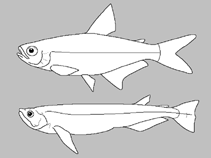 No image available for this species;
drawing shows typical species in Characidae.
Images Google
drawing shows typical species in Characidae.
Classification / Noms Noms communs | Synonymes | Catalog of Fishes(Genre, Espèce) | ITIS | CoL | WoRMS | Cloffa
> Characiformes (Characins) > Characidae (Characins; tetras) > Cheirodontinae
Etymology: Serrapinnus: Latin, serran, serranus, saw and a fish of genus Serranus + Latin, pinna = spiny, thorn (Ref. 45335); lucindai: Named for Paulo Henrique Franco Lucinda (UNT), in recognition of his contribution to the taxonomy of Neotropical freshwater fish, mainly those of the rio Tocantins basin.
Eponymy: Dr Paulo Henrique Franco Lucinda is a Brazilian zoologist, bio-geographer and ichthyologist at Universidade Federal do Tocantins, Porto Nacional, Brazil, where he is Associate Professor I. [...] (Ref. 128868), visit book page.
Etymology: Serrapinnus: Latin, serran, serranus, saw and a fish of genus Serranus + Latin, pinna = spiny, thorn (Ref. 45335); lucindai: Named for Paulo Henrique Franco Lucinda (UNT), in recognition of his contribution to the taxonomy of Neotropical freshwater fish, mainly those of the rio Tocantins basin.
Eponymy: Dr Paulo Henrique Franco Lucinda is a Brazilian zoologist, bio-geographer and ichthyologist at Universidade Federal do Tocantins, Porto Nacional, Brazil, where he is Associate Professor I. [...] (Ref. 128868), visit book page.
Environnement : milieu / zone climatique / profondeur / gamme de distribution Écologie
; eau douce benthopélagique. Tropical
Distribution Territoires | Zones FAO | Écosystèmes | Occurrences | Carte par point | Introductions | Faunafri
South America: Rio Tocantins-Araguaia basin, Brazil.
Taille / Poids / Âge
Description synthétique Clés d'identification | Morphologie | Morphométrie
Rayons mous dorsaux (Total) : 11. Serrapinnus lucindai can be primarily diagnosed from its congeners by having 17 to 19 ventral procurrent caudal-fin rays (vs. less than 17). Furthermore, it differs from other species of the genus by having the following characters: anal-fin hooks on the first unbranched and five branched rays of mature males (vs. anal-fin hooks on at least the anterior six branched rays on the remaining species of the genus); 9 to 11 cusps on the premaxillary teeth (vs. 5 in S. microdon and S. potiguar, 7 in S. aster, 7 to 9 in S. calliurus, S. heterodon, S. kriegi, S. micropterus, S. notomelas and S. piaba, and 10 to 12 in S. gracilis and S. littoris); continuous mid-lateral black stripe extending from the opercular region to the caudal-peduncle spot absent (vs. present in S. sterbai); dentary teeth without expanded cusps forming a sharp cutting edge and the incomplete lateral line (vs. dentary teeth with expanded cusps forming a sharp cutting edge and complete lateral line in S. heterodon); hyaline dorsal fin (vs. fin with a proximal black blotch in S. notomelas); and black spot absent in the posteroventral region of the abdomen (vs. present in S. kriegi) (Ref. 96959).
Body shape (shape guide): elongated.
Body shape (shape guide): elongated.
Cycle de vie et comportement reproducteur Maturité | Reproduction | Frai | Œufs | Fécondité | Larves
Référence principale
Téléchargez vos références | Références | Coordinateur | Collaborateurs
Malabarba, L.R. and F.C. Jerep, 2014. Review of the species of the genus Serrapinnus Malabarba, 1998 (Teleostei: Characidae: Cheirodontinae) from the rio Tocantins-Araguaia basin, with description of three new species. Zootaxa 3847(1):057-079. (Ref. 96959)
Statut dans la liste rouge de l'IUCN (Ref. 130435: Version 2025-2 (Global))
Préoccupation mineure (LC) ; Date assessed: 07 November 2018
CITES
Not Evaluated
Menace pour l'homme
Harmless
Utilisations par l'homme
Pêcheries: sans intérêt
FAO - Publication: search | FishSource |
Plus d'informations
Écologie trophique
Aliments (proies)
Composition du régime alimentaire
Consommation alimentaire
Rations alimentaires
Prédateurs
Aliments (proies)
Composition du régime alimentaire
Consommation alimentaire
Rations alimentaires
Prédateurs
Dynamique des populations
Paramètres de croissance
Âges / tailles maximales
Longueur-poids rel.
Rel. longueur-longueur.
Fréquences de longueurs
Conversion de masse
Recrutement
Abondance
Paramètres de croissance
Âges / tailles maximales
Longueur-poids rel.
Rel. longueur-longueur.
Fréquences de longueurs
Conversion de masse
Recrutement
Abondance
Cycle de vie
Reproduction
Maturité
Maturité/épines rel.
Fécondité
Frai
Agrégats de frai
Œufs
Développement de l'œuf
Larves
Dynamique des populations larvaires
Reproduction
Maturité
Maturité/épines rel.
Fécondité
Frai
Agrégats de frai
Œufs
Développement de l'œuf
Larves
Dynamique des populations larvaires
Anatomie
Surface branchiale
Cerveau
Otolithe
Surface branchiale
Cerveau
Otolithe
Physiologie
Composition corporelle
Nutriments
Consommation d'oxygène
Type de natation
Vitesse de nage
Pigments visuels
Son de poisson
Maladies et parasites
Toxicité (CL50)
Composition corporelle
Nutriments
Consommation d'oxygène
Type de natation
Vitesse de nage
Pigments visuels
Son de poisson
Maladies et parasites
Toxicité (CL50)
Génétique
génôme
Génétique
Hétérozygotie
Héritabilité
Diversité génétique
génôme
Génétique
Hétérozygotie
Héritabilité
Diversité génétique
Liées à l'homme
Systèmes d'aquaculture
Profils d'aquaculture
Souches
Cas de ciguatera
Timbres, pièces de monnaie, divers
Systèmes d'aquaculture
Profils d'aquaculture
Souches
Cas de ciguatera
Timbres, pièces de monnaie, divers
Outils
E-book | Guide de terrain | Générateur de fréquences de longueur | Outil de dynamique de population | Carte par point |
Capture-MSY |
Articles particuliers
Télécharger en XML
Sources Internet
AFORO (otoliths) | Aquatic Commons | BHL | Cloffa | Websites from users | FishWatcher | CISTI | Catalog of Fishes: Genre, Espèce | DiscoverLife | ECOTOX | FAO - Publication: search | Faunafri | Fishipedia | Fishtrace | GloBI | Google Books | Google Scholar | Google | IGFA World Record | OneZoom | Open Tree of Life | Otolith Atlas of Taiwan Fishes | PubMed | Reef Life Survey | Socotra Atlas | TreeBase | Arbre de Vie | Wikipedia: aller à, chercher | World Records Freshwater Fishing | Zoobank | Zoological Record
Estimations basées sur des modèles
Indice de diversité phylogénétique (Réf. 82804): PD50 = 0.5000 [Uniqueness, from 0.5 = low to 2.0 = high].
Bayesian length-weight: a=0.01072 (0.00446 - 0.02572), b=3.07 (2.88 - 3.26), in cm total length, based on LWR estimates for this Genus-body shape (Ref. 93245).
Niveau trophique (Réf. 69278): 2.7 ±0.5 se; based on size and trophs of closest relatives