



Stiphodon niraikanaiensis Maeda, 2013
Carregue seu(sua) Fotos e vídeos
Imagem do Google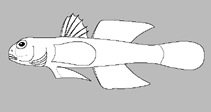 No image available for this species;
drawing shows typical species in Gobiidae.
Imagem do Google
drawing shows typical species in Gobiidae.
Classificação / Nomes Nomes comuns | Sinônimos | Catalog of Fishes(Gênero, Espécies) | ITIS | CoL | WoRMS | Cloffa
> Gobiiformes (Gobies) > Gobiidae (Gobies) > Sicydiinae
Etymology: Stiphodon: Greek, stiphos, -eos, -oys = mass + Greek, odous = teeth (Ref. 45335); niraikanaiensis: Named after the okinawan mythical place, Niraikanai, and Latin suffix ensis.
Etymology: Stiphodon: Greek, stiphos, -eos, -oys = mass + Greek, odous = teeth (Ref. 45335); niraikanaiensis: Named after the okinawan mythical place, Niraikanai, and Latin suffix ensis.
Meio ambiente: milieu / Zona climática / intervalo de profundidade / faixa de distribuição Ecologia
; Água doce bentopelágico; anfídromo; intervalo de profundidade ? - 1 m (Ref. 95104). Subtropical
Distribuição Territórios | Áreas da FAO | Ecossistemas | Ocorrências | Mapa de pontos | Introduções | Faunafri
Northwestern Pacific: Japan.
Tamanho / Peso / Idade
Maturidade: Lm ? range ? - ? cm
Max length : 3.7 cm SL macho/indeterminado; (Ref. 104909); 3.6 cm SL (female)
Max length : 3.7 cm SL macho/indeterminado; (Ref. 104909); 3.6 cm SL (female)
Descrição suscinta Chaves de identificação | Morfologia | Morfometria
Espinhos dorsais (total) : 7; Raios dorsais (total) : 9; Espinhos anais: 1; Raios anais : 10. This species is distinguished by the following set of characters: D2 9, first dorsal fin pointed with elongate fourth spine in male; pectoral-fin rays 16; premaxilla 46-50 tricuspid teeth; dentary 4 (male) or 1 (female) symphyseal teeth and 40-46 unicuspid horizontal teeth in 2.7-3.6 cm SL; scales in longitudinal row 30-32; nape and posterior half of occipital region with cycloid scales; males without white patch behind pectoral-fin base and a broad black band along distal margin of second dorsal fin, the lateral side of body and dorsal and caudal fins often tinged with vivid orange; females with 11 or 12 dusky transverse bars laterally on trunk and tail, intersecting with the mid-lateral longitudinal band and has several conspicuous black spots on each of the spines and soft rays on the first and second dorsal, and caudal fins; anal fin lacking remarkable marking; pectoral-fin rays with 2-5 and 1-4 black spots, respectively, for male and female (Ref. 95104).
Body shape (shape guide): elongated; Cross section: oval.
Body shape (shape guide): elongated; Cross section: oval.
The species was observed in a small pool less than 1 m deep and a rapid just below the pool, located 1.5 km from the stream mouth, no major barrier to upstream migration between the stream mouth and this site. The individuals were often shoaled with the abundant S. percnopterygionus and observed scratching on the rock surface for feeding with them. Single individuals of S. atropurpureus and S. multisquamus were also observed at the same site. Other abundant fishes found on the site were amphidromous gobies, such as Sicyopterus japonicus (Tanaka 1909), Awaous melanocephalus (Bleeker 1849), Rhinogobius nagoyae Jordan and Seale 1906, and Tridentiger kuroiwae Jordan and Tanaka 1927, amphidromous pipefish, Microphis leiaspis (Bleeker 1854), and catadromous flagtail, Kuhlia marginata (Cuvier 1829) (Ref. 95104).
Ciclo de vida ou comportamento de acasalamento Maturidade | Reprodução | Desova | Ovos | Fecundidade | Larvas
Referência principal
Carregar suas referências | Referências | Coordenador | Colaboradores
Maeda, K., 2014. Stiphodon niraikanaiensis, a new species of sicydiine goby from Okinawa Island (Gobiidae: Sicydiinae). Ichthyol. Res.61(2):99-107. (Ref. 95104)
CITES
Not Evaluated
Ameaça para os humanos
Harmless
Uso pelos humanos
Pescarias: sem interesse
FAO - Publication: search | FishSource |
Mais informação
Ecologia Trófica
Itens alimentares (presas)
Composição da dieta
Consumo alimentar
Rações alimentares
Predadores
Itens alimentares (presas)
Composição da dieta
Consumo alimentar
Rações alimentares
Predadores
Ecologia
Ecologia
Ecologia
Dinâmica populacional
Parâmetros de crescimento
Idade máxima / tamanhos
Relação comprimento-peso.
Relação comprimento-comprimento.
Frequências de comprimento
Conversão de massa
Recrutamento
Abundância
Parâmetros de crescimento
Idade máxima / tamanhos
Relação comprimento-peso.
Relação comprimento-comprimento.
Frequências de comprimento
Conversão de massa
Recrutamento
Abundância
Ciclo de vida
Reprodução
Maturidade
Maturidade/Rel. das guelras
Fecundidade
Desova
Agregações de desova
Ovos
Desenvolvimento dos ovos
Larvas
Dinâmica larval
Reprodução
Maturidade
Maturidade/Rel. das guelras
Fecundidade
Desova
Agregações de desova
Ovos
Desenvolvimento dos ovos
Larvas
Dinâmica larval
Anatomia
Área branquial
Cérebro
Otólito
Área branquial
Cérebro
Otólito
Fisiologia
Composição corporal
Nutrientes
Consumo de oxigênio
Tipo de natação
Velocidade de natação
Pigmentos visuais
Som de peixe
Doenças e Parasitas
Toxicidade (LC50s)
Composição corporal
Nutrientes
Consumo de oxigênio
Tipo de natação
Velocidade de natação
Pigmentos visuais
Som de peixe
Doenças e Parasitas
Toxicidade (LC50s)
Genética
genoma
Genética
Heterozigosidade
Hereditariedade
Diversidade genética
genoma
Genética
Heterozigosidade
Hereditariedade
Diversidade genética
Relacionado a humanos
Sistemas de aquicultura
Perfis para aquacultura
Estirpes
Casos de Ciguatera
Selos, moedas, diversos.
Sistemas de aquicultura
Perfis para aquacultura
Estirpes
Casos de Ciguatera
Selos, moedas, diversos.
Ferramentas
Livro eletrônico | Guia de campo | Ferramenta auxiliar de frequências de comprimento | Ferramenta sobre a história de vida | Mapa de pontos |
Catch-MSY |
Relatórios especiais
Checar Manutenção em Aquário | Checar Planilhas de Fatos sobre as Espécies | Checar Planilhas de Fatos sobre Aquicultura
Baixar XML
Fontes da internet
AFORO (otoliths) | Aquatic Commons | BHL | Cloffa | Websites from users | Checar Observador de Peixes (FishWatcher) | CISTI | Catalog of Fishes: Gênero, Espécies | DiscoverLife | ECOTOX | FAO - Publication: search | Faunafri | Fishipedia | Fishtrace | GloBI | Google Books | Google Scholar | Google | IGFA World Record | OneZoom | Open Tree of Life | Otolith Atlas of Taiwan Fishes | PubMed | Reef Life Survey | Socotra Atlas | TreeBase | Árvore da vida | Wikipedia: Ir para, procura | World Records Freshwater Fishing | Zoobank | Registro zoológico
Estimativas baseadas em modelos
Índice de diversidade filogenética (Ref. 82804): PD50 = 0.5000 [Uniqueness, from 0.5 = low to 2.0 = high].
Bayesian length-weight: a=0.00389 (0.00180 - 0.00842), b=3.12 (2.94 - 3.30), in cm total length, based on all LWR estimates for this body shape (Ref. 93245).
Resiliência (Ref. 120179): Elevada, tempo mínimo de duplicação da população menor que 15 meses (Preliminary K or Fecundity.).