



Gymnochanda ploegi Tan & Lim, 2014
Uploaden van uw Foto's en video's
Google afbeelding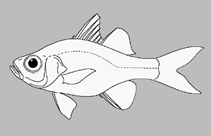 No image available for this species;
drawing shows typical species in Ambassidae.
Google afbeelding
drawing shows typical species in Ambassidae.
Classificatie / Namen Lokale namen | Synoniemen | Catalog of Fishes(Genus, Soort(en)) | ITIS | CoL | WoRMS | Cloffa
> Ovalentaria/misc (Various families in series Ovalentaria) > Ambassidae (Asiatic glassfishes)
Etymology: ploegi: Named for Alex Ploeg, a good friend, fellow taxonomist, advisor and fellow conservationist against alien aquatic species; for his services to the ornamental fish trade in this region and abroad in his role as the Secretary General of the Ornamental Fish International; who unfortunately perished in a terrible tragedy over Ukraine on 17 July 2014.
Eponymy: Dr Alex A Ploeg (d: 2014) was a Dutch ichthyologist who was Secretary General of Ornamental Fish International (2004–2014) and Secretary General of the European Pet Organization (2006–2014). [...] (Ref. 128868), visit book page.
Etymology: ploegi: Named for Alex Ploeg, a good friend, fellow taxonomist, advisor and fellow conservationist against alien aquatic species; for his services to the ornamental fish trade in this region and abroad in his role as the Secretary General of the Ornamental Fish International; who unfortunately perished in a terrible tragedy over Ukraine on 17 July 2014.
Eponymy: Dr Alex A Ploeg (d: 2014) was a Dutch ichthyologist who was Secretary General of Ornamental Fish International (2004–2014) and Secretary General of the European Pet Organization (2006–2014). [...] (Ref. 128868), visit book page.
Milieu: milieu / Klimaatzone / Diepte / verspreidingsgebied Ecologie
; zoet water benthopelagisch. Tropical
Verspreiding Gebieden | FAO regio's | Ecosystemen | Voorkomen | Verspreidingskaart | Introducties | Faunafri
Asia: Sanggau and Kapuas Lakes regions in West Kalimantan, Indonesia.
Grootte / Gewicht / Leeftijd
Korte beschrijving Determinatiesleutels | Morfologie | Morfometrie
Dorsale stekels (totaal) : 8; Dorsale zachte stralen (totaal) : 11; Anale stekels: 3; Anale zachte stralen: 11; Wervels: 25. Distinguished from all other species of Gymnochanda by the following characters: mature males have pinkish body with dorsal half suffused with reddish pigments, anal and second dorsal fins expanded with their soft rays also expanded to reach 2/3 of caudal fin forming a crescentic profile, without any individual fin ray free from the interradial fin membrane; anterior part to whole of both anal and second dorsal fins maroon red in life, with posterior portion of distal rays black forming a crescentic pattern (hyaline when preserved); caudal fin entirely lightly suffused with red in life (hyaline when preserved); females possess yellowish body suffused with reddish pigments without any fin elongation (hyaline when preserved), both dorsal fins suffused with reddish pigments (hyaline when preserved) (Ref. 97398).
Body shape (shape guide): fusiform / normal.
Body shape (shape guide): fusiform / normal.
Found in pools with still water near swamp forest and riverine systems (Ref. 97398).
Levenscyclus en paargedrag Maturiteit | Voortplanting | Paaien | Eieren | Fecunditeit | Larven
Hoofdreferentie
Upload uw referenties | Referenties | Coördinator | Medewerkers
Tan, H.H. and K.K.P. Lim, 2014. Gymnochanda ploegi, a new species of ambassid glassperch from West Kalimantan, Indonesia. Raffles Bulletin of Zoology 62:688-695. (Ref. 97398)
Status op de Rode Lijst van het IUCN (Ref. 130435: Version 2025-2 (Global))
Onvoldoende gegevens (DD) ; Date assessed: 18 November 2019
CITES
Not Evaluated
Gevaar voor de mens
Harmless
Gebruik door de mens
FAO - Publication: search | FishSource |
Meer informatie
Trofische ecologie
Voedsel (prooien)
Dieetsamenstelling
Voedselconsumptie
Voedselrantsoenen
Predatoren
Voedsel (prooien)
Dieetsamenstelling
Voedselconsumptie
Voedselrantsoenen
Predatoren
Populatiedynamica
Groeiparameters
Max. leeftijden / maten
Lengte-gewicht rel.
Lengte-lengte rel.
Lengtefrequenties
Massaconversie
Rekrutering
Abundantie
Groeiparameters
Max. leeftijden / maten
Lengte-gewicht rel.
Lengte-lengte rel.
Lengtefrequenties
Massaconversie
Rekrutering
Abundantie
Levenscyclus
Voortplanting
Maturiteit
Rijpheid/kieuwen rel.
Fecunditeit
Paaien
Paaibestanden
Eieren
Ontwikkeling van de eieren
Larven
Larvale populatiedynamiek
Voortplanting
Maturiteit
Rijpheid/kieuwen rel.
Fecunditeit
Paaien
Paaibestanden
Eieren
Ontwikkeling van de eieren
Larven
Larvale populatiedynamiek
Anatomie
Kieuwoppervlak
Hersenen
Otoliet
Kieuwoppervlak
Hersenen
Otoliet
Fysiologie
Lichaamssamenstelling
Voedingsstoffen
Zuurstofverbruik
Type zwemmen
Zwemsnelheid
Visuele pigmenten
Vis geluid
Ziekten en parasieten
Toxiciteit (LC50)
Lichaamssamenstelling
Voedingsstoffen
Zuurstofverbruik
Type zwemmen
Zwemsnelheid
Visuele pigmenten
Vis geluid
Ziekten en parasieten
Toxiciteit (LC50)
Genetica
genoom
Genetica
Heterozygositeit
Erfelijkheid
Genetische diversiteit
genoom
Genetica
Heterozygositeit
Erfelijkheid
Genetische diversiteit
Menselijk gerelateerd
Aquacultuursystemen
Aquacultuurprofielen
Kweeklijnen
Ciguatera gevallen
Postzegels, munten, diversen.
Aquacultuursystemen
Aquacultuurprofielen
Kweeklijnen
Ciguatera gevallen
Postzegels, munten, diversen.
Tools
Speciale rapporten
Bekijk gegevens voor het houden in een aquarium | Bekijk Fact Sheets voor de soort | Bekijk Aquacultuur Fact Sheets
Download XML
Internetbronnen
AFORO (otoliths) | Aquatic Commons | BHL | Cloffa | Websites from users | Bekijk FishWatcher | CISTI | Catalog of Fishes: Genus, Soort(en) | DiscoverLife | ECOTOX | FAO - Publication: search | Faunafri | Fishipedia | Fishtrace | GloBI | Google Books | Google Scholar | Google | IGFA World Record | OneZoom | Open Tree of Life | Otolith Atlas of Taiwan Fishes | PubMed | Reef Life Survey | Socotra Atlas | TreeBase | Tree of Life | Wikipedia: ga naar, zoek | World Records Freshwater Fishing | Zoobank | Zoological Record
Schattingen op basis van modellen
Fylogenetische diversiteitsindex (Ref. 82804): PD50 = 0.5312 [Uniqueness, from 0.5 = low to 2.0 = high].
Bayesian length-weight: a=0.01175 (0.00494 - 0.02795), b=3.02 (2.82 - 3.22), in cm total length, based on LWR estimates for this (Sub)family-body shape (Ref. 93245).
Trofisch niveau (Ref. 69278): 3.2 ±0.4 se; based on size and trophs of closest relatives
Weerstandsvermogen (Ref. 120179): Hoog, minimale populatieverdubbelingstijd minder dan 15 maanden (Preliminary K or Fecundity.).