



Marcusenius krameri Maake, Gon & Swartz, 2014
Hochladen Photos und videos
Google Bild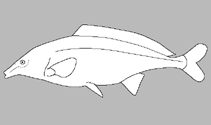 No image available for this species;
drawing shows typical species in Mormyridae.
Google Bild
drawing shows typical species in Mormyridae.
Klassifizierung / Names Namen | Synonyme | Catalog of Fishes(Gattung, Arten) | ITIS | CoL | WoRMS | Cloffa
> Osteoglossiformes (Bony tongues) > Mormyridae (Elephantfishes)
Etymology: Marcusenius: Becasue of J. Marcusen, author of "Zur Phauna des Schwarzen Meeres", 1867; ichthyologist; krameri: Marcusenius krameri is named for Prof. Bernd Kramer from the Zoological Institute of the University of Regensburg, Germany, in recognition of his contribution to the systematics of southern African mormyrids (Ref. 95448).
Eponymy: Dr Johann Andreas Marcusen (1817–1894) was a Latvian of German descent who was a physician, ichthyologist and zoologist. [...] Dr Leo Bernd Kramer is a German ichthyologist who was Professor at the Zoological Institute of the University of Regensburg, Germany until he retired (2009). [...] (Ref. 128868), visit book page.
Etymology: Marcusenius: Becasue of J. Marcusen, author of "Zur Phauna des Schwarzen Meeres", 1867; ichthyologist; krameri: Marcusenius krameri is named for Prof. Bernd Kramer from the Zoological Institute of the University of Regensburg, Germany, in recognition of his contribution to the systematics of southern African mormyrids (Ref. 95448).
Eponymy: Dr Johann Andreas Marcusen (1817–1894) was a Latvian of German descent who was a physician, ichthyologist and zoologist. [...] Dr Leo Bernd Kramer is a German ichthyologist who was Professor at the Zoological Institute of the University of Regensburg, Germany until he retired (2009). [...] (Ref. 128868), visit book page.
Umwelt: Milieu / Klimazone / Tiefenbereich / Verbreitungsgebiet Ökologie
; süßwasser benthopelagisch. Tropical; 17°C - 27°C (Ref. 95448); 24°S - 25°S
Verbreitung Territorien | FAO Gebiete | Ökosysteme | Vorkommen | Punkt Karte | Einführungen | Faunafri
Africa: Limpopo River and several of its tributaries in South Africa (Ref. 95448).
Größe / Gewicht / Alter
Kurzbeschreibung Bestimmungsschlüssel | Morphologie | Morphometrie
Rückenflossenstacheln (insgesamt) : 0; Rückenflossenweichstrahlen (insgesamt) : 22 - 25; Afterflossenstacheln: 0; Afterflossenweichstrahlen: 28 - 31; Wirbelzahl: 44. Diagnosis: Marcusenius krameri can be distinguished from its congeners by following characters: middle body depth 21.9-28.1% of standard length; distance from dorsal fin origin to end of caudal peduncle 39.9-41.7% of standard length; distance from anal fin origin to end of caudal peduncle 42.8-44.9% of standard length; dorsal fin length 15.5-20.0% of standard length; anal fin length 23.2-25.5% of standard length; depth of caudal peduncle 26.0-40.6% of its length; scales around caudal peduncle 16; total vertebrae 44; anterior gill rakers (5-6)+(5); total anterior gill rakers 10-11; posterior gill rakers (8)+(9); total posterior gill rakers 17; dorsal fin rays 22-25; anal fin rays 28-31; scales along lateral line 69-72; conical teeth on upper/lower jaws 4-6 (Ref. 95448).
Body shape (shape guide): elongated; Cross section: compressed.
Body shape (shape guide): elongated; Cross section: compressed.
Individuals of this species were found in groups; during the day they were commonly encountered below undercut river banks, especially in dense networks of tree roots or reed beds along the stream margins; places with shallow water and slow-flowing reaches of rivers and streams are especially attractive to them (Ref. 95448). Large numbers of small juveniles were found in bushes of aquatic reeds and floating grass on the periphery of the river or in side channels (Ref. 95448).
Lebenszyklus und Paarungsverhalten Geschlechtsreife | Fortpflanzung | Ablaichen | Eier | Fruchtbarkeit | Larven
Hauptreferenz
Laden Sie Ihre Referenzen hoch | Referenzen | Koordinator | Partner
Maake, P.A., O. Gon and E.R. Swartz, 2014. Descriptions of three new species of Marcusenius Gill, 1862 (Teleostei: Mormyridae) from South Africa and Mozambique. Zootaxa 3780(3):455-480. (Ref. 95448)
IUCN Rote Liste Status (Ref. 130435: Version 2025-2 (Global))
nicht bedroht (LC) ; Date assessed: 06 December 2016
CITES
Not Evaluated
Bedrohung für Menschen
Harmless
Nutzung durch Menschen
FAO - Publication: search | FishSource |
Mehr Information
Trophische Ökologie
Lebensmittel (Beutetiere)
Nahrungszusammensetzung
Nahrungsaufnahme
Lebensmittelrationen
Räuber
Lebensmittel (Beutetiere)
Nahrungszusammensetzung
Nahrungsaufnahme
Lebensmittelrationen
Räuber
Populationsdynamik
Wachstumsparameter
Max. Alter/Größen
Länge-Gewicht-Rel.
Länge-Länge-Verhältnis.
Längenhäufigkeiten
Massenkonvertierung
Rekrutierung
Dichte
Wachstumsparameter
Max. Alter/Größen
Länge-Gewicht-Rel.
Länge-Länge-Verhältnis.
Längenhäufigkeiten
Massenkonvertierung
Rekrutierung
Dichte
Lebenszyklus
Fortpflanzung
Geschlechtsreife
Reifung/Kiemen rel.
Fruchtbarkeit
Ablaichen
Laichaggregationen
Eier
Eientwicklung
Larven
Larven Pop.Dyn.
Fortpflanzung
Geschlechtsreife
Reifung/Kiemen rel.
Fruchtbarkeit
Ablaichen
Laichaggregationen
Eier
Eientwicklung
Larven
Larven Pop.Dyn.
Anatomie
Kiemenoberfläche
Gehirn
Otolith
Kiemenoberfläche
Gehirn
Otolith
Physiologie
Körperliche Zusammensetzung
Nährstoffe
Sauerstoffverbrauch
Schwimmart
Schwimmgeschwindigkeit
Visuelle Pigmente
Fischgeräusche
Krankheiten und Parasiten
Toxizität (LC50s)
Körperliche Zusammensetzung
Nährstoffe
Sauerstoffverbrauch
Schwimmart
Schwimmgeschwindigkeit
Visuelle Pigmente
Fischgeräusche
Krankheiten und Parasiten
Toxizität (LC50s)
Genetik
Genom
Genetik
Heterozygotie
Vererbbarkeit
Genetische Vielfalt
Genom
Genetik
Heterozygotie
Vererbbarkeit
Genetische Vielfalt
Menschenbezogen
Aquakultur-Systeme
Aquakultur Profile
Zuchtlinien
Ciguatera-Fälle
Briefmarken, Münzen, Verschiedenes.
Aquakultur-Systeme
Aquakultur Profile
Zuchtlinien
Ciguatera-Fälle
Briefmarken, Münzen, Verschiedenes.
Tools
Zusatzinformationen
Download XML
Zusammenfassung | Punktdaten | Namen | Photos
Internet Quellen
AFORO (otoliths) | Aquatic Commons | BHL | Cloffa | Websites from users | FishWatcher Einträge suchen | CISTI | Catalog of Fishes: Gattung, Arten | DiscoverLife | ECOTOX | FAO - Publication: search | Faunafri | Fishipedia | Fishtrace | GloBI | Google Books | Google Scholar | Google | IGFA World Record | OneZoom | Open Tree of Life | Otolith Atlas of Taiwan Fishes | PubMed | Reef Life Survey | Socotra Atlas | TreeBase | Tree of Life | Wikipedia: Gehe zu, Suchen | World Records Freshwater Fishing | Zoobank | Zoologischer Rekord
Schätzungen auf der Grundlage von Modellen
Phylogenetischer Diversitätsindex (Ref. 82804): PD50 = 0.5000 [Uniqueness, from 0.5 = low to 2.0 = high].
Bayesian length-weight: a=0.00562 (0.00248 - 0.01273), b=3.05 (2.85 - 3.25), in cm total length, based on LWR estimates for this (Sub)family-body shape (Ref. 93245).
Trophische Ebene (Ref. 69278): 3.1 ±0.4 se; based on size and trophs of closest relatives
Widerstandsfähigkeit (Ref. 120179): hoch, Verdopplung der Population dauert weniger als 15 Monate. (Preliminary K or Fecundity.).