



Garra arunachalensis Nebeshwar & Vishwanath, 2013
muatnaik fotos/gambar dan video
imej Google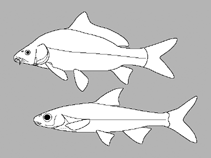 No image available for this species;
drawing shows typical species in Cyprinidae.
imej Google
drawing shows typical species in Cyprinidae.
klasifikasi / Nama Nama-nama umum | Sinonim (persamaan) | Catalog of Fishes(Marga, Jenis) | ITIS | CoL | WoRMS | Cloffa
> Cypriniformes (Carps) > Cyprinidae (Minnows or carps) > Labeoninae
Etymology: Garra: Name based on a vernacular Indian name (Hamilton, 1822:343, Ref. 1813); a fish living in mud (Ref. 128817); arunachalensis: Named for Arunachal Pradesh, the state where it is distributed; an adjective.
Etymology: Garra: Name based on a vernacular Indian name (Hamilton, 1822:343, Ref. 1813); a fish living in mud (Ref. 128817); arunachalensis: Named for Arunachal Pradesh, the state where it is distributed; an adjective.
Lingkungan: lingkungan / zona iklim / kisaran kedalaman / jangkauan distribusi Ekologi
; air tawar bentopelagis. Subtropical
Penyebaran Wilayah | Daerah-daerah FAO | Ekosistem | Kemunculan | peta titik | Introduksi | Faunafri
Asia: India.
Ukuran / Berat / umur
deskripsi pendek Kunci identifiaksi (pengenalan) | Morfologi | Morfometrik
vertebrata, bertulang belakang: 33 - 34. This species is distinguished from its congeners in the Ganga-Brahmaputra by the following characters: snout morphology with a transverse lobe with 8-24 small- to medium-sized tubercles, distinct quadrate proboscis slightly tapering anteriorly and moderately elevated upwards, the anterior margin of the proboscis is truncate and sharply delineated from the depressed rostral surface by a narrow transverse groove, each anterolateral marginal corner of the proboscis have one large unicuspid, acanthoid tubercle, and one small tubercle in between, and the lateral margin of the proboscis with 3-6 small tubercles in one row; differs from G. birostris, G. quadratirostris, G. gotyla in lacking (vs. having) an anterolateral lobe of the lower lip, a more posteriorly situated anus (distance from anus to anal fin 19-25 % of pelvic-anal distance vs. 22-44), by the number of lateral-line scales 35 (vs. 33-34; except in G. quadratirostris). it has fewer transverse scale rows between lateral line and anal-fin origin 3 1/2 (vs. 4-4 1/2), with circumpeduncular scale rows 12 (vs. 16), has a larger adhesive disc with disc length 45-53 % HL (vs. 33-42), central callous-pad width 39-48 % HL (vs. 30-41), and length 32-38 % HL (vs. 20-28), without (vs. with) a black spot at the upper angle of the gill opening; differs from G. quadratirostris in having fewer lateral-line scales 35 (vs. 37), total vertebrae 33-34 (vs. 35-36),
abdominal vertebrae 15-16 (vs. 17-18), and predorsal vertebrae 9 (vs. 10-11) (Ref. 94542); differs from Garra nethravathiensis by having the following characters: unbranched dorsal-fin rays 3 (vs.2); unbranched anal-fin rays 3 (vs. 2); branched pectoral-fin rays 14-15 (13); pre-dorsal scales 10-12 (vs. 8-10); lateral-line scales 35 (vs. 30-31); scales between lateral line to origin of pelvic-fin 3.5 (2.5); circumpeduncular scales 12 (vs. 16) (Ref. 96640).
Body shape (shape guide): elongated; Cross section: oval.
Body shape (shape guide): elongated; Cross section: oval.
Siklus hidup dan perilaku kawin Kematangan | Reproduksi, perkembang biakan | Pemijahan | telur-telur | Fekunditas | Larva
rujukan utama
Unggah referensi Anda | Acuan | Koordinator | mitra
Nebeshwar, K. and W. Vishwanath, 2013. Three new species of Garra (Pisces: Cyprinidae) from north-eastern India and redescription of G. gotyla. Ichthyol. Explor. Freshwat. 24(2):97-120. (Ref. 94542)
CITES
Not Evaluated
ancaman kepada manusia
Harmless
penggunaan manusia
Perikanan: tidak ada kepentingan
FAO - Publication: search | FishSource |
informasi lanjut
Ekologi trofik
Item makanan (mangsa)
Komposisi makanan
Konsumsi makanan
Ransum makanan
Pemangsa
Item makanan (mangsa)
Komposisi makanan
Konsumsi makanan
Ransum makanan
Pemangsa
Dinamika populasi
Parameter pertumbuhan
Maks. usia / ukuran
Panjang-berat rel.
Panjang-panjang rel.
ukuran frekuensi
Konversi massa
pemulihan
Kelimpahan
Parameter pertumbuhan
Maks. usia / ukuran
Panjang-berat rel.
Panjang-panjang rel.
ukuran frekuensi
Konversi massa
pemulihan
Kelimpahan
Siklus hidup
Reproduksi, perkembang biakan
Kematangan
Kedewasaan / insang rel.
Fekunditas
Pemijahan
Agregasi pemijahan
telur-telur
pekembangan telor
Larva
Dinamika larva
Reproduksi, perkembang biakan
Kematangan
Kedewasaan / insang rel.
Fekunditas
Pemijahan
Agregasi pemijahan
telur-telur
pekembangan telor
Larva
Dinamika larva
Anatomi
Area insang
Otak
Otolith
Area insang
Otak
Otolith
Fisiologi
Komposisi tubuh
Nutrisi
Konsumsi oksigen
Jenis renang
Kecepatan berenang
Pigmen visual
Suara ikan
Penyakit & Parasit
Toksisitas (LC50)
Komposisi tubuh
Nutrisi
Konsumsi oksigen
Jenis renang
Kecepatan berenang
Pigmen visual
Suara ikan
Penyakit & Parasit
Toksisitas (LC50)
Genetika
genom
Genetika
Heterozigositas
Diturunkan
Keanekaragaman Genetik
genom
Genetika
Heterozigositas
Diturunkan
Keanekaragaman Genetik
Yang berhubungan dengan manusia
Sistem akuakultur
profil budidaya air
Strain
Kasus Ciguatera
Perangko, koin, dll.
Sistem akuakultur
profil budidaya air
Strain
Kasus Ciguatera
Perangko, koin, dll.
Alat, peralatan
E-book | Penuntun lapangan | tanda freqkuenci panjang | peringkat sejarah hidup | peta titik |
Tangkap-MSY |
laporan khas
muat turun XML
Sumber internet
AFORO (otoliths) | Aquatic Commons | BHL | Cloffa | Websites from users | semak peneliti ikan | CISTI | Catalog of Fishes: Marga, Jenis | DiscoverLife | ECOTOX | FAO - Publication: search | Faunafri | Fishipedia | Fishtrace | GloBI | Google Books | Google Scholar | Google | IGFA World Record | OneZoom | Open Tree of Life | Otolith Atlas of Taiwan Fishes | PubMed | Reef Life Survey | Socotra Atlas | TreeBase | Tree of Life | Wikipedia: pergi, Cari | | Zoobank | Catatan Zoologi
Estimasi berdasarkan model
|
Indeks keanekaragaman filogenetik (Acuan 82804) |
PD50 = 0.5000 [Uniqueness, from 0.5 = low to 2.0 = high]. |
| Bayesian length-weight | a=0.00794 (0.00354 - 0.01782), b=3.04 (2.87 - 3.21), in cm total length, based on LWR estimates for this Genus-body shape (Ref. 93245). |
| 0 | |
|
Daya lenting (Acuan 120179) |
Tinggi, Waktu penggandaan populasi minimum kurang dari 15 bulan (Preliminary K or Fecundity.). |
|
Kerentanan Penangkapan Ikan (Ref. 59153) |
Low vulnerability (24 of 100). 🛈 |