



Erromyzon kalotaenia Yang, Kottelat, Yang & Chen, 2012
Carregue seu(sua) Fotos e vídeos
Imagem do Google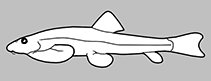 No image available for this species;
drawing shows typical species in Gastromyzontidae.
Imagem do Google
drawing shows typical species in Gastromyzontidae.
Classificação / Nomes Nomes comuns | Sinônimos | Catalog of Fishes(Gênero, Espécies) | ITIS | CoL | WoRMS | Cloffa
> Cypriniformes (Carps) > Gastromyzontidae (Hillstream loaches)
Etymology: kalotaenia: Derived from the Greek kalos, meaning beautiful, and taenia, from Greek tainia, meaning stripes or bars, in reference to the blotches on the flank of this species. A noun in apposition.
Etymology: kalotaenia: Derived from the Greek kalos, meaning beautiful, and taenia, from Greek tainia, meaning stripes or bars, in reference to the blotches on the flank of this species. A noun in apposition.
Meio ambiente: milieu / Zona climática / intervalo de profundidade / faixa de distribuição Ecologia
; Água doce demersal; intervalo de profundidade 0 - ? m (Ref. 93072). Subtropical
Distribuição Territórios | Áreas da FAO | Ecossistemas | Ocorrências | Mapa de pontos | Introduções | Faunafri
Asia: Liuding and Dishui streams of the Guijiang river drainage (a tributary of Pearl River) in Guangxi, China.
Tamanho / Peso / Idade
Descrição suscinta Chaves de identificação | Morfologia | Morfometria
Raios dorsais (total) : 11; Raios anais : 7. Differs from all congeners by the combination of the following characters: a small median lobe of the rostral fold; lower lip distinctly covered with melanophores; 9-12 squarish blotches on side of body, their height about one-third body depth; and 85-89 lateral line scales. Can be diagnosed from Erromyzon sinensis by having 9-12 irregular blotches on body (vs. 17-21 very irregular bars or a mottled pattern); from
E. compactus by having lower lip with two or three folds (vs. folds absent), a midlateral row of squarish blotches on flank (vs. bars continuous across dorsum), and four rows of blackish spots on dorsal-fin rays, six rows on caudal-fin rays (vs. two rows on both dorsal and caudal-fin rays); and from E. yangi in having 85-89 lateral-line scales (vs. 96-99) and by its color pattern consisting of 9-12 blotches on flank (vs. a black midlateral stripe dark brown dorsum and an incomplete lower black stripe) (Ref. 93072).
Body shape (shape guide): elongated.
Body shape (shape guide): elongated.
Inhabits shallow water at depths of 0.1-0.5 m among boulders and cobbles mixed with sand on the river bed. In Dishui River, other fishes found together with this species include cyprinids (Opsariichthys bidens, Acrossocheilus parallens), balitorids (Pseudogastromyzon fangi, Vanmanenia pingchowensis, Yaoshania pachychilus, Schistura fasciolata) and sisorids (Glyptothorax fokiensis, Pterocryptis anomala). In Liuding River, this species occurs together with Zacco platypus, Puntius semifasciolatus, Pseudorasbora parva, Carassius auratus, Oreonectes platycephalus, Traccatichthys pulcher, Cobitis sinensis and Tachysurus adiposalis (Ref. 93072).
Ciclo de vida ou comportamento de acasalamento Maturidade | Reprodução | Desova | Ovos | Fecundidade | Larvas
Referência principal
Carregar suas referências | Referências | Coordenador | Colaboradores
Yang, J., M. Kottelat, J.-X. Yang and X.-Y. Chen, 2012. Yaoshania and Erromyzon kalotaenia, a new genus and species of balitorid loaches for Guangxi, China (Teleostei: Cypriniformes). Zootaxa 3586:173-186. (Ref. 93072)
Status na Lista Vermelha da UICN (Ref. 130435: Version 2025-2 (Global))
Segura ou pouco preocupante (LC) ; Date assessed: 28 April 2023
CITES
Not Evaluated
Ameaça para os humanos
Harmless
Uso pelos humanos
Pescarias: sem interesse
FAO - Publication: search | FishSource |
Mais informação
Ecologia Trófica
Itens alimentares (presas)
Composição da dieta
Consumo alimentar
Rações alimentares
Predadores
Itens alimentares (presas)
Composição da dieta
Consumo alimentar
Rações alimentares
Predadores
Dinâmica populacional
Parâmetros de crescimento
Idade máxima / tamanhos
Relação comprimento-peso.
Relação comprimento-comprimento.
Frequências de comprimento
Conversão de massa
Recrutamento
Abundância
Parâmetros de crescimento
Idade máxima / tamanhos
Relação comprimento-peso.
Relação comprimento-comprimento.
Frequências de comprimento
Conversão de massa
Recrutamento
Abundância
Ciclo de vida
Reprodução
Maturidade
Maturidade/Rel. das guelras
Fecundidade
Desova
Agregações de desova
Ovos
Desenvolvimento dos ovos
Larvas
Dinâmica larval
Reprodução
Maturidade
Maturidade/Rel. das guelras
Fecundidade
Desova
Agregações de desova
Ovos
Desenvolvimento dos ovos
Larvas
Dinâmica larval
Anatomia
Área branquial
Cérebro
Otólito
Área branquial
Cérebro
Otólito
Fisiologia
Composição corporal
Nutrientes
Consumo de oxigênio
Tipo de natação
Velocidade de natação
Pigmentos visuais
Som de peixe
Doenças e Parasitas
Toxicidade (LC50s)
Composição corporal
Nutrientes
Consumo de oxigênio
Tipo de natação
Velocidade de natação
Pigmentos visuais
Som de peixe
Doenças e Parasitas
Toxicidade (LC50s)
Genética
genoma
Genética
Heterozigosidade
Hereditariedade
Diversidade genética
genoma
Genética
Heterozigosidade
Hereditariedade
Diversidade genética
Relacionado a humanos
Sistemas de aquicultura
Perfis para aquacultura
Estirpes
Casos de Ciguatera
Selos, moedas, diversos.
Sistemas de aquicultura
Perfis para aquacultura
Estirpes
Casos de Ciguatera
Selos, moedas, diversos.
Ferramentas
Livro eletrônico | Guia de campo | Ferramenta auxiliar de frequências de comprimento | Ferramenta sobre a história de vida | Mapa de pontos |
Catch-MSY |
Relatórios especiais
Checar Manutenção em Aquário | Checar Planilhas de Fatos sobre as Espécies | Checar Planilhas de Fatos sobre Aquicultura
Baixar XML
Fontes da internet
AFORO (otoliths) | Aquatic Commons | BHL | Cloffa | Websites from users | Checar Observador de Peixes (FishWatcher) | CISTI | Catalog of Fishes: Gênero, Espécies | DiscoverLife | ECOTOX | FAO - Publication: search | Faunafri | Fishipedia | Fishtrace | GloBI | Google Books | Google Scholar | Google | IGFA World Record | OneZoom | Open Tree of Life | Otolith Atlas of Taiwan Fishes | PubMed | Reef Life Survey | Socotra Atlas | TreeBase | Árvore da vida | Wikipedia: Ir para, procura | World Records Freshwater Fishing | Zoobank | Registro zoológico
Estimativas baseadas em modelos
Índice de diversidade filogenética (Ref. 82804): PD50 = 0.5625 [Uniqueness, from 0.5 = low to 2.0 = high].
Bayesian length-weight: a=0.00646 (0.00285 - 0.01461), b=3.11 (2.91 - 3.31), in cm total length, based on LWR estimates for this (Sub)family-body shape (Ref. 93245).
Nível Trófico (Ref. 69278): 2.8 ±0.3 se; based on size and trophs of closest relatives