This website uses cookies to enhance your browsing experience and ensure the functionality of our site. For more detailed information about the types of cookies we use and how we protect your privacy, please visit our Privacy Information page.
×
Cookie Settings
This website uses different types of cookies to enhance your experience. Please select your preferences below:
> Gobiiformes (Gobies) > Gobiidae (Gobies) > Gobiinae
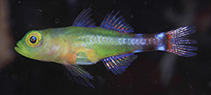
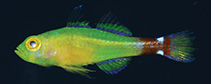
Etymology: Trimma:Greek, trimma, -atos = something crushed (Ref. 45335); meranyx:Name from Greek words 'mera' meaning day, and 'nyx' meaning night, for ‘day-night pygmy goby’, referring to its unique colouration of a black peduncle with twin 'suns' dorsally and ventrally; noun in apposition.
Ambiente: milieu / zona climatica / distribuzione batimetrica / gamma di distribuzione Ecologia
marino associati a barriera corallina; distribuzione batimetrica 45 - 70 m (Ref. 96671). Tropical
Western Pacific: Indonesia, Papua New Guinea; photographic taken from the Philippines and Vanuatu.
Dimensione / Peso / Età
Maturità: Lm? range ? - ? cm Max length : 1.9 cm SL (female)
Breve descrizione Chiavi di identificazione | Morfologia | Morfometria
Spine dorsali (totale) : 7; Raggi dorsali molli (totale) : 8; Spine anali: 1; Raggi anali molli: 8. This species is distinguished by the following set of characters: a narrow bony interorbital (< 55% pupil width), predorsal midline with 8-9 scales; cycloid scales usually along the upper border of the opercle which may be in up to 3 horizontal rows; 2 (usually cycloid) cheek scales; a very slightly elongate second dorsal spine usually reaching posteriorly to between the base of the spine and the base of the second ray of the second dorsal fin; unbranched pectoral-fin rays; fifth pelvic-fin ray which branches once dichotomously and is 64-85% the length of the fourth ray; a full basal membrane connecting the inner margins of the fifth pelvic fins rays in undamaged specimens; black posterior half of the caudal peduncle with a large white spot dorsally and ventrally just anterior to the procurrent caudal fin rays is unique within the genus (Ref. 96671). Body shape (shape guide): fusiform / normal; Cross section: oval.
Most specimens of this 'twilight zone' species are reported from the 70 m depth range (though
have been collected as shallow as 45-55 m in the Lembeh Strait). The species do not appear to school or aggregate as with many congeners, but rather are found individually in small caves and crevices, frequently quite deep into the interstices of the reef and only visible using a strong underwater flashlight. Specimens collected were found exclusively on deep reefs sheltered from wave exposure but nonetheless exposed to currents, and although there was frequently significant silt build-up present in the caves in which they sheltered, water visibility was always good because of the significant water flow over the reefs (Ref. 96671).
Ciclo vitale e comportamento di accoppiamento Maturità | Riproduzione | Deposizione | Uova | Fecondità | Larve
Winterbottom, R., M.V. Erdmann and N.K.D. Cahyani, 2014. Three new species of Trimma (Pisces; Gobioidei) from Indonesia. Zootaxa 3838(3):367-384. (Ref. 96671)
Stato della Lista Rossa IUCN (Ref. 130435: Version 2025-2 (Global))
Dinamica della popolazione Parametri di crescita Età massima / dimensioni massime Rapporto lunghezza-peso. Lunghezza-lunghezza rel. Lunghezza-frequenze Conversione di massa Reclutamento Abbondanza
Ciclo di vita Riproduzione Maturità Maturità/Gli occhielli sono relativi. Fecondità Deposizione Aggregazioni riproduttive Uova Sviluppo delle uova Larve Dinamica popolazioni larvali
Fisiologia Composizione corporea Nutrienti Consumo di ossigeno Tipo di nuoto Velocità di nuoto Pigmenti visivi Suono del pesce Malattie e parassiti Tossicità (LC50)
Temperatura preferita (Fonte Biblio. 123201): 26.7 - 29, mean 27.7 °C (based on 16 cells).
Indice di diversità filogenetica (Fonte Biblio. 82804): PD50 = 0.5000 [Uniqueness, from 0.5 = low to 2.0 = high].
Bayesian length-weight: a=0.01023 (0.00477 - 0.02194), b=3.01 (2.83 - 3.19), in cm total length, based on LWR estimates for this (Sub)family-body shape (Ref. 93245).
Resilienza (Fonte Biblio. 120179): Alto, tempo minimo di raddoppiamento della popolazione meno di 15 mesi (Preliminary K or Fecundity.).
Vulnerabilità della pesca (Ref. 59153): Low vulnerability (10 of 100). 🛈