



Crenicichla taikyra Casciotta, Almirón, Aichino, Gómez, Piálek & Říčan, 2013
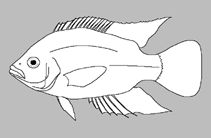
分類 / 名前 共通名の | 類義語 | Catalog of Fishes(部類, 種) | ITIS | CoL | WoRMS | Cloffa
> Cichliformes (Cichlids, convict blennies) > Cichlidae (Cichlids) > Cichlinae
Etymology: Crenicichla: Latin, crenulatus = cut, clipped + Greek, kichle = wrasse (Ref. 45335); taikyra: The specific name is derived from Guaraní words tãi (tooth) and kyra (thick), in reference to the thick molariform teeth and the stout lower pharyngeal tooth plate of the species.
Etymology: Crenicichla: Latin, crenulatus = cut, clipped + Greek, kichle = wrasse (Ref. 45335); taikyra: The specific name is derived from Guaraní words tãi (tooth) and kyra (thick), in reference to the thick molariform teeth and the stout lower pharyngeal tooth plate of the species.
環境:環境 / 気候帯 / 深さの範囲 / 分布範囲 生態学
; 新鮮な水 底生の漂泳性; pH range: 7.1 - ?. Subtropical; 25°C - ? (Ref. 94256)
分布 領土 | 国連食糧農業機関の区域 | エコシステム | 事件 | 目的のマップ | 導入 | Faunafri
South America: middle río Paraná in Argentina.
サイズ / 重さ / 年齢
簡単な記述 検索表 | 形態学 | 形態計測学
背面の脊椎 (合計) : 20 - 22; 背鰭 (合計) : 10 - 12; 臀鰭: 10 - 11; 脊つい: 35 - 36. Distinguished from all congeners except Crenicichla jurubi, C. semifasciata, and C. yaha by its stout lower pharyngeal tooth plate with molariform teeth (vs. slender pharyngeal tooth plate without molariform teeth). Differs from C. jurubi in having a serrated preopercle (vs. smooth), a well developed suborbital stripe (vs. absent or reduced to a spot at margin of orbit), and lacking scattered dots on back and sides (vs. presence); from C. semifasciata in having an ascending arm of the premaxilla longer (vs. shorter than the dentigerous one), caudal fins subtruncated (vs. deeply rounded), caudal fin scaled only on its basal third (vs. mostly scaled), caudal spot without light ring (vs. caudal spot surrounded by a silvery or orange ring), and a narrower interorbital width (17.1-23.3% vs. 32.0-40.0% of HL); and from C. yaha by having a stouter lower pharyngeal tooth plate with about 16 molariform teeth (vs. about 4 molariform teeth), and absence of microbranchiospines on gill arches (vs. presence).
Differs further from other species inhabiting the rio Parana basin by the following characters: from C. iguassuensis and C. tesay) in having isognathous jaws (vs. lower jaw prognathous); from C. hu in having a color pattern with a gray or olive green background (vs. dark brown to black), and E1 row scales 54-60 (vs. 47-54 ); from C. mandelburgeri in having more scales in E1 row scales (54-60 vs. 44-56), jaws isognathous (vs. lower jaws prognathous), and absence of lateral band in adults (vs. presence); from C. ypo in having isognathous jaws and blotches on flanks placed below the upper lateral line (vs. lower jaw slightly prognathous and the blotches are extending 3 to 4 scale rows above and below lateral line); and from C. haroldo by lacking brown dots on each lateral line scale and lateral band on flanks (vs. present in C. haroldoi). The absence of a lateral band separates C. taikyra from C. jaguarensis. Crenicichla jupiaensis can be diagnosed from C. taikyra in having the suborbital stripe reduced to a few spots posterior to the orbit, a thin black line on the posterior margin of preoperculum, cheek naked, and numerous vertical stripes. Crenicichla lepidota and C. britskii have a humeral spot (vs. absent in C. taikyra). Crenicichla scottii has parallel and thin longitudinal bands and C. gillmorlisi has small dark dots all over the sides, features not present in C. taikyra. Crenicichla vittata has 78-85 in E1 row scales, lateral band, and a particular color pattern on top of the head forming a crown design whereas C. taikyra has 54-60 E1 row scales, absence of lateral band, and the pattern of pigmentation on head described above (Ref. 94256).
Body shape (shape guide): fusiform / normal.
Body shape (shape guide): fusiform / normal.
Inhabits stony environment with Secchi disk 212 mm, water temperature 25.1°C, pH 7.14, conductivity 51.4 μS cm-1, dissolved oxygen 99.7% saturation, and alkalinity 9.0 mg l-1.. Stomach contents of two specimens contained snails (Potamolithus sp. and Limnoperna fortunei) and remains of fishes (Ref. 94256).
ライフサイクルと交尾行動 成熟 | 繁殖 | 放精 | 卵 | 生産力 | 幼生
主な参考文献
参考文献のアップロード | 参考文献 | コーディネーター : Kullander, Sven O. | 協力者
Casciotta, J., Aichino, D. Almirón, S. Gómez, L. Piálek and O. Řičan, 2013. Crenicichla taikyra (Teleostei: Cichlidae), a new species of pike cichlid from the middle río Paraná, Argentina. Zootaxa 3721(4):379-386. (Ref. 94256)
CITES
Not Evaluated
人間に対する脅威
Harmless
人間の用途
FAO - Publication: search | FishSource |
より多くの情報
ライフサイクル
繁殖
成熟
成熟度/エラ
生産力
放精
産卵群
卵
卵の開発
幼生
幼生の動力
繁殖
成熟
成熟度/エラ
生産力
放精
産卵群
卵
卵の開発
幼生
幼生の動力
解剖学
カマ
脳
オトリス
カマ
脳
オトリス
生理学
体組成
栄養素
酸素消費
水泳タイプ
泳ぐ速さ
視覚色素
フィッシュ・サウンド
病気と寄生虫
毒性(LC50)
体組成
栄養素
酸素消費
水泳タイプ
泳ぐ速さ
視覚色素
フィッシュ・サウンド
病気と寄生虫
毒性(LC50)
遺伝子の
ゲノム
遺伝子の
ヘテロ接合性
遺伝
遺伝的多様性
ゲノム
遺伝子の
ヘテロ接合性
遺伝
遺伝的多様性
用具
特記事項
XMLをダウンロードして下さい
インターネットの情報源
AFORO (otoliths) | Aquatic Commons | BHL | Cloffa | Websites from users | Check FishWatcher | CISTI | Catalog of Fishes: 部類, 種 | DiscoverLife | ECOTOX | FAO - Publication: search | Faunafri | Fishipedia | Fishtrace | GloBI | Google Books | Google Scholar | Google | IGFA World Record | OneZoom | Open Tree of Life | Otolith Atlas of Taiwan Fishes | PubMed | Reef Life Survey | Socotra Atlas | TreeBase | 生命の木 | Wikipedia: 行く, 検索する | World Records Freshwater Fishing | Zoobank | 動物に関する記録
モデルに基づく推定値
系統多様性指数 (参照 82804): PD50 = 0.5000 [Uniqueness, from 0.5 = low to 2.0 = high].
Bayesian length-weight: a=0.01445 (0.00665 - 0.03141), b=3.08 (2.90 - 3.26), in cm total length, based on LWR estimates for this (Sub)family-body shape (Ref. 93245).
栄養段階 (参照 69278): 3.2 ±0.5 se; based on size and trophs of closest relatives
回復力 (参照 120179): 高い, 15か月以下の倍増期間の最小個体群 (Preliminary K or Fecundity.).