This website uses cookies to enhance your browsing experience and ensure the functionality of our site. For more detailed information about the types of cookies we use and how we protect your privacy, please visit our Privacy Information page.
×
Cookie Settings
This website uses different types of cookies to enhance your experience. Please select your preferences below:
> Cyprinodontiformes (Rivulines, killifishes and live bearers) > Aphaniidae (Oriental killifishes)
Etymology: Aphaniops:Aphanius-opsis, resembling Aphanius; furcatus:The specific name furcatus refers to its slightly forked caudal fin that is unique in Aphanius species.
Environnement : milieu / zone climatique / profondeur / gamme de distribution Écologie
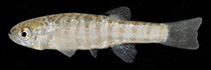
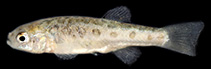
Rayons mous dorsaux (Total) : 9 - 12; Rayons mous anaux: 9 - 11; Vertèbres: 26 - 27. Distinguished from all other species of Aphanius by the following combination of characters: completely without scales; caudal fin slightly forked; males with dark pigmentation at the base of the four anterior dorsal rays; single row of tricuspid teeth with the two lateral cusps shorter than the middle one; rounded otolith with short rostrum and antirostrum of almost equal length; reduction in biomineralization of caudal skeleton such as thin epural bone; 157 (vs. A. dispar) and 170 (vs. A. ginaonis) molecular characters in the 12S mt-DNA and tRNA-Val (Ref. 96446).
Body shape (shape guide): fusiform / normal.
Inhabits rivers and springs that are often seasonal and characterized by shallow water and white layers of salt around and within the river. Often dominates on the riversides, where the water is shallow, warm and water flow is slow. Sympatric with Aphanius dispar (Ref. 96446).
Cycle de vie et comportement reproducteur Maturité | Reproduction | Frai | Œufs | Fécondité | Larves
Freyhof, J. and B. Yoğurtçuoğlu, 2020. A proposal for a new generic structure of the killifish family Aphaniidae, with the description of Aphaniops teimorii (Teleostei: Cyprinodontiformes). Zootaxa 4810(3):421-451. (Ref. 126233)
Statut dans la liste rouge de l'IUCN (Ref. 130435: Version 2025-2 (Global))
Dynamique des populations Paramètres de croissance Âges / tailles maximales Longueur-poids rel. Rel. longueur-longueur. Fréquences de longueurs Conversion de masse Recrutement Abondance
Cycle de vie Reproduction Maturité Maturité/épines rel. Fécondité Frai Agrégats de frai Œufs Développement de l'œuf Larves Dynamique des populations larvaires
Physiologie Composition corporelle Nutriments Consommation d'oxygène Type de natation Vitesse de nage Pigments visuels Son de poisson Maladies et parasites Toxicité (CL50)