



Liopropoma olneyi Baldwin & Johnson, 2014
Yellow-spotted golden bass
Ajouter votre observation dans Fish Watcher
| Native range | All suitable habitat | Point map | Year 2050 |

|
| This map was computer-generated and has not yet been reviewed. |
| Liopropoma olneyi AquaMaps Data sources: GBIF OBIS |
Envoyez vos Photos et vidéos
Images Google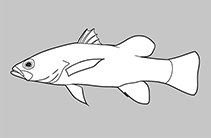 No image available for this species;
drawing shows typical species in Liopropomatidae.
Images Google
drawing shows typical species in Liopropomatidae.
Classification / Noms Noms communs | Synonymes | Catalog of Fishes(Genre, Espèce) | ITIS | CoL | WoRMS | Cloffa
> Perciformes/Serranoidei (Groupers) > Liopropomatidae (Painted basslets) > Liopropomatinae
Etymology: Liopropoma: Greek, leio = smooth + Greek, pro = in front of + Greek, poma, -atos = cover, operculum (Ref. 45335); olneyi: Named for John E. Olney.
Eponymy: John Edward Olney Sr (1947–2010) was an American ichthyologist, fisheries biologist and naturalist who worked at the Virginia Institute of Marine Science. [...] (Ref. 128868), visit book page.
Etymology: Liopropoma: Greek, leio = smooth + Greek, pro = in front of + Greek, poma, -atos = cover, operculum (Ref. 45335); olneyi: Named for John E. Olney.
Eponymy: John Edward Olney Sr (1947–2010) was an American ichthyologist, fisheries biologist and naturalist who worked at the Virginia Institute of Marine Science. [...] (Ref. 128868), visit book page.
Environnement : milieu / zone climatique / profondeur / gamme de distribution Écologie
marin pelagic-neritic; profondeur 123 - 220 m (Ref. 95863). Tropical
Distribution Territoires | Zones FAO | Écosystèmes | Occurrences | Carte par point | Introductions | Faunafri
Caribbean: adults are known from images and specimens from Curaçao. Larvae are known from the Florida Straits and Gulf of Mexico.
Taille / Poids / Âge
Description synthétique Clés d'identification | Morphologie | Morphométrie
Épines dorsales (Total) : 9; Rayons mous dorsaux (Total) : 11; Épines anales: 3; Rayons mous anaux: 8; Vertèbres: 24. This liopropomin serranid is distinguished by the following set of adult and larval characters: D IX,11; A III, 8; pectoral fin 14-15; in adults - lateral-line scales 46-48, length of first dorsal spine 4.5% SL; margin of spinous dorsal fin shallowly indented posteriorly (fourth spine 9.7-12% SL, fifth spine only slightly shorter than fourth, 8.3-9.3% SL, and sixth-ninth spines approximately subequal, 5.5–8.9% SL); in larvae, second-eighth spines elongate, 57.1-150% SL; body of adults slender, depth at dorsal-fin origin 23% SL and the least caudal-peduncle depth is 13-15% SL. Predominant color of adults when alive is yellow; yellow covering dorsal portion of trunk, in stripe from tip of upper jaw to posterior edge of operculum and in narrower broken stripe from ventral edge of orbit to posterior edge of operculum, on dorsal and caudal fins, and in stripe on anal fin; top of head is dark rose/orange, ventral portions of head and trunk pale rose to white; dorsal and ventral portions of trunk with scattered yellow spots. When preserved in alcohol, the head and trunk uniformly pale, slightly paler on abdomen and throat. Larvae has a conspicuous pattern of orange chromatophores in life on head and trunk, orange pigment on elongate second dorsal-fin spine associated with swellings in sheath covering spine, several orange blotches on anal-fin rays, large blotch of orange pigment covering most of pelvic fin, and melanophores on spinous dorsal fin (Ref. 95863).
Body shape (shape guide): fusiform / normal; Cross section: compressed.
Body shape (shape guide): fusiform / normal; Cross section: compressed.
Collected from rocky slopes and ledges. When threatened, it retreats into small caves and crevices. Larva from Florida Straits was captured between 25 and 50 m (Ref. 95863).
Cycle de vie et comportement reproducteur Maturité | Reproduction | Frai | Œufs | Fécondité | Larves
Référence principale
Téléchargez vos références | Références | Coordinateur | Collaborateurs
Baldwin, C. and G.D. Johnson, 2014. Connectivity across the Caribbean Sea: DNA barcoding and morphology unite an enigmatic fish larva from the Florida Straits with a new species of sea bass from deep reefs off Curaçao. PLoS ONE 9(5):e97661. (Ref. 95863)
Statut dans la liste rouge de l'IUCN (Ref. 130435: Version 2025-2 (Global))
Données manquantes (DD) ; Date assessed: 10 September 2014
CITES
Not Evaluated
Menace pour l'homme
Harmless
Utilisations par l'homme
FAO - Publication: search | FishSource |
Plus d'informations
Écologie trophique
Aliments (proies)
Composition du régime alimentaire
Consommation alimentaire
Rations alimentaires
Prédateurs
Aliments (proies)
Composition du régime alimentaire
Consommation alimentaire
Rations alimentaires
Prédateurs
Écologie
Écologie
Écologie
Dynamique des populations
Paramètres de croissance
Âges / tailles maximales
Longueur-poids rel.
Rel. longueur-longueur.
Fréquences de longueurs
Conversion de masse
Recrutement
Abondance
Paramètres de croissance
Âges / tailles maximales
Longueur-poids rel.
Rel. longueur-longueur.
Fréquences de longueurs
Conversion de masse
Recrutement
Abondance
Cycle de vie
Reproduction
Maturité
Maturité/épines rel.
Fécondité
Frai
Agrégats de frai
Œufs
Développement de l'œuf
Larves
Dynamique des populations larvaires
Reproduction
Maturité
Maturité/épines rel.
Fécondité
Frai
Agrégats de frai
Œufs
Développement de l'œuf
Larves
Dynamique des populations larvaires
Anatomie
Surface branchiale
Cerveau
Otolithe
Surface branchiale
Cerveau
Otolithe
Physiologie
Composition corporelle
Nutriments
Consommation d'oxygène
Type de natation
Vitesse de nage
Pigments visuels
Son de poisson
Maladies et parasites
Toxicité (CL50)
Composition corporelle
Nutriments
Consommation d'oxygène
Type de natation
Vitesse de nage
Pigments visuels
Son de poisson
Maladies et parasites
Toxicité (CL50)
Génétique
génôme
Génétique
Hétérozygotie
Héritabilité
Diversité génétique
génôme
Génétique
Hétérozygotie
Héritabilité
Diversité génétique
Liées à l'homme
Systèmes d'aquaculture
Profils d'aquaculture
Souches
Cas de ciguatera
Timbres, pièces de monnaie, divers
Systèmes d'aquaculture
Profils d'aquaculture
Souches
Cas de ciguatera
Timbres, pièces de monnaie, divers
Outils
E-book | Guide de terrain | Générateur de fréquences de longueur | Outil de dynamique de population | Carte par point |
Capture-MSY |
Articles particuliers
Télécharger en XML
Sources Internet
AFORO (otoliths) | Aquatic Commons | BHL | Cloffa | Websites from users | FishWatcher | CISTI | Catalog of Fishes: Genre, Espèce | DiscoverLife | ECOTOX | FAO - Publication: search | Faunafri | Fishipedia | Fishtrace | GloBI | Google Books | Google Scholar | Google | IGFA World Record | OneZoom | Open Tree of Life | Otolith Atlas of Taiwan Fishes | PubMed | Reef Life Survey | Socotra Atlas | TreeBase | Arbre de Vie | Wikipedia: aller à, chercher | World Records Freshwater Fishing | Zoobank | Zoological Record
Estimations basées sur des modèles
Température préférée (Réf. 123201): 19.7 - 23.7, mean 21.4 °C (based on 7 cells).
Indice de diversité phylogénétique (Réf. 82804): PD50 = 0.5000 [Uniqueness, from 0.5 = low to 2.0 = high].
Bayesian length-weight: a=0.01122 (0.00514 - 0.02450), b=3.04 (2.87 - 3.21), in cm total length, based on all LWR estimates for this body shape (Ref. 93245).
Niveau trophique (Réf. 69278): 3.7 ±0.6 se; based on size and trophs of closest relatives