



Acanthopagrus sheim Iwatsuki, 2013
Spotted yellowfin seabream
Hochladen Photos und videos
Bilder | Google Bild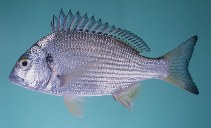 Acanthopagrus sheim
Photo von Randall, J.E.
Bilder | Google Bild
Photo von Randall, J.E.
Klassifizierung / Names Namen | Synonyme | Catalog of Fishes(Gattung, Arten) | ITIS | CoL | WoRMS | Cloffa
> Eupercaria/misc (Various families in series Eupercaria) > Sparidae (Porgies)
Etymology: Acanthopagrus: Greek, akantha = thorn + Greek, pagros, a kind of fish (Ref. 45335); sheim: Named after the local Arabic name Sheim.
Etymology: Acanthopagrus: Greek, akantha = thorn + Greek, pagros, a kind of fish (Ref. 45335); sheim: Named after the local Arabic name Sheim.
Umwelt: Milieu / Klimazone / Tiefenbereich / Verbreitungsgebiet Ökologie
seewasser demersal. Tropical
Verbreitung Territorien | FAO Gebiete | Ökosysteme | Vorkommen | Punkt Karte | Einführungen | Faunafri
Western Indian Ocean: Persian Gulf.
Größe / Gewicht / Alter
Kurzbeschreibung Bestimmungsschlüssel | Morphologie | Morphometrie
Rückenflossenstacheln (insgesamt) : 11 - 12; Rückenflossenweichstrahlen (insgesamt) : 10 - 11; Afterflossenstacheln: 3; Afterflossenweichstrahlen: 8. This species is characterized by the following: body relatively deep, 2.11-2.40 (mean 2.22); D XI,11 (rarely XII,10 or XI,10); scale rows between fifth dorsal-fin spine base and lateral line 4.5 ; scale rows above lateral line 5.5, below 11.5 or 12.5; second anal-fin spine strong [14.7-20.7% (mean 17.8%) of SL], 1.10-1.46 (mean 1.30) in 2AS/3AS; pored lateral-line scales 43-47 (mean 45.4); first soft dorsal-fin ray slightly longer than last dorsal-fin spine. Colour of fins: pale or strong yellow to bright yellow pelvic, anal, and caudal fins, lower caudal-fin lobe strong yellow, usually with wide dense black posterior margin; black streaks usually observed from middle to lowest portions on inter-radial membranes between yellow anal-fin rays, even in preserved specimens; two black blotches (rarely three irregular blotches) on lower inter-radial membranes between dorsal-fin rays; conspicuous diffuse dark blotch at origin of lateral line (covering first and second pored lateral line scales), continuing as dense blackish shading over upper cleithrum and upper part of posterior opercle. Strong diagnostic characteristics of this species are the presence of two black blotches (rarely 3) on the inter-radial membranes between the dorsal-fin rays, and wide dense black posterior margin (Ref. 93743).
Body shape (shape guide): short and / or deep; Cross section: compressed.
Body shape (shape guide): short and / or deep; Cross section: compressed.
Lebenszyklus und Paarungsverhalten Geschlechtsreife | Fortpflanzung | Ablaichen | Eier | Fruchtbarkeit | Larven
Hauptreferenz
Laden Sie Ihre Referenzen hoch | Referenzen | Koordinator | Partner
Iwatsuki, Y., 2013. Review of the Acanthopagrus latus complex (Perciformes: Sparidae) with descriptions of three new species from the Indo-West Pacific Ocean. J. Fish Biol. 83(1):64-95. (Ref. 93743)
IUCN Rote Liste Status (Ref. 130435: Version 2025-2 (Global))
nicht bedroht (LC) ; Date assessed: 17 March 2014
CITES
Not Evaluated
Bedrohung für Menschen
Harmless
Nutzung durch Menschen
Fischereien: kommerziell
FAO - Publication: search | FishSource |
Mehr Information
Trophische Ökologie
Lebensmittel (Beutetiere)
Nahrungszusammensetzung
Nahrungsaufnahme
Lebensmittelrationen
Räuber
Lebensmittel (Beutetiere)
Nahrungszusammensetzung
Nahrungsaufnahme
Lebensmittelrationen
Räuber
Ökologie
Ökologie
Ökologie
Populationsdynamik
Wachstumsparameter
Max. Alter/Größen
Länge-Gewicht-Rel.
Länge-Länge-Verhältnis.
Längenhäufigkeiten
Massenkonvertierung
Rekrutierung
Dichte
Wachstumsparameter
Max. Alter/Größen
Länge-Gewicht-Rel.
Länge-Länge-Verhältnis.
Längenhäufigkeiten
Massenkonvertierung
Rekrutierung
Dichte
Lebenszyklus
Fortpflanzung
Geschlechtsreife
Reifung/Kiemen rel.
Fruchtbarkeit
Ablaichen
Laichaggregationen
Eier
Eientwicklung
Larven
Larven Pop.Dyn.
Fortpflanzung
Geschlechtsreife
Reifung/Kiemen rel.
Fruchtbarkeit
Ablaichen
Laichaggregationen
Eier
Eientwicklung
Larven
Larven Pop.Dyn.
Anatomie
Kiemenoberfläche
Gehirn
Otolith
Kiemenoberfläche
Gehirn
Otolith
Physiologie
Körperliche Zusammensetzung
Nährstoffe
Sauerstoffverbrauch
Schwimmart
Schwimmgeschwindigkeit
Visuelle Pigmente
Fischgeräusche
Krankheiten und Parasiten
Toxizität (LC50s)
Körperliche Zusammensetzung
Nährstoffe
Sauerstoffverbrauch
Schwimmart
Schwimmgeschwindigkeit
Visuelle Pigmente
Fischgeräusche
Krankheiten und Parasiten
Toxizität (LC50s)
Genetik
Genom
Genetik
Heterozygotie
Vererbbarkeit
Genetische Vielfalt
Genom
Genetik
Heterozygotie
Vererbbarkeit
Genetische Vielfalt
Menschenbezogen
Aquakultur-Systeme
Aquakultur Profile
Zuchtlinien
Ciguatera-Fälle
Briefmarken, Münzen, Verschiedenes.
Aquakultur-Systeme
Aquakultur Profile
Zuchtlinien
Ciguatera-Fälle
Briefmarken, Münzen, Verschiedenes.
Tools
Zusatzinformationen
Download XML
Zusammenfassung | Punktdaten | Namen | Photos
Internet Quellen
AFORO (otoliths) | Aquatic Commons | BHL | Cloffa | Websites from users | FishWatcher Einträge suchen | CISTI | Catalog of Fishes: Gattung, Arten | DiscoverLife | ECOTOX | FAO - Publication: search | Faunafri | Fishipedia | Fishtrace | GloBI | Google Books | Google Scholar | Google | IGFA World Record | OneZoom | Open Tree of Life | Otolith Atlas of Taiwan Fishes | PubMed | Reef Life Survey | Socotra Atlas | TreeBase | Tree of Life | Wikipedia: Gehe zu, Suchen | World Records Freshwater Fishing | Zoobank | Zoologischer Rekord
Schätzungen auf der Grundlage von Modellen
Phylogenetischer Diversitätsindex (Ref. 82804): PD50 = 0.5000 [Uniqueness, from 0.5 = low to 2.0 = high].
Bayesian length-weight: a=0.01995 (0.00886 - 0.04496), b=2.97 (2.80 - 3.14), in cm total length, based on LWR estimates for this Genus-body shape (Ref. 93245).
Trophische Ebene (Ref. 69278): 3.4 ±0.4 se; based on size and trophs of closest relatives
Widerstandsfähigkeit (Ref. 120179): mittel, Verdopplung der Population dauert 1,4 - 4,4 Jahre. (Preliminary K or Fecundity.).