This website uses cookies to enhance your browsing experience and ensure the functionality of our site. For more detailed information about the types of cookies we use and how we protect your privacy, please visit our Privacy Information page.
×
Cookie Settings
This website uses different types of cookies to enhance your experience. Please select your preferences below:
> Gobiiformes (Gobies) > Gobiidae (Gobies) > Gobiinae
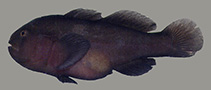
Etymology: Gobiodon:Latin, gobius = gudgeon + Greek, odous = teeth (Ref. 45335); ater:Named for its uniformly black life colouration, including the eye; from the Latin words 'ater' for black.
Entorno: milieu / zona climática / rango de profundidad / gama de distribución Ecología
Madurez: Lm? range ? - ? cm Max length : 2.7 cm SL macho / no sexado; (Ref. 94082)
Descripción breve Claves de identificación | Morfología | Morfometría
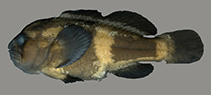
Espinas dorsales (total) : 7; Radios blandos dorsales (total) : 10; Espinas anales: 1; Radios blandos anales: 8. This species is distinguished by the following characters: D VI+I,10; A I,8; head and body are naked; presence of a deep curved groove on isthmus; body and caudal peduncle slender (depth 37-41.2% and 13.8-14.7% SL, respectively); juveniles with rounded head, large adults slightly hump-headed; colour in juveniles and adults uniformly black, including iris; very small species (< 2.8 cm SL); females of breeding pairs usually significantly larger than males, recorded smallest highly gravid female is 1.85 cm SL (Ref. 94082). Body shape (shape guide): short and / or deep; Cross section: compressed.
Facultative air-breathing in the genus (Ref. 126274); This species is found in shallow water regions such as protected reef flats and reef crests. It is highly specialized and prefers fine-branched corals such as Acropora selago and small tabulate colonies of Acropora hyacinthus. Seldom occurs in other Acropora species, such as A. acuminata, A. samoensis, A. eurystoma and A. valida. Due to its black colouration it is sometimes difficult to detect within the dark interstices of narrow-branched Acropora colonies (Ref. 94082).
Ciclo vital y comportamiento de apareamiento Madurez | Reproducción | Puesta | Huevos | Fecundidad | Larva
Herler, J., S.V. Bogorodsky and T. Suzuki, 2013. Four new species of coral gobies (Teleostei: Gobiidae: Gobiodon), with comments on their relationships within the genus. Zootaxa 3709(4):301-329. (Ref. 94082)
Situación en la Lista Roja de la UICN (Ref. 130435: Version 2025-2 (Global))
Ecología Trófica Alimentos (presas) Composición de la dieta consumo de alimento Raciones de comida Despredadores
Ecología Ecología
Dinámica de la población Coeficiente del crecimiento para Edades / tallas máximas Longitud-peso rel. Longitud-longitud rel. Longitud-frecuencias Conversión de masas Reclutamiento Abundancia
Ciclo de vida Reproducción Madurez Madurez/Gills rel. Fecundidad Puesta Agregaciones de desove Huevos Desarrollo de los huevos Larva Dinámica larvaria
Fisiología Composición corporal Nutrientes Consumo del oxígeno Tipo de natación Velocidad de natación Pigmentos visuales Sonido de peces Enfermedades y parásitos Toxicidad (CL50)
Temperatura preferida (Referencia 123201): 24.9 - 27.2, mean 26.7 °C (based on 18 cells).
Índice de diversidad filogenética (Referencia 82804): PD50 = 0.5000 [Uniqueness, from 0.5 = low to 2.0 = high].
Bayesian length-weight: a=0.01995 (0.00906 - 0.04395), b=3.01 (2.83 - 3.19), in cm total length, based on all LWR estimates for this body shape (Ref. 93245).
Nivel trófico (Referencia 69278): 3.2 ±0.4 se; based on size and trophs of closest relatives
Resiliencia (Referencia 120179): Alto, población duplicada en un tiempo mínimo inferior a 15 meses (Preliminary K or Fecundity.).
Vulnerabilidad pesquera (Ref. 59153): Low vulnerability (10 of 100). 🛈