This website uses cookies to enhance your browsing experience and ensure the functionality of our site. For more detailed information about the types of cookies we use and how we protect your privacy, please visit our Privacy Information page.
×
Cookie Settings
This website uses different types of cookies to enhance your experience. Please select your preferences below:
Classificação / Nomes Nomes comuns | Sinônimos | Catalog of Fishes(Gênero, Espécies) | ITIS | CoL | WoRMS | Cloffa
> Gymnotiformes (Knifefishes) > Sternopygidae (Glass knifefishes) > Eigenmanninae
Etymology: Archolaemus:Greek, archo = anus + Greek, laimos = throat (Ref. 45335); luciae:Named for Lucia Py-Daniel of the Instituto Nacional de Pesquisas da Amazônia, in recognition of her many contributions to the knowledge of the fishes of the Amazon and her assistance to the authors over the years. Eponymy: Dr Lúcia Helena Rapp Py-Daniel is a Brazilian ichthyologist. (See Py-Daniel) (Ref. 128868), visit book page.
Meio ambiente: milieu / Zona climática / intervalo de profundidade / faixa de distribuição Ecologia
South America: Rio Jari, Rio Trombetas and Rio Tapajós basins in eastern Amazon; Rio Araguari, Brazil.
Tamanho / Peso / Idade
Maturidade: Lm? range ? - ? cm Max length : 49.7 cm TL macho/indeterminado; (Ref. 93148)
Descrição suscinta Chaves de identificação | Morfologia | Morfometria
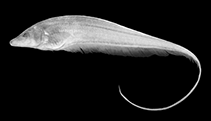
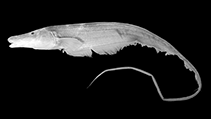
Raios anais : 192 - 213. Distinguished by having the following combination of characters: depth of the caudal filament 3.3-4.8% CL; length of the caudal filament 28.6-46.1% LEA; length of the coronomeckelian bone 50% or more the length of Meckel’s cartilage; length of the posterior ceratohyal approximately the same length as the ventral hypohyal; gape relatively long and the rictus extending posteriorly beyond the vertical through the posterior naris; teeth between seven and ten irregularly distributed on the internal surface of the endopterygoid; anteroposterior length of premaxilla greater than the transverse width; teeth on the dentary restricted to the anterior one-half or slightly more of the dorsal margin; presence of a narrow dark stripe along the lateral line and a broad band of dusky to dark pigmentation overlying the basal pterygiophores of the anal fin; 19-21 pectoral-fin rays; and 192-213 anal-fin rays (Ref. 93148).
Body shape (shape guide): elongated.
Occurs in swift-flowing water habitats. Also found in main stream of shallow rapids and
small waterfalls, always over a rocky bottom (Ref. 93418).
Ciclo de vida ou comportamento de acasalamento Maturidade | Reprodução | Desova | Ovos | Fecundidade | Larvas
Vari, R.P., C.D. de Santana and W.B. Wosiacki, 2012. South American electric knifefishes of the genus Archolaemus (Ostariophysi, Gymnotiformes): undetected diversity in a clade of rheophiles. Zoological Journal of the Linnaean Society 165:670-699. (Ref. 93148)
Status na Lista Vermelha da UICN (Ref. 130435: Version 2025-2 (Global))
Ecologia Trófica Itens alimentares (presas) Composição da dieta Consumo alimentar Rações alimentares Predadores
Ecologia Ecologia
Dinâmica populacional Parâmetros de crescimento Idade máxima / tamanhos Relação comprimento-peso. Relação comprimento-comprimento. Frequências de comprimento Conversão de massa Recrutamento Abundância
Ciclo de vida Reprodução Maturidade Maturidade/Rel. das guelras Fecundidade Desova Agregações de desova Ovos Desenvolvimento dos ovos Larvas Dinâmica larval
Fisiologia Composição corporal Nutrientes Consumo de oxigênio Tipo de natação Velocidade de natação Pigmentos visuais Som de peixe Doenças e Parasitas Toxicidade (LC50s)