



Nothonotus starnesi Keck & Near, 2013
Caney fork darter
muatnaik fotos/gambar dan video
imej Google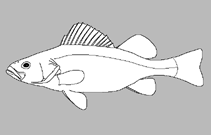 No image available for this species;
drawing shows typical species in Percidae.
imej Google
drawing shows typical species in Percidae.
klasifikasi / Nama Nama-nama umum | Sinonim (persamaan) | Catalog of Fishes(Marga, Jenis) | ITIS | CoL | WoRMS | Cloffa
> Perciformes/Percoidei (Perchs) > Percidae (Perches) > Etheostomatinae
Etymology: starnesi: Named for ichthyologist Wayne C. Starnes, Curator of Fishes and Director of the Research Lab at the North Carolina Museum of Natural Sciences.
Eponymy: Dr Wayne C Starnes is a zoologist interested in evolutionary biology, systematics and genetics. [...] (Ref. 128868), visit book page.
Etymology: starnesi: Named for ichthyologist Wayne C. Starnes, Curator of Fishes and Director of the Research Lab at the North Carolina Museum of Natural Sciences.
Eponymy: Dr Wayne C Starnes is a zoologist interested in evolutionary biology, systematics and genetics. [...] (Ref. 128868), visit book page.
Lingkungan: lingkungan / zona iklim / kisaran kedalaman / jangkauan distribusi Ekologi
; air tawar bentopelagis. Subtropical
Penyebaran Wilayah | Daerah-daerah FAO | Ekosistem | Kemunculan | peta titik | Introduksi | Faunafri
North America: USA.
Panjang pada saat jatuh tempo pertama / Ukuran / Berat / umur
deskripsi pendek Kunci identifiaksi (pengenalan) | Morfologi | Morfometrik
Duri punggung (Keseluruhan (total)) : 12 - 14; duri punggung lunak (Keseluruhan (total)) : 10 - 13; Duri dubur: 2; Sirip dubur lunak: 7 - 9. This species belonging to the N. maculatus species group have scales associated with the postorbital spot on the cheek and show breeding behavior in which males guard clumps of eggs in crevices under rocks (vs. having a completely unscaled cheek and burying clumps of eggs in substrate with no subsequent care in all other species of Nothonotus<>). Within the species group, N. starnesi and N. sanguifluus differs from all other species on the basis of pigmentation patterns, males have red pigmentation covering a high proportion of all the median fins (vs. green median fins in N. wapiti and N. microlepidus; greenish blue anal and pelvic fins in N. vulneratus and N. maculatus); and, the presence of a suborbital bar (vs. absent in Nothonotus aquali). Male nuptial coloration of N. starnesi tends to have less-pronounced darkening of pigment at the base of the first three interradial membranes of the spinous dorsal fin and in the pelvic fins, has much more discrete and contrasting vermiculation on the head and cheek, and has more red in the pectoral fins when compared with N. sanguifluus. In addition, N. starnesi have lower mean numbers for pored lateral line scales, scales below the lateral line, and scales in the most ventral row of the opercle (Ref. 93269).
This species is found to be most abundant in the faster-flowing riffles of medium to large streams; substrate in these riffles is mostly large cobble and small boulders that is not embedded. Adults and juveniles are found in the same riffles, but smaller individuals tend to be more common near the banks of the streams. N. starnesi is expected to spawn in a manner similar to other members of the N. maculatus species group, with the males guarding a nest site under a larger cobble in fast current and eggs deposited in a clump in the crevice under the cobble. During the dryer, summer months, the surface flow of several eastern Caney Fork tributaries flowing over the more karst-like areas completely disappears, creating a series of isolated pools with little or no observable current. During these times, the species have only been observed in patches of silt-free substrate along the margins of the pool, presumably indicating areas of subsurface water upwelling. Gravid females are observed from May through July (Ref. 93269).
Siklus hidup dan perilaku kawin Kematangan | Reproduksi, perkembang biakan | Pemijahan | telur-telur | Fekunditas | Larva
rujukan utama
Unggah referensi Anda | Acuan | Koordinator | mitra
Keck, B.P. and T.J. Near, 2013. A new species of Nothonotus Darter (Teleostei: Percidae) from the Caney Fork in Tennessee, USA. Bulletin of the Peabody Museum of Natural History 54(1):3-21. (Ref. 93269)
CITES
Not Evaluated
ancaman kepada manusia
Harmless
penggunaan manusia
FAO - Publication: search | FishSource |
informasi lanjut
Ekologi trofik
Item makanan (mangsa)
Komposisi makanan
Konsumsi makanan
Ransum makanan
Pemangsa
Item makanan (mangsa)
Komposisi makanan
Konsumsi makanan
Ransum makanan
Pemangsa
Ekologi
Ekologi
Ekologi
Dinamika populasi
Parameter pertumbuhan
Maks. usia / ukuran
Panjang-berat rel.
Panjang-panjang rel.
ukuran frekuensi
Konversi massa
pemulihan
Kelimpahan
Parameter pertumbuhan
Maks. usia / ukuran
Panjang-berat rel.
Panjang-panjang rel.
ukuran frekuensi
Konversi massa
pemulihan
Kelimpahan
Siklus hidup
Reproduksi, perkembang biakan
Kematangan
Kedewasaan / insang rel.
Fekunditas
Pemijahan
Agregasi pemijahan
telur-telur
pekembangan telor
Larva
Dinamika larva
Reproduksi, perkembang biakan
Kematangan
Kedewasaan / insang rel.
Fekunditas
Pemijahan
Agregasi pemijahan
telur-telur
pekembangan telor
Larva
Dinamika larva
Anatomi
Area insang
Otak
Otolith
Area insang
Otak
Otolith
Fisiologi
Komposisi tubuh
Nutrisi
Konsumsi oksigen
Jenis renang
Kecepatan berenang
Pigmen visual
Suara ikan
Penyakit & Parasit
Toksisitas (LC50)
Komposisi tubuh
Nutrisi
Konsumsi oksigen
Jenis renang
Kecepatan berenang
Pigmen visual
Suara ikan
Penyakit & Parasit
Toksisitas (LC50)
Genetika
genom
Genetika
Heterozigositas
Diturunkan
Keanekaragaman Genetik
genom
Genetika
Heterozigositas
Diturunkan
Keanekaragaman Genetik
Yang berhubungan dengan manusia
Sistem akuakultur
profil budidaya air
Strain
Kasus Ciguatera
Perangko, koin, dll.
Sistem akuakultur
profil budidaya air
Strain
Kasus Ciguatera
Perangko, koin, dll.
Alat, peralatan
E-book | Penuntun lapangan | tanda freqkuenci panjang | peringkat sejarah hidup | peta titik |
Tangkap-MSY |
laporan khas
muat turun XML
Sumber internet
AFORO (otoliths) | Aquatic Commons | BHL | Cloffa | Websites from users | semak peneliti ikan | CISTI | Catalog of Fishes: Marga, Jenis | DiscoverLife | ECOTOX | FAO - Publication: search | Faunafri | Fishipedia | Fishtrace | GloBI | Google Books | Google Scholar | Google | IGFA World Record | OneZoom | Open Tree of Life | Otolith Atlas of Taiwan Fishes | PubMed | Reef Life Survey | Socotra Atlas | TreeBase | Tree of Life | Wikipedia: pergi, Cari | World Records Freshwater Fishing | Zoobank | Catatan Zoologi
Estimasi berdasarkan model
Indeks keanekaragaman filogenetik (Acuan 82804): PD50 = 0.5625 [Uniqueness, from 0.5 = low to 2.0 = high].
Bayesian length-weight: a=0.00575 (0.00268 - 0.01234), b=3.13 (2.95 - 3.31), in cm total length, based on LWR estimates for this (Sub)family-body shape (Ref. 93245).
Tingkat Trofik (Acuan 69278): 3.3 ±0.5 se; based on size and trophs of closest relatives
Daya lenting (Acuan 120179): Tinggi, Waktu penggandaan populasi minimum kurang dari 15 bulan (Preliminary K or Fecundity.).