



Puntigrus navjotsodhii (Tan, 2012)
Hochladen Photos und videos
Google Bild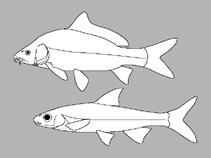 No image available for this species;
drawing shows typical species in Cyprinidae.
Google Bild
drawing shows typical species in Cyprinidae.
Klassifizierung / Names Namen | Synonyme | Catalog of Fishes(Gattung, Arten) | ITIS | CoL | WoRMS | Cloffa
> Cypriniformes (Carps) > Cyprinidae (Minnows or carps) > Smiliogastrinae
Etymology: Puntigrus: Name combination of Puntius and tigrus, sound like the Latin word 'tigris' for tiger; an allusion to the barred color pattern and the common name tiger barb often used for some species of this genus; navjotsodhii: Named for Professor Navjot S. Sodhi (1962-2011), for his inputs to conservation and ecological research in Southeast Asia and also for his considerable contributions and services to the editorship of the Raffles Bulletin of Zoology (as Editor-in-Chief from 1996 to 2001, Associate Editor from 2001 to 2005, and Editorial Board member from 2006 to 2011).
Eponymy: Dr Navjot Singh Sodhi (1962–2011) was an Indian-born tropical biologist, ecologist and conservationist with interests in ornithology, ichthyology and malacology. [...] (Ref. 128868), visit book page.
Etymology: Puntigrus: Name combination of Puntius and tigrus, sound like the Latin word 'tigris' for tiger; an allusion to the barred color pattern and the common name tiger barb often used for some species of this genus; navjotsodhii: Named for Professor Navjot S. Sodhi (1962-2011), for his inputs to conservation and ecological research in Southeast Asia and also for his considerable contributions and services to the editorship of the Raffles Bulletin of Zoology (as Editor-in-Chief from 1996 to 2001, Associate Editor from 2001 to 2005, and Editorial Board member from 2006 to 2011).
Eponymy: Dr Navjot Singh Sodhi (1962–2011) was an Indian-born tropical biologist, ecologist and conservationist with interests in ornithology, ichthyology and malacology. [...] (Ref. 128868), visit book page.
Umwelt: Milieu / Klimazone / Tiefenbereich / Verbreitungsgebiet Ökologie
; süßwasser benthopelagisch. Tropical
Verbreitung Territorien | FAO Gebiete | Ökosysteme | Vorkommen | Punkt Karte | Einführungen | Faunafri
Asia: upper Katingan and Barito river basins in Central Kalimantan, Borneo, Indonesia.
Größe / Gewicht / Alter
Kurzbeschreibung Bestimmungsschlüssel | Morphologie | Morphometrie
Can be diagnosed from Group 1 tiger barbs by the combination of the following
characters: presence of 4 broad, black bars (up to 5 scales wide), second and third bars distinctly curved posteriorly; dorsal fi n anterior ¾ black (anterior-most portion red in
life, whitish when preserved), posterior margin red in life, whitish when preserved; pelvic fi ns almost entirely red in life (whitish when preserved); upper and lower lips black; complete lateral line, lateral scale series 20-21 (all pored); deep body (body depth at dorsal-fi n origin 53.6-59.2% SL); and deep caudal peduncle (18.4-19.9% SL) (Ref. 90833).
Body shape (shape guide): short and / or deep.
Body shape (shape guide): short and / or deep.
Lebenszyklus und Paarungsverhalten Geschlechtsreife | Fortpflanzung | Ablaichen | Eier | Fruchtbarkeit | Larven
Hauptreferenz
Laden Sie Ihre Referenzen hoch | Referenzen | Koordinator | Partner
Tan, H.H., 2012. Systomus navjotsodhii, a new cyprinid fish from Central Kalimantan, Borneo. The Raffles Bulletin of Zoology, Supplement No. 25:285-289. (Ref. 90833)
IUCN Rote Liste Status (Ref. 130435: Version 2025-2 (Global))
nicht bedroht (LC) ; Date assessed: 12 April 2020
CITES
Not Evaluated
Bedrohung für Menschen
Harmless
Nutzung durch Menschen
FAO - Publication: search | FishSource |
Mehr Information
Trophische Ökologie
Lebensmittel (Beutetiere)
Nahrungszusammensetzung
Nahrungsaufnahme
Lebensmittelrationen
Räuber
Lebensmittel (Beutetiere)
Nahrungszusammensetzung
Nahrungsaufnahme
Lebensmittelrationen
Räuber
Ökologie
Ökologie
Ökologie
Populationsdynamik
Wachstumsparameter
Max. Alter/Größen
Länge-Gewicht-Rel.
Länge-Länge-Verhältnis.
Längenhäufigkeiten
Massenkonvertierung
Rekrutierung
Dichte
Wachstumsparameter
Max. Alter/Größen
Länge-Gewicht-Rel.
Länge-Länge-Verhältnis.
Längenhäufigkeiten
Massenkonvertierung
Rekrutierung
Dichte
Lebenszyklus
Fortpflanzung
Geschlechtsreife
Reifung/Kiemen rel.
Fruchtbarkeit
Ablaichen
Laichaggregationen
Eier
Eientwicklung
Larven
Larven Pop.Dyn.
Fortpflanzung
Geschlechtsreife
Reifung/Kiemen rel.
Fruchtbarkeit
Ablaichen
Laichaggregationen
Eier
Eientwicklung
Larven
Larven Pop.Dyn.
Anatomie
Kiemenoberfläche
Gehirn
Otolith
Kiemenoberfläche
Gehirn
Otolith
Physiologie
Körperliche Zusammensetzung
Nährstoffe
Sauerstoffverbrauch
Schwimmart
Schwimmgeschwindigkeit
Visuelle Pigmente
Fischgeräusche
Krankheiten und Parasiten
Toxizität (LC50s)
Körperliche Zusammensetzung
Nährstoffe
Sauerstoffverbrauch
Schwimmart
Schwimmgeschwindigkeit
Visuelle Pigmente
Fischgeräusche
Krankheiten und Parasiten
Toxizität (LC50s)
Genetik
Genom
Genetik
Heterozygotie
Vererbbarkeit
Genetische Vielfalt
Genom
Genetik
Heterozygotie
Vererbbarkeit
Genetische Vielfalt
Menschenbezogen
Aquakultur-Systeme
Aquakultur Profile
Zuchtlinien
Ciguatera-Fälle
Briefmarken, Münzen, Verschiedenes.
Aquakultur-Systeme
Aquakultur Profile
Zuchtlinien
Ciguatera-Fälle
Briefmarken, Münzen, Verschiedenes.
Tools
Zusatzinformationen
Download XML
Zusammenfassung | Punktdaten | Namen | Photos
Internet Quellen
AFORO (otoliths) | Aquatic Commons | BHL | Cloffa | Websites from users | FishWatcher Einträge suchen | CISTI | Catalog of Fishes: Gattung, Arten | DiscoverLife | ECOTOX | FAO - Publication: search | Faunafri | Fishipedia | Fishtrace | GloBI | Google Books | Google Scholar | Google | IGFA World Record | OneZoom | Open Tree of Life | Otolith Atlas of Taiwan Fishes | PubMed | Reef Life Survey | Socotra Atlas | TreeBase | Tree of Life | Wikipedia: Gehe zu, Suchen | World Records Freshwater Fishing | Zoologischer Rekord
Schätzungen auf der Grundlage von Modellen
Phylogenetischer Diversitätsindex (Ref. 82804): PD50 = 0.5312 [Uniqueness, from 0.5 = low to 2.0 = high].
Bayesian length-weight: a=0.01622 (0.00606 - 0.04338), b=2.94 (2.71 - 3.17), in cm total length, based on LWR estimates for this (Sub)family-body shape (Ref. 93245).
Trophische Ebene (Ref. 69278): 2.9 ±0.3 se; based on size and trophs of closest relatives
Widerstandsfähigkeit (Ref. 120179): hoch, Verdopplung der Population dauert weniger als 15 Monate. (Preliminary K or Fecundity.).