



Adicionar o seu Fotografias e vídeos
Imagem do Google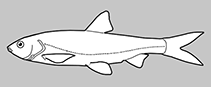 No image available for this species;
drawing shows typical species in Xenocyprididae.
Imagem do Google
drawing shows typical species in Xenocyprididae.
Classificação / Nomes Nomes comuns | Sinónimos | Catalog of Fishes(Género, Espécies) | ITIS | CoL | WoRMS | Cloffa
> Cypriniformes (Carps) > Xenocyprididae (East Asian minnows)
Etymology: bounthobi: Named for Bounthob Praxaysombath (NUOL), who was the leading researcher performing the field surveys throughout the NUOL-NEF project on 2007-2010. Eight of all 10 type series of the new species were brought from the project surveys.
Eponymy: Dr Charles William Metz (1889–1975) was an American zoologist, geneticist and taxonomist whose doctorate was awarded by Stanford University. He co-wrote: A catalog of the fishes known from the waters of Korea (1913). Dr Bounthob Praxaysombath is a zoologist, entomologist and arachnologist at the National University of Laos, Vientiane, where he is Professor and Head of the Deapartment of Biology, Faculty of Science. [...] (Ref. 128868), visit book page.
Etymology: bounthobi: Named for Bounthob Praxaysombath (NUOL), who was the leading researcher performing the field surveys throughout the NUOL-NEF project on 2007-2010. Eight of all 10 type series of the new species were brought from the project surveys.
Eponymy: Dr Charles William Metz (1889–1975) was an American zoologist, geneticist and taxonomist whose doctorate was awarded by Stanford University. He co-wrote: A catalog of the fishes known from the waters of Korea (1913). Dr Bounthob Praxaysombath is a zoologist, entomologist and arachnologist at the National University of Laos, Vientiane, where he is Professor and Head of the Deapartment of Biology, Faculty of Science. [...] (Ref. 128868), visit book page.
Ambiente: milieu / zona climática / intervalo de profundidade / gama de distribuição Ecologia
; Água doce bentopelágico. Tropical
Distribuição Territórios | Áreas FAO | Ecossistemas | Ocorrências | Mapa dos pontos | Introduções | Faunafri
Asia: Ou River basin (a tributary of the Mekong) in Phongsaly and Luang Prabang provinces of Laos.
Tamanho / Peso / Idade
Descrição breve Chaves de identificação | Morfologia | Morfometria
Raios dorsais moles (total) : 10; Raios anais moles: 21 - 23. Differs from all other species of Metzia in having the following characters: anal fin with 18-20 branched rays; scales on lateral line 49-55; predorsal scale rows 33-36; circumpeduncular scale rows 20-22; gill rakers on outer surface of first gill arch 8-10. Resembles species of Hemiculterella, Ischikauia and at least a part of Anabarilius in sharing a sharp keel restricted in development to the area between pelvic-fin base and anus, last unbranched dorsal-fin ray being soft, and an air bladder composed of two chambers. However, this species differs in having the following characters; a notably rounded snout (vs. pointed in Hemiculterella, Ischikauia and Anabarilius); 18-20 branched anal-fin rays (vs. 8-17 in Hemiculterella, Ischiakua and Anabarilius ); 49-55 lateral-line scales (vs. more than 58 in Ischikauia and Anabarilius, except for A. transmontana with 54-57); air bladder with rounded posterior end (vs. posterior end with a small lobe at least in Hemiculterella); and 39-40 vertebrae (vs. 40-43, 42-43 and 43-48 in Hemiculterella, Ischikauia and Anabarilius, respectively). Also similar to its sympatric species Paralaubuca barroni but can be readily distinguished by having 18-20 anal-fin rays (vs. 24-29 ) and 8-10 gill rakers (vs. 19-24) and a distinct keel between anus and a vertical through posterior end of pelvic-fin base, keel preceded by a very weak midventral, blunt ridge extending anteriorly to a vertical through posterior half of pectoral fin (vs. a distinct, complete abdominal keel extending from anus to isthmus) (Ref. 93140).
Body shape (shape guide): elongated.
Body shape (shape guide): elongated.
Occurs in upland clear streams with moderate or slow current (Ref. 93140).
Ciclo de vida e comportamento de acasalamento Maturidade | Reprodução | Desova | Ovos | Fecundidade | Larvas
Referência principal
Carregar as suas referências | Referências | Coordenador | Colaboradores
Shibukawa, K., P. Phousavanh, K. Phongsa and A. Iwata, 2012. A new species of Metzia (Cypriniformes: Cyprinidae) from Northern Laos. Zootaxa 3586:264-271. (Ref. 93140)
CITES
Not Evaluated
Ameaça para o homem
Harmless
Utilização humana
FAO - Publication: search | FishSource |
Mais informação
Ecologia Trófica
Produtos alimentares (presas)
Composição da dieta
Consumo alimentar
Rações alimentares
Predadores
Produtos alimentares (presas)
Composição da dieta
Consumo alimentar
Rações alimentares
Predadores
Ecologia
Ecologia
Ecologia
Dinâmica das populações
Parâmetros de crescimento
Idades / tamanhos máximos
Comprimento-peso rel.
Comprimento-comprimento rel.
Frequência de comprimento
Conversão de massa
Recrutamento
Abundância
Parâmetros de crescimento
Idades / tamanhos máximos
Comprimento-peso rel.
Comprimento-comprimento rel.
Frequência de comprimento
Conversão de massa
Recrutamento
Abundância
Ciclo de vida
Reprodução
Maturidade
Maturidade/Rel. das guelras
Fecundidade
Desova
Agregações de desova
Ovos
Desenvolvimento dos ovos
Larvas
Dinâmica larvar
Reprodução
Maturidade
Maturidade/Rel. das guelras
Fecundidade
Desova
Agregações de desova
Ovos
Desenvolvimento dos ovos
Larvas
Dinâmica larvar
Anatomia
Área branquial
Cérebro
Otólitos
Área branquial
Cérebro
Otólitos
Fisiologia
Composição corporal
Nutrientes
Consumo de oxigénio
Tipo de natação
Velocidade de natação
Pigmentos visuais
Som de peixe
Doenças e Parasitas
Toxicidade (LC50s)
Composição corporal
Nutrientes
Consumo de oxigénio
Tipo de natação
Velocidade de natação
Pigmentos visuais
Som de peixe
Doenças e Parasitas
Toxicidade (LC50s)
Genética
genoma
Genética
Heterozigotia
Hereditariedade
Diversidade genética
genoma
Genética
Heterozigotia
Hereditariedade
Diversidade genética
Relacionado com o ser humano
Sistemas de aquacultura
Perfis para aquacultura
Estirpes
Casos de Ciguatera
Selos, moedas, diversos.
Sistemas de aquacultura
Perfis para aquacultura
Estirpes
Casos de Ciguatera
Selos, moedas, diversos.
Ferramentas
E-book | Guia de campo | Ferramenta auxiliar de frequências de comprimento | Ferramenta sobre a história de vida | Mapa dos pontos |
Captura-MSY |
Relatórios especiais
Descarregue XML
Fontes da internet
AFORO (otoliths) | Aquatic Commons | BHL | Cloffa | Websites from users | Consultar FishWatcher | CISTI | Catalog of Fishes: Género, Espécies | DiscoverLife | ECOTOX | FAO - Publication: search | Faunafri | Fishipedia | Fishtrace | GloBI | Google Books | Google Scholar | Google | IGFA World Record | OneZoom | Open Tree of Life | Otolith Atlas of Taiwan Fishes | PubMed | Reef Life Survey | Socotra Atlas | TreeBase | Árvore da vida | Wikipedia: ir para, procurar | World Records Freshwater Fishing | Zoobank | Registo zoológico
Estimativas baseadas em modelos
Índice de diversidade filogenética (Ref. 82804): PD50 = 0.5039 [Uniqueness, from 0.5 = low to 2.0 = high].
Bayesian length-weight: a=0.00631 (0.00298 - 0.01335), b=3.07 (2.90 - 3.24), in cm total length, based on LWR estimates for this (Sub)family-body shape (Ref. 93245).
Nível Trófico (Ref. 69278): 3.1 ±0.4 se; based on size and trophs of closest relatives
Resiliência (Ref. 120179): Elevada, tempo mínimo de duplicação da população menor que 15 meses (Preliminary K or Fecundity.).