



Trichomycterus rubbioli Bichuette & Rizzato, 2012
Carica il tuo foto e Video
Google image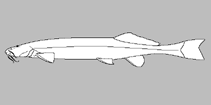 No image available for this species;
drawing shows typical species in Trichomycteridae.
Google image
drawing shows typical species in Trichomycteridae.
Classificazione / Nomi Nomi Comuni | Sinonimi | Catalog of Fishes(Genere, Specie) | ITIS | CoL | WoRMS | Cloffa
> Siluriformes (Catfishes) > Trichomycteridae (Pencil or parasitic catfishes) > Trichomycterinae
Etymology: Trichomycterus: Greek, thrix = hair + Greek, mykter, -eros = nose (Ref. 45335); rubbioli: Named for Ezio Rubbioli, speleologist, the first explorer of Serra do Ramalho caves, who brought this new species to the attention of the authors. A noun in apposition.
Eponymy: Ezio Luiz Rubbioli (d: 1964) is a Brazilian speleologist who was the first person to explore the Serra do Ramalho caves. He co-wrote: Mapping of Caverns (2005). He brought this species to the authors’ attention. (Ref. 128868), visit book page.
Etymology: Trichomycterus: Greek, thrix = hair + Greek, mykter, -eros = nose (Ref. 45335); rubbioli: Named for Ezio Rubbioli, speleologist, the first explorer of Serra do Ramalho caves, who brought this new species to the attention of the authors. A noun in apposition.
Eponymy: Ezio Luiz Rubbioli (d: 1964) is a Brazilian speleologist who was the first person to explore the Serra do Ramalho caves. He co-wrote: Mapping of Caverns (2005). He brought this species to the authors’ attention. (Ref. 128868), visit book page.
Ambiente: milieu / zona climatica / distribuzione batimetrica / gamma di distribuzione Ecologia
; acqua dolce demersale. Tropical
Distribuzione Territories | Aree FAO | Ecosistemi | Presenze | Mappa dei ritrovamenti | Introduzioni | Faunafri
South America: subterranean waters in at least two caves of the same cave system in the Serra do Ramalho karst area, middle São Francisco River basin, Brazil: Lapa dos Peixes and Gruna da Água Clara.
Dimensione / Peso / Età
Breve descrizione Chiavi di identificazione | Morfologia | Morfometria
Raggi dorsali molli (totale) : 9; Raggi anali molli: 7. Can be easily distinguished from epigean and most hypogean congeners by three distinctive, non-exclusive characters: highly reduced skin pigmentation (except for Trichomycterus gorgona and cave-restricted congeners, Trichomycterus chaberti, Trichomycterus itacarambiensis, Trichomycterus spelaeus, Trichomycterus sandovali, Trichomycterus santanderensis, Trichomycterus uisae and Trichomycterus dali); reduced eyes, visible externally as small black or reddish-brown spots (except for Trichomycterus gorgona and the hypogean Trichomycterus chaberti, Trichomycterus itacarambiensis, Trichomycterus santanderensis, Trichomycterus uisae and Trichomycterus sketi); and barbels long, especially nasal (86.9-127.1% of HL) and maxillary (98.1-129.3% of HL) (except for Trichomycterus longibarbatus and the hypogean Trichomycterus spelaeus, Trichomycterus santanderensis, Trichomycterus uisae, Trichomycterus sketi and Trichomycterus dali). These characters, in combination, separate this species from all hypogean congeners except for Trichomycterus santanderensis and Trichomycterus uisae. Further differs from almost all congeners, including Trichomycterus santanderensis and Trichomycterus uisae (except for Trichomycterus hualco, Trichomycterus sketi and Trichomycterus dali) by having I, 9 pectoral-fin rays (Ref. 91769).
Body shape (shape guide): elongated.
Body shape (shape guide): elongated.
Occurs in limestone caves. Found concentrated in places with the bottom formed by clay and small blocks of limestone, usually hiding under these blocks and inside crevices in the walls, thereby allowing a strong cryptobiotic habit. When not hidden, this species prefers to stay on the bottom and on walls (rcky and silt substrate) with occasional incursions into the midwater and surface. Inhabits water bodies formed by infiltration in the rock, and, because of this, it must be considered fragile and as a priority in conservation programs of Brazilian karstic areas (Ref. 91769).
Ciclo vitale e comportamento di accoppiamento Maturità | Riproduzione | Deposizione | Uova | Fecondità | Larve
Riferimento principale
Caricare le referenze | Bibliografia | Coordinatore : Pinna, Mário de | Collaboratori
Bichuette, M.E. and P.P. Rizzato, 2012. A new species of cave catfish from Brazil, Trichomycterus rubbioli sp.n., from Serra do Ramalho karstic area, São Francisco River basin, Bahia State (Silurifomes: Trichomycteridae). Zootaxa 3480:48-66. (Ref. 91769)
Stato della Lista Rossa IUCN (Ref. 130435: Version 2025-2 (Global))
Endangered (EN) (B1ab(iii)+2ab(iii)); Date assessed: 07 November 2018
CITES
Not Evaluated
Minaccia per l'uomo
Harmless
Usi umani
FAO - Publication: search | FishSource |
Informazioni ulteriori
Ecologia trofica
Articoli alimentari (prede)
Alimentazione
Consumo di cibo
Razioni alimentari
Predatori
Articoli alimentari (prede)
Alimentazione
Consumo di cibo
Razioni alimentari
Predatori
Ecologia
Ecologia
Ecologia
Dinamica della popolazione
Parametri di crescita
Età massima / dimensioni massime
Rapporto lunghezza-peso.
Lunghezza-lunghezza rel.
Lunghezza-frequenze
Conversione di massa
Reclutamento
Abbondanza
Parametri di crescita
Età massima / dimensioni massime
Rapporto lunghezza-peso.
Lunghezza-lunghezza rel.
Lunghezza-frequenze
Conversione di massa
Reclutamento
Abbondanza
Ciclo di vita
Riproduzione
Maturità
Maturità/Gli occhielli sono relativi.
Fecondità
Deposizione
Aggregazioni riproduttive
Uova
Sviluppo delle uova
Larve
Dinamica popolazioni larvali
Riproduzione
Maturità
Maturità/Gli occhielli sono relativi.
Fecondità
Deposizione
Aggregazioni riproduttive
Uova
Sviluppo delle uova
Larve
Dinamica popolazioni larvali
Anatomia
Area branchiale
Cervello
Otolite
Area branchiale
Cervello
Otolite
Fisiologia
Composizione corporea
Nutrienti
Consumo di ossigeno
Tipo di nuoto
Velocità di nuoto
Pigmenti visivi
Suono del pesce
Malattie e parassiti
Tossicità (LC50)
Composizione corporea
Nutrienti
Consumo di ossigeno
Tipo di nuoto
Velocità di nuoto
Pigmenti visivi
Suono del pesce
Malattie e parassiti
Tossicità (LC50)
Genetica
Genome
Genetica
Eterozigosi
Ereditarietà
Diversità genetica
Genome
Genetica
Eterozigosi
Ereditarietà
Diversità genetica
Legato all'uomo
Sistemi di acquacoltura
Profili di acquacoltura
Varietà
Casi di Ciguatera
Francobolli, monete, materiale vario.
Sistemi di acquacoltura
Profili di acquacoltura
Varietà
Casi di Ciguatera
Francobolli, monete, materiale vario.
Strumenti
Libro elettronico | Giuda pratica | Generatore frequenze di lunghezza | Strumento Parametri Biologici | Mappa dei ritrovamenti |
Cattura-MSY |
Rapporti speciali
Controllo della manutenzione dell'acquario | Verificare la presenza di schede informative sulle specie | Verifica delle schede informative sull'acquacoltura
Scarica XML
Fonti Internet
AFORO (otoliths) | Aquatic Commons | BHL | Cloffa | Websites from users | Check FishWatcher | CISTI | Catalog of Fishes: Genere, Specie | DiscoverLife | ECOTOX | FAO - Publication: search | Faunafri | Fishipedia | Fishtrace | GloBI | Google Books | Google Scholar | Google | IGFA World Record | OneZoom | Open Tree of Life | Otolith Atlas of Taiwan Fishes | PubMed | Reef Life Survey | Socotra Atlas | TreeBase | Tree of Life | Wikipedia: Go, ricerca | World Records Freshwater Fishing | Zoobank | Record zoologico
Stime basate su modelli
Indice di diversità filogenetica (Fonte Biblio. 82804): PD50 = 0.5000 [Uniqueness, from 0.5 = low to 2.0 = high].
Bayesian length-weight: a=0.00912 (0.00396 - 0.02102), b=2.97 (2.79 - 3.15), in cm total length, based on LWR estimates for this Genus-body shape (Ref. 93245).
Livello trofico (Fonte Biblio. 69278): 3.2 ±0.4 se; based on size and trophs of closest relatives