



Trichomycterus puriventris Barbosa & Costa, 2012
Hochladen Photos und videos
Google Bild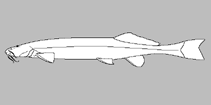 No image available for this species;
drawing shows typical species in Trichomycteridae.
Google Bild
drawing shows typical species in Trichomycteridae.
Klassifizierung / Names Namen | Synonyme | Catalog of Fishes(Gattung, Arten) | ITIS | CoL | WoRMS | Cloffa
> Siluriformes (Catfishes) > Trichomycteridae (Pencil or parasitic catfishes) > Trichomycterinae
Etymology: Trichomycterus: Greek, thrix = hair + Greek, mykter, -eros = nose (Ref. 45335); puriventris: Derived from the Latin purus (pure) and ventris (venter), in reference to the absence of dark pigmentation below lateral midline of body.
Etymology: Trichomycterus: Greek, thrix = hair + Greek, mykter, -eros = nose (Ref. 45335); puriventris: Derived from the Latin purus (pure) and ventris (venter), in reference to the absence of dark pigmentation below lateral midline of body.
Umwelt: Milieu / Klimazone / Tiefenbereich / Verbreitungsgebiet Ökologie
; süßwasser demersal. Tropical
Verbreitung Territorien | FAO Gebiete | Ökosysteme | Vorkommen | Punkt Karte | Einführungen | Faunafri
South America: Tributaries of the upper rio Santíssimo, rio Grande drainage, rio Paraíba do Sul basin, Serra do Barracão in Brazil.
Größe / Gewicht / Alter
Kurzbeschreibung Bestimmungsschlüssel | Morphologie | Morphometrie
Rückenflossenweichstrahlen (insgesamt) : 11 - 13; Afterflossenweichstrahlen: 9 - 11; Wirbelzahl: 36 - 38. Similar to Trichomycterus alternatus, T. caudofasciatus, T. longibarbatus, and T. pantherinus, and can be diagnosed from other species of the Trichomycterus by the long filamentous first pectoral-fin ray about 50-70 % of the pectoral-fin length (vs. 0-40 %). Can be distinguised from T. pantherinus by the presence of the anteriormost section of the infraorbital canal (vs. absence) and 8 pectoral-fin rays (vs. 7); from T. alternatus by having 13-14 pleural ribs (vs. 10-12), and by the pelvic-fin insertion placed in a vertical through the centrum of the 17th or 18th vertebra (vs. 14-15th); from T. caudofasciatus by having pelvic-fin insertion, dorsal-fin and anal-fin origin in the vertical through 17th- 18th (vs. 14th-15th), 19th- 21st (vs. 17 th), 23nd- 24 th (vs. 21st- 22nd) respectively; from T. longibarbatus by having shorter nasal barbel, reaching middle of pectoral-fin base (vs. posterior portion of pectoral-fin base), more slender and narrower body (body depth 11.7-13.5 % SL, vs. 14.9-18.2 %, body width 6.4 -8.3 % SL, vs. 8.6- 12.9 %), shorter head (head length 16.8-19.5 % SL (vs. 20.4 - 21.8%). Differs from all congeners from southeastern Brazilian river basins, by having a unique color pattern, consisting of dark pigmentation concentrated along and above midline of flank, but absent below midline (vs. dark pigmentation extending to ventral portion of flank) (Ref. 91059).
Body shape (shape guide): elongated.
Body shape (shape guide): elongated.
Occurs in fast running water stream, with about 2 m width and 1 m depth, sandy bottom and pale brown and turbid water. Also found in clear water stream with rocky bottom. Encountered under marginal vegetation and no specimen was seen swimming at daylight, suggesting a nocturnal or crepuscular behavior (Ref. 91059).
Lebenszyklus und Paarungsverhalten Geschlechtsreife | Fortpflanzung | Ablaichen | Eier | Fruchtbarkeit | Larven
Hauptreferenz
Laden Sie Ihre Referenzen hoch | Referenzen | Koordinator : Pinna, Mário de | Partner
Barbosa, M.A. and W.J.E.M. Costa, 2012. Trichomycterus puriventris (Teleostei: Siluriformes: Trichomycteridae), a new species of catfish from the rio Paraíba do Sul basin, southeastern Brazil. Verteb. Zool. 62(2):155-160. (Ref. 91059)
IUCN Rote Liste Status (Ref. 130435: Version 2025-2 (Global))
Daten mangelhaft (DD) ; Date assessed: 07 November 2018
CITES
Not Evaluated
Bedrohung für Menschen
Harmless
Nutzung durch Menschen
FAO - Publication: search | FishSource |
Mehr Information
Trophische Ökologie
Lebensmittel (Beutetiere)
Nahrungszusammensetzung
Nahrungsaufnahme
Lebensmittelrationen
Räuber
Lebensmittel (Beutetiere)
Nahrungszusammensetzung
Nahrungsaufnahme
Lebensmittelrationen
Räuber
Ökologie
Ökologie
Ökologie
Populationsdynamik
Wachstumsparameter
Max. Alter/Größen
Länge-Gewicht-Rel.
Länge-Länge-Verhältnis.
Längenhäufigkeiten
Massenkonvertierung
Rekrutierung
Dichte
Wachstumsparameter
Max. Alter/Größen
Länge-Gewicht-Rel.
Länge-Länge-Verhältnis.
Längenhäufigkeiten
Massenkonvertierung
Rekrutierung
Dichte
Lebenszyklus
Fortpflanzung
Geschlechtsreife
Reifung/Kiemen rel.
Fruchtbarkeit
Ablaichen
Laichaggregationen
Eier
Eientwicklung
Larven
Larven Pop.Dyn.
Fortpflanzung
Geschlechtsreife
Reifung/Kiemen rel.
Fruchtbarkeit
Ablaichen
Laichaggregationen
Eier
Eientwicklung
Larven
Larven Pop.Dyn.
Anatomie
Kiemenoberfläche
Gehirn
Otolith
Kiemenoberfläche
Gehirn
Otolith
Physiologie
Körperliche Zusammensetzung
Nährstoffe
Sauerstoffverbrauch
Schwimmart
Schwimmgeschwindigkeit
Visuelle Pigmente
Fischgeräusche
Krankheiten und Parasiten
Toxizität (LC50s)
Körperliche Zusammensetzung
Nährstoffe
Sauerstoffverbrauch
Schwimmart
Schwimmgeschwindigkeit
Visuelle Pigmente
Fischgeräusche
Krankheiten und Parasiten
Toxizität (LC50s)
Genetik
Genom
Genetik
Heterozygotie
Vererbbarkeit
Genetische Vielfalt
Genom
Genetik
Heterozygotie
Vererbbarkeit
Genetische Vielfalt
Menschenbezogen
Aquakultur-Systeme
Aquakultur Profile
Zuchtlinien
Ciguatera-Fälle
Briefmarken, Münzen, Verschiedenes.
Aquakultur-Systeme
Aquakultur Profile
Zuchtlinien
Ciguatera-Fälle
Briefmarken, Münzen, Verschiedenes.
Tools
Zusatzinformationen
Download XML
Zusammenfassung | Punktdaten | Namen | Photos
Internet Quellen
AFORO (otoliths) | Aquatic Commons | BHL | Cloffa | Websites from users | FishWatcher Einträge suchen | CISTI | Catalog of Fishes: Gattung, Arten | DiscoverLife | ECOTOX | FAO - Publication: search | Faunafri | Fishipedia | Fishtrace | GloBI | Google Books | Google Scholar | Google | IGFA World Record | OneZoom | Open Tree of Life | Otolith Atlas of Taiwan Fishes | PubMed | Reef Life Survey | Socotra Atlas | TreeBase | Tree of Life | Wikipedia: Gehe zu, Suchen | World Records Freshwater Fishing | Zoobank | Zoologischer Rekord
Schätzungen auf der Grundlage von Modellen
Phylogenetischer Diversitätsindex (Ref. 82804): PD50 = 0.5000 [Uniqueness, from 0.5 = low to 2.0 = high].
Bayesian length-weight: a=0.00912 (0.00396 - 0.02102), b=2.97 (2.79 - 3.15), in cm total length, based on LWR estimates for this Genus-body shape (Ref. 93245).
Trophische Ebene (Ref. 69278): 3.2 ±0.4 se; based on size and trophs of closest relatives