



Planonasus parini Weigmann, Stehmann & Thiel, 2013
Dwarf False Catshark
Carica il tuo foto e Video
Immagini | Google image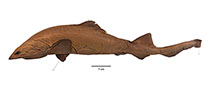 Planonasus parini
Female Immagine di Weigmann, S.
Immagini | Google image
Female Immagine di Weigmann, S.
Classificazione / Nomi Nomi Comuni | Sinonimi | Catalog of Fishes(Genere, Specie) | ITIS | CoL | WoRMS | Cloffa
Elasmobranchi (squali e razze) (sharks and rays) > Carcharhiniformes (Ground sharks) > Pseudotriakidae (False catsharks)
Etymology: Planonasus: planus (L.), flat; nasus (L.), nose, referring to its soft, flat snout (See ETYFish); parini: In honor of the late Nikolai Vasil’evich Parin (1932-2012), P. P. Shirov Institute of Oceanology, Russian Academy of Sciences, ichthyologist and chief scientist of the “memorable” cruise 17 of the research vessel Vityaz in 1988/89, during which holotype was collected (See ETYFish).
Eponymy: Professor Dr Nikolai Vasilyevich Parin (1932–2012) of the P. [...] (Ref. 128868), visit book page.
Etymology: Planonasus: planus (L.), flat; nasus (L.), nose, referring to its soft, flat snout (See ETYFish); parini: In honor of the late Nikolai Vasil’evich Parin (1932-2012), P. P. Shirov Institute of Oceanology, Russian Academy of Sciences, ichthyologist and chief scientist of the “memorable” cruise 17 of the research vessel Vityaz in 1988/89, during which holotype was collected (See ETYFish).
Eponymy: Professor Dr Nikolai Vasilyevich Parin (1932–2012) of the P. [...] (Ref. 128868), visit book page.
Ambiente: milieu / zona climatica / distribuzione batimetrica / gamma di distribuzione Ecologia
marino batidemersale; distribuzione batimetrica 1000 - 1120 m (Ref. 92921). Deep-water
Distribuzione Territories | Aree FAO | Ecosistemi | Presenze | Mappa dei ritrovamenti | Introduzioni | Faunafri
Northwestern Indian Ocean: off the Socotra Islands, south of Yemen and east of the Horn of Africa.
Dimensione / Peso / Età
Maturità: Lm ? range ? - ? cm
Max length : 53.4 cm TL (female); peso massimo pubblicato: 560.00 g (Ref. 92921)
Max length : 53.4 cm TL (female); peso massimo pubblicato: 560.00 g (Ref. 92921)
Breve descrizione Chiavi di identificazione | Morfologia | Morfometria
This small deep-water pseudotriakid species is distinguished by the following set of characters: soft body; bell-shaped head with a broadly parabolic snout; preorbital snout length 1.5-1.9 times the eye length; preoral length 0.7-0.8 times the mouth width, 1.4-1.5 times the prenarial snout length; eye length 1.9-2.3 times the nostril width; relatively broad head, width at middle gill slits 10-16% of TL; preorbital snout length 1.0-1.7 times the interorbital space (integumental) and 2.1-2.3 (skeletal), respectively; head length 2.0-2.5 times the mouth width, 9.8-10.9 times the nostril width, 2.8-3.3 times the length of preventral caudal-fin margin; length of pectoral-fin anterior margin 2.1-2.2 times the pectoral base length; length of first dorsal-fin inner margin 0.4-0.5 times the pectoral-fin base length; second dorsal-fin base length 13% of TL; color: plain dusky with fins and ventral snout somewhat darker, free rear tip of first dorsal fin marked white; each jaw with about 110-120 rows of very small tri- to multicuspidate teeth; monospondylous trunk vertebrae centra 50-52, diplospondylous precaudal centra 41, total centra about 115-140 (Ref. 92921).
Body shape (shape guide): elongated.
Body shape (shape guide): elongated.
Ciclo vitale e comportamento di accoppiamento Maturità | Riproduzione | Deposizione | Uova | Fecondità | Larve
Riferimento principale
Caricare le referenze | Bibliografia | Coordinatore | Collaboratori
Weigmann, S., M.F.W. Stehmann and R. Thiel, 2013. Planonasus parini n. g. and n. sp., a new genus and species of false cat sharks (Carchariniformes, Pseudotriakidae) from the deep northwestern Indian Ocean off Socotra Islands. Zootaxa 3609(2):163-181. (Ref. 92921)
Stato della Lista Rossa IUCN (Ref. 130435: Version 2025-2 (Global))
Least Concern (LC) ; Date assessed: 09 February 2017
CITES
Not Evaluated
Minaccia per l'uomo
Harmless
Usi umani
FAO - Publication: search | FishSource |
Informazioni ulteriori
Ecologia trofica
Articoli alimentari (prede)
Alimentazione
Consumo di cibo
Razioni alimentari
Predatori
Articoli alimentari (prede)
Alimentazione
Consumo di cibo
Razioni alimentari
Predatori
Ecologia
Ecologia
Ecologia
Dinamica della popolazione
Parametri di crescita
Età massima / dimensioni massime
Rapporto lunghezza-peso.
Lunghezza-lunghezza rel.
Lunghezza-frequenze
Conversione di massa
Reclutamento
Abbondanza
Parametri di crescita
Età massima / dimensioni massime
Rapporto lunghezza-peso.
Lunghezza-lunghezza rel.
Lunghezza-frequenze
Conversione di massa
Reclutamento
Abbondanza
Ciclo di vita
Riproduzione
Maturità
Maturità/Gli occhielli sono relativi.
Fecondità
Deposizione
Aggregazioni riproduttive
Uova
Sviluppo delle uova
Larve
Dinamica popolazioni larvali
Riproduzione
Maturità
Maturità/Gli occhielli sono relativi.
Fecondità
Deposizione
Aggregazioni riproduttive
Uova
Sviluppo delle uova
Larve
Dinamica popolazioni larvali
Anatomia
Area branchiale
Cervello
Otolite
Area branchiale
Cervello
Otolite
Fisiologia
Composizione corporea
Nutrienti
Consumo di ossigeno
Tipo di nuoto
Velocità di nuoto
Pigmenti visivi
Suono del pesce
Malattie e parassiti
Tossicità (LC50)
Composizione corporea
Nutrienti
Consumo di ossigeno
Tipo di nuoto
Velocità di nuoto
Pigmenti visivi
Suono del pesce
Malattie e parassiti
Tossicità (LC50)
Genetica
Genome
Genetica
Eterozigosi
Ereditarietà
Diversità genetica
Genome
Genetica
Eterozigosi
Ereditarietà
Diversità genetica
Legato all'uomo
Sistemi di acquacoltura
Profili di acquacoltura
Varietà
Casi di Ciguatera
Francobolli, monete, materiale vario.
Sistemi di acquacoltura
Profili di acquacoltura
Varietà
Casi di Ciguatera
Francobolli, monete, materiale vario.
Strumenti
Libro elettronico | Giuda pratica | Chiavi di identificazione | Generatore frequenze di lunghezza | Strumento Parametri Biologici | Mappa dei ritrovamenti |
Cattura-MSY |
Rapporti speciali
Controllo della manutenzione dell'acquario | Verificare la presenza di schede informative sulle specie | Verifica delle schede informative sull'acquacoltura
Scarica XML
Fonti Internet
AFORO (otoliths) | Aquatic Commons | BHL | Cloffa | Websites from users | Check FishWatcher | CISTI | Catalog of Fishes: Genere, Specie | DiscoverLife | ECOTOX | FAO - Publication: search | Faunafri | Fishipedia | Fishtrace | GloBI | Google Books | Google Scholar | Google | IGFA World Record | OneZoom | Open Tree of Life | Otolith Atlas of Taiwan Fishes | PubMed | Reef Life Survey | Socotra Atlas | TreeBase | Tree of Life | Wikipedia: Go, ricerca | World Records Freshwater Fishing | Zoobank | Record zoologico
Stime basate su modelli
Indice di diversità filogenetica (Fonte Biblio. 82804): PD50 = 0.7812 [Uniqueness, from 0.5 = low to 2.0 = high].
Bayesian length-weight: a=0.00174 (0.00069 - 0.00436), b=3.21 (2.99 - 3.43), in cm total length, based on LWR estimates for this (Sub)family-body shape (Ref. 93245).
Livello trofico (Fonte Biblio. 69278): 3.9 ±0.4 se; based on size and trophs of closest relatives