



Uploaden van uw Foto's en video's
Google afbeelding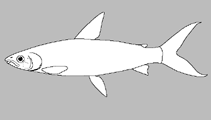 No image available for this species;
drawing shows typical species in Hemiodontidae.
Google afbeelding
drawing shows typical species in Hemiodontidae.
Classificatie / Namen Lokale namen | Synoniemen | Catalog of Fishes(Genus, Soort(en)) | ITIS | CoL | WoRMS | Cloffa
> Characiformes (Characins) > Hemiodontidae (Halftooths)
Etymology: Hemiodus: Greek, hemi = half + Greek, odous = teeth (Ref. 45335); langeanii: Named for Dr. Francisco Langeani, for his highly relevant contributions to the knowledge of hemiodontid fishes.
Eponymy: Dr Francisco Langeani Neto is a Brazilian ichthyologist who specialises in Neotropical fish at Universidade Estadual Paulista, Instituto de Biociências, Letras e Ciências Exatas, where he is an adjunct professor. [...] (Ref. 128868), visit book page.
Etymology: Hemiodus: Greek, hemi = half + Greek, odous = teeth (Ref. 45335); langeanii: Named for Dr. Francisco Langeani, for his highly relevant contributions to the knowledge of hemiodontid fishes.
Eponymy: Dr Francisco Langeani Neto is a Brazilian ichthyologist who specialises in Neotropical fish at Universidade Estadual Paulista, Instituto de Biociências, Letras e Ciências Exatas, where he is an adjunct professor. [...] (Ref. 128868), visit book page.
Milieu: milieu / Klimaatzone / Diepte / verspreidingsgebied Ecologie
; zoet water benthopelagisch; pH range: 6.4 - 6.8. Tropical; 26°C - 28°C (Ref. 91067)
Verspreiding Gebieden | FAO regio's | Ecosystemen | Voorkomen | Verspreidingskaart | Introducties | Faunafri
South America: known of the type locality in the rio Amana, rio Maués-Açu drainage, near the boundary of the States of Pará and Amazonas, Brazil
Grootte / Gewicht / Leeftijd
Korte beschrijving Determinatiesleutels | Morfologie | Morfometrie
Dorsale zachte stralen (totaal) : 11 - 12; Anale zachte stralen: 11 - 13; Wervels: 36. Distinguished from other species of Hemiodus by its high body (27.1-35.3%, average 32.3% SL vs. 18.8-28.5% in remaining species). Other diagnostic characters include the following: presence of a large lateral dark spot that is equal to, or greater than, the eye diameter (vs. smaller in remaining species except for Hemiodus microlepis); absence of conspicuous lateral stripe or transverse bands; 68-74 scales on lateral line (vs. 94-123 in Hemiodus argenteus, 124-148 in Hemiodus microlepis, 86-99 in Hemiodus orthonops and 77-92 in Hemiodus parnaguae). Differs from Hemiodus unimaculatus (which overlaps in the number of lateral line scales) by having 9-10 scales between the lateral line and the pelvic fin origin (vs. 4-7), which are similar sized above and below lateral line (vs. scales larger bellow the lateral line in Hemiodus unimaculatus) (Ref. 91067).
Found in slow-flowing stretches of the rio Amana and igarapé Porquinho (1.0-2.5 m deep) and in artificial ponds (4.0-5.0 m deep and 40-70 m in diameter) resulting from gold-mining activities. The Rio Amana and its tributaries are characterized by clear water (not stained by humic acids) but turbid due to excess of fine suspended solids (clay) as a result of mining activities along river margins and/or bottom such as dredging (Ref. 91067).
Levenscyclus en paargedrag Maturiteit | Voortplanting | Paaien | Eieren | Fecunditeit | Larven
Hoofdreferentie
Upload uw referenties | Referenties | Coördinator : Langeani, Francisco | Medewerkers
Beltrão, H. and J. Zuanon, 2012. Hemiodus langeanii (Characiformes: Hemiodontidae), a new species from rio Amana, rio Maués-Açú drainage, Amazon basin, Brazil. Neotrop. Ichthyol. 10(2):255-262. (Ref. 91067)
Status op de Rode Lijst van het IUCN (Ref. 130435: Version 2025-2 (Global))
Onvoldoende gegevens (DD) ; Date assessed: 17 November 2018
CITES
Not Evaluated
Gevaar voor de mens
Harmless
Gebruik door de mens
FAO - Publication: search | FishSource |
Meer informatie
Trofische ecologie
Voedsel (prooien)
Dieetsamenstelling
Voedselconsumptie
Voedselrantsoenen
Predatoren
Voedsel (prooien)
Dieetsamenstelling
Voedselconsumptie
Voedselrantsoenen
Predatoren
Ecologie
Ecologie
Ecologie
Populatiedynamica
Groeiparameters
Max. leeftijden / maten
Lengte-gewicht rel.
Lengte-lengte rel.
Lengtefrequenties
Massaconversie
Rekrutering
Abundantie
Groeiparameters
Max. leeftijden / maten
Lengte-gewicht rel.
Lengte-lengte rel.
Lengtefrequenties
Massaconversie
Rekrutering
Abundantie
Levenscyclus
Voortplanting
Maturiteit
Rijpheid/kieuwen rel.
Fecunditeit
Paaien
Paaibestanden
Eieren
Ontwikkeling van de eieren
Larven
Larvale populatiedynamiek
Voortplanting
Maturiteit
Rijpheid/kieuwen rel.
Fecunditeit
Paaien
Paaibestanden
Eieren
Ontwikkeling van de eieren
Larven
Larvale populatiedynamiek
Anatomie
Kieuwoppervlak
Hersenen
Otoliet
Kieuwoppervlak
Hersenen
Otoliet
Fysiologie
Lichaamssamenstelling
Voedingsstoffen
Zuurstofverbruik
Type zwemmen
Zwemsnelheid
Visuele pigmenten
Vis geluid
Ziekten en parasieten
Toxiciteit (LC50)
Lichaamssamenstelling
Voedingsstoffen
Zuurstofverbruik
Type zwemmen
Zwemsnelheid
Visuele pigmenten
Vis geluid
Ziekten en parasieten
Toxiciteit (LC50)
Genetica
genoom
Genetica
Heterozygositeit
Erfelijkheid
Genetische diversiteit
genoom
Genetica
Heterozygositeit
Erfelijkheid
Genetische diversiteit
Menselijk gerelateerd
Aquacultuursystemen
Aquacultuurprofielen
Kweeklijnen
Ciguatera gevallen
Postzegels, munten, diversen.
Aquacultuursystemen
Aquacultuurprofielen
Kweeklijnen
Ciguatera gevallen
Postzegels, munten, diversen.
Tools
Speciale rapporten
Bekijk gegevens voor het houden in een aquarium | Bekijk Fact Sheets voor de soort | Bekijk Aquacultuur Fact Sheets
Download XML
Internetbronnen
AFORO (otoliths) | Aquatic Commons | BHL | Cloffa | Websites from users | Bekijk FishWatcher | CISTI | Catalog of Fishes: Genus, Soort(en) | DiscoverLife | ECOTOX | FAO - Publication: search | Faunafri | Fishipedia | Fishtrace | GloBI | Google Books | Google Scholar | Google | IGFA World Record | OneZoom | Open Tree of Life | Otolith Atlas of Taiwan Fishes | PubMed | Reef Life Survey | Socotra Atlas | TreeBase | Tree of Life | Wikipedia: ga naar, zoek | World Records Freshwater Fishing | Zoobank | Zoological Record
Schattingen op basis van modellen
Fylogenetische diversiteitsindex (Ref. 82804): PD50 = 0.5000 [Uniqueness, from 0.5 = low to 2.0 = high].
Bayesian length-weight: a=0.00537 (0.00256 - 0.01126), b=3.13 (2.95 - 3.31), in cm total length, based on LWR estimates for this (Sub)family-body shape (Ref. 93245).
Trofisch niveau (Ref. 69278): 2.7 ±0.3 se; based on size and trophs of closest relatives