



Liopropoma emanueli Wirtz & Schliewen, 2012
Cape Verdes basslet
Envoyez vos Photos et vidéos
Images | Images Google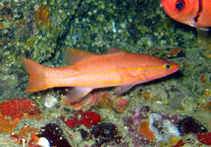 Liopropoma emanueli
Female Photo de Wirtz, P.
Images | Images Google
Female Photo de Wirtz, P.
Classification / Noms Noms communs | Synonymes | Catalog of Fishes(Genre, Espèce) | ITIS | CoL | WoRMS | Cloffa
> Perciformes/Serranoidei (Groupers) > Liopropomatidae (Painted basslets) > Liopropomatinae
Etymology: Liopropoma: Greek, leio = smooth + Greek, pro = in front of + Greek, poma, -atos = cover, operculum (Ref. 45335); emanueli: Named for Emanuel d’Oliveira.
Eponymy: Emanuel Charles D’Oliveira (d: 1958) is a PE teacher and professional diver as well as a recreational diving instructor. [...] (Ref. 128868), visit book page.
Etymology: Liopropoma: Greek, leio = smooth + Greek, pro = in front of + Greek, poma, -atos = cover, operculum (Ref. 45335); emanueli: Named for Emanuel d’Oliveira.
Eponymy: Emanuel Charles D’Oliveira (d: 1958) is a PE teacher and professional diver as well as a recreational diving instructor. [...] (Ref. 128868), visit book page.
Environnement : milieu / zone climatique / profondeur / gamme de distribution Écologie
marin récifal; profondeur 20 - 32 m (Ref. 91766). Subtropical
Distribution Territoires | Zones FAO | Écosystèmes | Occurrences | Carte par point | Introductions | Faunafri
Eastern Atlantic, Cape Verde Islands.
Taille / Poids / Âge
Maturité: Lm ? range ? - ? cm
Max length : 12.4 cm SL mâle / non sexé; (Ref. 91766); 10.2 cm SL (female)
Max length : 12.4 cm SL mâle / non sexé; (Ref. 91766); 10.2 cm SL (female)
Description synthétique Clés d'identification | Morphologie | Morphométrie
Épines dorsales (Total) : 8; Rayons mous dorsaux (Total) : 11; Épines anales: 3; Rayons mous anaux: 8. This species is distinguished by the following characters: D VI?I?I+11; seventh dorsal spine embedded and scaled over, the first dorsal spine minute, both are only visible in the radiographs; sixth dorsal spine clearly visible above interdorsal ridge; 16 pectoral rays; about 54 lateral-line scales (only countable in holotype); approx. 4?5+1+8?11 gill rakers; inner teeth at front of jaws and side of lower jaw substantially longer than teeth in outer row; posterior margin of upper central part of preopercle is irregular, finely serrated; pink ground coloration, with broad yellow-orange stripe from snout through eye along the midlateral part of flanks; numerous thinner yellow-orange stripes above and below this central stripe, slightly irregular on opercle and tail; yellow-orange caudal fin's upper and lower margin, the dorsal margin of softray dorsal fin and lower margin of anal fin; caudal fin slightly emarginate (Ref. 91766).
Body shape (shape guide): fusiform / normal; Cross section: compressed.
Body shape (shape guide): fusiform / normal; Cross section: compressed.
Encountered in front of a vertical wall covered with the sun coral Tubastrea aurea, at 36 m depth. It retreated into one of the many small (bucket to bathtub-sized) caves in this wall. During later dives, several other individuals were encountered along the same vertical wall, but additional individuals were later also seen in other areas, consisting of large boulders overgrown with black coral (Antipathella and Tanacetipathes species.). They retreated below these boulders when approached. The most common species in the same area were the soldier fishes Myripristis jacobus Cuvier, 1829 and Sargocentron hastatum (Cuvier, 1829); and Corniger spinosus Agassiz, 1831, was also seen at the vertical Tubastrea wall (Ref. 91766).
Cycle de vie et comportement reproducteur Maturité | Reproduction | Frai | Œufs | Fécondité | Larves
Référence principale
Téléchargez vos références | Références | Coordinateur | Collaborateurs
Wirtz, P. and U.K. Schliewen, 2012. A new species of Liopropoma Gill, 1862 from the Cape Verde Islands, Eastern Atlantic (Teleostei, Perciformes, Serranidae). Spixiana 35(1):149-154. (Ref. 91766)
CITES
Not Evaluated
Menace pour l'homme
Harmless
Utilisations par l'homme
FAO - Publication: search | FishSource |
Plus d'informations
Écologie trophique
Aliments (proies)
Composition du régime alimentaire
Consommation alimentaire
Rations alimentaires
Prédateurs
Aliments (proies)
Composition du régime alimentaire
Consommation alimentaire
Rations alimentaires
Prédateurs
Écologie
Écologie
Écologie
Dynamique des populations
Paramètres de croissance
Âges / tailles maximales
Longueur-poids rel.
Rel. longueur-longueur.
Fréquences de longueurs
Conversion de masse
Recrutement
Abondance
Paramètres de croissance
Âges / tailles maximales
Longueur-poids rel.
Rel. longueur-longueur.
Fréquences de longueurs
Conversion de masse
Recrutement
Abondance
Cycle de vie
Reproduction
Maturité
Maturité/épines rel.
Fécondité
Frai
Agrégats de frai
Œufs
Développement de l'œuf
Larves
Dynamique des populations larvaires
Reproduction
Maturité
Maturité/épines rel.
Fécondité
Frai
Agrégats de frai
Œufs
Développement de l'œuf
Larves
Dynamique des populations larvaires
Anatomie
Surface branchiale
Cerveau
Otolithe
Surface branchiale
Cerveau
Otolithe
Physiologie
Composition corporelle
Nutriments
Consommation d'oxygène
Type de natation
Vitesse de nage
Pigments visuels
Son de poisson
Maladies et parasites
Toxicité (CL50)
Composition corporelle
Nutriments
Consommation d'oxygène
Type de natation
Vitesse de nage
Pigments visuels
Son de poisson
Maladies et parasites
Toxicité (CL50)
Génétique
génôme
Génétique
Hétérozygotie
Héritabilité
Diversité génétique
génôme
Génétique
Hétérozygotie
Héritabilité
Diversité génétique
Liées à l'homme
Systèmes d'aquaculture
Profils d'aquaculture
Souches
Cas de ciguatera
Timbres, pièces de monnaie, divers
Systèmes d'aquaculture
Profils d'aquaculture
Souches
Cas de ciguatera
Timbres, pièces de monnaie, divers
Outils
E-book | Guide de terrain | Générateur de fréquences de longueur | Outil de dynamique de population | Carte par point |
Capture-MSY |
Articles particuliers
Télécharger en XML
Sources Internet
AFORO (otoliths) | Aquatic Commons | BHL | Cloffa | Websites from users | FishWatcher | CISTI | Catalog of Fishes: Genre, Espèce | DiscoverLife | ECOTOX | FAO - Publication: search | Faunafri | Fishipedia | Fishtrace | GloBI | Google Books | Google Scholar | Google | IGFA World Record | OneZoom | Open Tree of Life | Otolith Atlas of Taiwan Fishes | PubMed | Reef Life Survey | Socotra Atlas | TreeBase | Arbre de Vie | Wikipedia: aller à, chercher | World Records Freshwater Fishing | Zoobank | Zoological Record
Estimations basées sur des modèles
Indice de diversité phylogénétique (Réf. 82804): PD50 = 0.5000 [Uniqueness, from 0.5 = low to 2.0 = high].
Bayesian length-weight: a=0.01122 (0.00514 - 0.02450), b=3.04 (2.87 - 3.21), in cm total length, based on all LWR estimates for this body shape (Ref. 93245).
Niveau trophique (Réf. 69278): 3.9 ±0.6 se; based on size and trophs of closest relatives