This website uses cookies to enhance your browsing experience and ensure the functionality of our site. For more detailed information about the types of cookies we use and how we protect your privacy, please visit our Privacy Information page.
×
Cookie Settings
This website uses different types of cookies to enhance your experience. Please select your preferences below:
> Gobiiformes (Gobies) > Gobiidae (Gobies) > Gobiinae
Etymology: Eviota:No etymology given, suggested by Christopher Scharpt: from Latin 'eu' for 'true' and 'iota' for anything very small, in combination 'truly very small' referring to it as being the smallest vertebrate at the time it has benn described by Jenkins (thus, making the suggestion by Scharpt plausible; fallax:Name from Latin word 'fallax' meaning deceitful, false; refers to its superficial similarity to Eviota natalis; noun in apposition.
Western Pacific: Indonesia (Bali, West Papua, Banda, and Sangihe Island), Papua New Guinea (Kimbe, New Britain), Solomon Islands, Philippines, Micronesia (Chuuk, Yap, and Ngulu Atoll), and Japan (Ryukyu Islands).
ขนาด / น้ำหนัก / อายุ
วัยเจริญพันธุ์: Lm? range ? - ? cm Max length : 1.8 cm SL เพศผู้/กระเทย; (Ref. 79588)
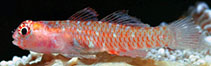
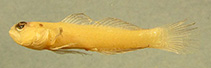
เงี่ยงครีบหลัง (รวม) : 7; ก้านครีบอ่อนที่หาง (รวม) : 9; เงี่ยงครีบก้น: 1; ก้านครีบอ่อนที่ก้น: 8. This species is distinguished from its congeners by the following characters: dark occipital spot, more well-developed in males and in preservation; an orange spot behind the eye in life; cephalic sensory-pore system pattern Group I (complete); dorsal/anal formula often 9/8; eye diameter 26.7-34.4% HL; caudal-peduncle depth 10.9-12.4% SL; 4th pelvic-fin ray with short, thick branches bound together by membranes (Ref. 79588). Body shape (shape guide): fusiform / normal; Cross section: oval.
Inhabits rocky caverns or coral heads on sand seen most frequently at depths of about 8-15 m on either live coral (frequently faviids) or on rocky surfaces covered with coralline algae patches (Ref. 79588).
อุณหภูมิที่ต้องการ (อ้างอิง 123201): 26.7 - 29.2, mean 28.7 °C (based on 662 cells).
ดัชนีความหลากหลายทางวิวัฒนาการ (อ้างอิง 82804): PD50 = 0.5000 [Uniqueness, from 0.5 = low to 2.0 = high].
Bayesian length-weight: a=0.01023 (0.00477 - 0.02194), b=3.01 (2.83 - 3.19), in cm total length, based on LWR estimates for this (Sub)family-body shape (Ref. 93245).
ระดับชั้นอาหาร (อ้างอิง 69278): 3.0 ±0.3 se; based on size and trophs of closest relatives
ความเสี่ยงต่อการตกปลา (Ref. 59153): Low vulnerability (10 of 100). 🛈