



Tanganikallabes stewarti Wright & Bailey, 2012
Envoyez vos Photos et vidéos
Images Google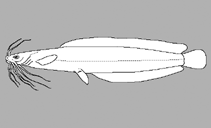 No image available for this species;
drawing shows typical species in Clariidae.
Images Google
drawing shows typical species in Clariidae.
Classification / Noms Noms communs | Synonymes | Catalog of Fishes(Genre, Espèce) | ITIS | CoL | WoRMS | Cloffa
> Siluriformes (Catfishes) > Clariidae (Airbreathing catfishes)
Etymology: Tanganikallabes: Composed from lake Tanganyka + Greek, allabes, -etos = a fish of the Nile, a kind of lamprey (Ref. 45335); stewarti: The specific epithet of this species is a patronym in honour of American ichthyologist Donald J. Stewart, who collected the holotype and other material used in the description of this species, as well as assisting in the collection of much of the type series of Tanganikallabes alboperca (Ref. 90118).
Eponymy: Dr Donald James Stewart (d: 1946) is Professor of Environment & Forest Biology at the College of Environmental Science and Forestry, State University of New York, Syracuse, where he presently teaches Ichthyology & Tropical Ecology. [...] (Ref. 128868), visit book page.
Etymology: Tanganikallabes: Composed from lake Tanganyka + Greek, allabes, -etos = a fish of the Nile, a kind of lamprey (Ref. 45335); stewarti: The specific epithet of this species is a patronym in honour of American ichthyologist Donald J. Stewart, who collected the holotype and other material used in the description of this species, as well as assisting in the collection of much of the type series of Tanganikallabes alboperca (Ref. 90118).
Eponymy: Dr Donald James Stewart (d: 1946) is Professor of Environment & Forest Biology at the College of Environmental Science and Forestry, State University of New York, Syracuse, where he presently teaches Ichthyology & Tropical Ecology. [...] (Ref. 128868), visit book page.
Environnement : milieu / zone climatique / profondeur / gamme de distribution Écologie
; eau douce benthopélagique. Tropical
Distribution Territoires | Zones FAO | Écosystèmes | Occurrences | Carte par point | Introductions | Faunafri
Africa: Lake Tanganyika (Ref. 90118).
Taille / Poids / Âge
Description synthétique Clés d'identification | Morphologie | Morphométrie
Épines dorsales (Total) : 0; Rayons mous dorsaux (Total) : 72 - 79; Épines anales: 0; Rayons mous anaux: 63 - 69. Diagnosis: Tanganikallabes stewarti is distinguished from all congeners by having an incomplete lateral line, which terminates at a vertical through a point approximately two-thirds of the distance along the anal fin base, vs. lateral line reaching the caudal peduncle in T. mortiauxi and extending much closer to the caudal peduncle in T. alboperca ; and by its relatively shallower body, body depth at anus 8.7-10.9% of standard length vs. 12.3-17.2% in T. mortiauxi and 11.7-14.6% in T. alboperca (Ref. 90118). Tanganikallabes stewarti is further separated from T. mortiauxi by its premaxillary toothpad shape, uniformly thin, broad crescent, vs. widest point anteroposteriorly thicker; lack of a free lower orbital margin; io-iv and the suprapreopercle consisting of multiple separate elements, vs. a single element; the extensions of the lateral ethmoid not reaching io-ii when viewed from above, vs. nearly or completely overlaying io-ii; its proportionally shorter prepelvic length, 35.7-39.2% of standard length vs. 39.7-44.4%; its proportionally shorter preanal length, 42.4-44.8% of standard length vs. 47.1-51.7%; longer anal fin, anal fin base 54.1-58.9% of standard length vs. 47.6-54.2% (Ref. 90118). It can additionally be distinguished from T. alboperca by its lack of a depigmented opercular margin; having longer pelvic fins, 7.1-9.3% of standard length vs. 6.0-7.7%, which reach beyond the origin of the anal fin when adpressed; proportionately longer pectoral fin spines, 5.0-6.8% of standard length vs. 3.6-5.3%; a shorter preanal length, 42.4-44.8% of standard length vs. 45.2-49.0%; and a generally higher number of dorsal fin rays, 72-79 vs. 65-74, and anal fin rays, 63-69 vs. 55-63 (Ref. 90118).
Body shape (shape guide): elongated.
Body shape (shape guide): elongated.
It is likely to inhabit rocky bottoms, over a range of depths (Ref. 90118).
Cycle de vie et comportement reproducteur Maturité | Reproduction | Frai | Œufs | Fécondité | Larves
Référence principale
Téléchargez vos références | Références | Coordinateur | Collaborateurs
Wright, J.J. and R.M. Bailey, 2012. Systematic revision of the formerly monotypic genus Tanganikallabes (Siluriformes: Clariidae). Zool. J. Linn. Soc. 165:121-142. (Ref. 90118)
Statut dans la liste rouge de l'IUCN (Ref. 130435: Version 2025-2 (Global))
Préoccupation mineure (LC) ; Date assessed: 21 February 2025
CITES
Not Evaluated
Menace pour l'homme
Harmless
Utilisations par l'homme
FAO - Publication: search | FishSource |
Plus d'informations
Écologie trophique
Aliments (proies)
Composition du régime alimentaire
Consommation alimentaire
Rations alimentaires
Prédateurs
Aliments (proies)
Composition du régime alimentaire
Consommation alimentaire
Rations alimentaires
Prédateurs
Dynamique des populations
Paramètres de croissance
Âges / tailles maximales
Longueur-poids rel.
Rel. longueur-longueur.
Fréquences de longueurs
Conversion de masse
Recrutement
Abondance
Paramètres de croissance
Âges / tailles maximales
Longueur-poids rel.
Rel. longueur-longueur.
Fréquences de longueurs
Conversion de masse
Recrutement
Abondance
Cycle de vie
Reproduction
Maturité
Maturité/épines rel.
Fécondité
Frai
Agrégats de frai
Œufs
Développement de l'œuf
Larves
Dynamique des populations larvaires
Reproduction
Maturité
Maturité/épines rel.
Fécondité
Frai
Agrégats de frai
Œufs
Développement de l'œuf
Larves
Dynamique des populations larvaires
Anatomie
Surface branchiale
Cerveau
Otolithe
Surface branchiale
Cerveau
Otolithe
Physiologie
Composition corporelle
Nutriments
Consommation d'oxygène
Type de natation
Vitesse de nage
Pigments visuels
Son de poisson
Maladies et parasites
Toxicité (CL50)
Composition corporelle
Nutriments
Consommation d'oxygène
Type de natation
Vitesse de nage
Pigments visuels
Son de poisson
Maladies et parasites
Toxicité (CL50)
Génétique
génôme
Génétique
Hétérozygotie
Héritabilité
Diversité génétique
génôme
Génétique
Hétérozygotie
Héritabilité
Diversité génétique
Liées à l'homme
Systèmes d'aquaculture
Profils d'aquaculture
Souches
Cas de ciguatera
Timbres, pièces de monnaie, divers
Systèmes d'aquaculture
Profils d'aquaculture
Souches
Cas de ciguatera
Timbres, pièces de monnaie, divers
Outils
E-book | Guide de terrain | Générateur de fréquences de longueur | Outil de dynamique de population | Carte par point |
Capture-MSY |
Articles particuliers
Télécharger en XML
Sources Internet
AFORO (otoliths) | Aquatic Commons | BHL | Cloffa | Websites from users | FishWatcher | CISTI | Catalog of Fishes: Genre, Espèce | DiscoverLife | ECOTOX | FAO - Publication: search | Faunafri | Fishipedia | Fishtrace | GloBI | Google Books | Google Scholar | Google | IGFA World Record | OneZoom | Open Tree of Life | Otolith Atlas of Taiwan Fishes | PubMed | Reef Life Survey | Socotra Atlas | TreeBase | Arbre de Vie | Wikipedia: aller à, chercher | World Records Freshwater Fishing | Zoobank | Zoological Record
Estimations basées sur des modèles
Indice de diversité phylogénétique (Réf. 82804): PD50 = 0.6250 [Uniqueness, from 0.5 = low to 2.0 = high].
Bayesian length-weight: a=0.00741 (0.00344 - 0.01597), b=2.97 (2.79 - 3.15), in cm total length, based on LWR estimates for this (Sub)family-body shape (Ref. 93245).
Niveau trophique (Réf. 69278): 3.4 ±0.6 se; based on size and trophs of closest relatives
Résilience (Réf. 120179): Haut, temps minimum de doublement de population inférieur à 15 mois (Preliminary K or Fecundity.).