



Australoheros tavaresi Ottoni, 2012
Hochladen Photos und videos
Google Bild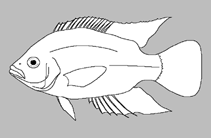 No image available for this species;
drawing shows typical species in Cichlidae.
Google Bild
drawing shows typical species in Cichlidae.
Klassifizierung / Names Namen | Synonyme | Catalog of Fishes(Gattung, Arten) | ITIS | CoL | WoRMS | Cloffa
> Cichliformes (Cichlids, convict blennies) > Cichlidae (Cichlids) > Cichlinae
Etymology: Australoheros: From the Latin word 'australis' meaning southern, and the name Heros, after the nominotypic genus of the Heroini tribe. Tribe; tavaresi: Named for Felipe Tavares Autran, a student in Laboratório de Sistemática e Evolução de Peixes Teleósteos, Universidade Federal do Rio de Janeiro (UFRJ), Brazil, during the 1990’s. He first recognized this species as new in his unpublished monograph (Autran, 1995) on the "Cichlasoma" facetum species complex, under orientation of Wilson Costa. This study, although widely known among Brazilian ichthyologists, was never published (Ref. 89866).
Eponymy: Felipe Tavares Autran was a student when he first recognised this species as new, in his unpublished monograph (Autran, 1995) on the Cichlasoma facetum species complex. [...] (Ref. 128868), visit book page.
Etymology: Australoheros: From the Latin word 'australis' meaning southern, and the name Heros, after the nominotypic genus of the Heroini tribe. Tribe; tavaresi: Named for Felipe Tavares Autran, a student in Laboratório de Sistemática e Evolução de Peixes Teleósteos, Universidade Federal do Rio de Janeiro (UFRJ), Brazil, during the 1990’s. He first recognized this species as new in his unpublished monograph (Autran, 1995) on the "Cichlasoma" facetum species complex, under orientation of Wilson Costa. This study, although widely known among Brazilian ichthyologists, was never published (Ref. 89866).
Eponymy: Felipe Tavares Autran was a student when he first recognised this species as new, in his unpublished monograph (Autran, 1995) on the Cichlasoma facetum species complex. [...] (Ref. 128868), visit book page.
Umwelt: Milieu / Klimazone / Tiefenbereich / Verbreitungsgebiet Ökologie
; süßwasser pelagisch. Tropical
Verbreitung Territorien | FAO Gebiete | Ökosysteme | Vorkommen | Punkt Karte | Einführungen | Faunafri
South America: Upper rio Tietê drainage, upper rio Paraná basin in São Paulo, Brazil.
Größe / Gewicht / Alter
Kurzbeschreibung Bestimmungsschlüssel | Morphologie | Morphometrie
Rückenflossenstacheln (insgesamt) : 16 - 17; Rückenflossenweichstrahlen (insgesamt) : 10 - 11; Afterflossenstacheln: 7 - 8; Afterflossenweichstrahlen: 8 - 9; Wirbelzahl: 26. Distinguished from all other species of Australoheros (except A. facetus) by having prognathous mouth (vs. isognathous); from species of the A. facetus, A. forquilha, A. kaaygua and A. scitulus species groups, and from A. acaroides, A. ykeregua, A. angiru and A. taura by having 12 caudal vertebrae (vs. 13 - 15) and 14 precaudal vertebrae (vs. 12 - 13); from species of the A. facetus, A. forquilha and A. kaaygua species groups by having three abdominal bars in all stages of life (vs. always four abdominal bars in juveniles, and adults with three bars in about 50% and four in about 50% of all specimens examined); from A. perdi by having 26 total vertebrae (vs. 25); from A. ykeregua by the absence of dark marks on the suborbital region (vs. presence); from A. agiru by having a conspicuous rounded caudal-fin base spot (vs. spot very narrow or absent); from all its congeners of the A. autrani species group (except A. mattosi and A. montanus) by having a fewer body depth (39.0 - 42.2% SL in A. tavaresi vs. 45.7 - 50.9% SL in A. autrani, 44.6 - 49.0% SL in A. barbosae, 47.3 - 51.2% SL in A. ipatinguensis, 46.6 - 49.8% SL in A. macacuensis, 44.0 - 48.2% SL in A. macaensis, 43.8 - 50.1% SL in A. muriae, 42.6 - 46.1% SL in A. paraibae, 47.4 - 51.3% SL in A. ribeirae, 43.7 - 46.0% SL in A. robustus, 44.0 - 48.2% SL in A. saquarema, 42.6 - 50.3% SL in A. capixaba); from A. saquarema, A. muriae, A. robustus, A. barbosae, A. macacuensis, A. ipatinguensis, A. paraibae and A. ribeirae by having a longer caudal peduncle (caudal peduncle length 9.8 - 11.6% SL in A. tavaresi vs. 6,6 - 8,0% SL in A. ipatinguensis, 6.7 - 9.0% SL in A. saquarema, 5.1 - 7.9% SL in A. macacuensis, 5.5 - 8.7% SL in A. barbosae, 7.1 - 8.9% SL in A. muriae, 6.4 - 8.1% SL in A. paraibae, 7.4 - 9.2% SL in A. robustus and 6.6 - 9.1% SL in A. ribeirae); from A. barbosae, A. macacuensis, A. paraibae, A. ribeirae and A. saquarema by having a fewer preorbital depth (51.2 - 60.0 % SL in A. tavaresi vs. 60.5 - 65.3% SL in A. barbosae, 62.2 - 65.4% SL in A. macacuensis, 60.4 - 65.2% SL in A. paraibae, 64.2 - 73.3% SL in A. ribeirae, 66.0 - 69.1% SL in A. saquarema); from A. macacuensis and A. montanus sp. n. by having arms of trunk bar 7 with the same width (vs. posterior arm of trunk bar 7 wider than anterior one); from A. mattosi by having anal-fin base squamation beginning at the sixth anal-fin spine (vs. anal-fin base squamation beginning at the third anal-fin spine); and from A. ribeirae by having a fewer head depth (head depth 80.6 - 94.2% HL vs. 95.4 - 98.9% HL) (Ref. 89866).
Lebenszyklus und Paarungsverhalten Geschlechtsreife | Fortpflanzung | Ablaichen | Eier | Fruchtbarkeit | Larven
Hauptreferenz
Laden Sie Ihre Referenzen hoch | Referenzen | Koordinator : Kullander, Sven O. | Partner
Ottoni, F.P., 2012. Three new species of Australoheros from southeastern Brazil, with taxonomic notes on Chromys oblonga, Heros autochton and H. jenynsii (Teleostei: Labroidei: Cichlidae). Vertebrate Zoology 62(1):83-96. (Ref. 89866)
IUCN Rote Liste Status (Ref. 130435: Version 2025-2 (Global))
nicht bedroht (LC) ; Date assessed: 07 November 2018
CITES
Not Evaluated
Bedrohung für Menschen
Harmless
Nutzung durch Menschen
FAO - Publication: search | FishSource |
Mehr Information
Trophische Ökologie
Lebensmittel (Beutetiere)
Nahrungszusammensetzung
Nahrungsaufnahme
Lebensmittelrationen
Räuber
Lebensmittel (Beutetiere)
Nahrungszusammensetzung
Nahrungsaufnahme
Lebensmittelrationen
Räuber
Ökologie
Ökologie
Ökologie
Populationsdynamik
Wachstumsparameter
Max. Alter/Größen
Länge-Gewicht-Rel.
Länge-Länge-Verhältnis.
Längenhäufigkeiten
Massenkonvertierung
Rekrutierung
Dichte
Wachstumsparameter
Max. Alter/Größen
Länge-Gewicht-Rel.
Länge-Länge-Verhältnis.
Längenhäufigkeiten
Massenkonvertierung
Rekrutierung
Dichte
Lebenszyklus
Fortpflanzung
Geschlechtsreife
Reifung/Kiemen rel.
Fruchtbarkeit
Ablaichen
Laichaggregationen
Eier
Eientwicklung
Larven
Larven Pop.Dyn.
Fortpflanzung
Geschlechtsreife
Reifung/Kiemen rel.
Fruchtbarkeit
Ablaichen
Laichaggregationen
Eier
Eientwicklung
Larven
Larven Pop.Dyn.
Anatomie
Kiemenoberfläche
Gehirn
Otolith
Kiemenoberfläche
Gehirn
Otolith
Physiologie
Körperliche Zusammensetzung
Nährstoffe
Sauerstoffverbrauch
Schwimmart
Schwimmgeschwindigkeit
Visuelle Pigmente
Fischgeräusche
Krankheiten und Parasiten
Toxizität (LC50s)
Körperliche Zusammensetzung
Nährstoffe
Sauerstoffverbrauch
Schwimmart
Schwimmgeschwindigkeit
Visuelle Pigmente
Fischgeräusche
Krankheiten und Parasiten
Toxizität (LC50s)
Genetik
Genom
Genetik
Heterozygotie
Vererbbarkeit
Genetische Vielfalt
Genom
Genetik
Heterozygotie
Vererbbarkeit
Genetische Vielfalt
Menschenbezogen
Aquakultur-Systeme
Aquakultur Profile
Zuchtlinien
Ciguatera-Fälle
Briefmarken, Münzen, Verschiedenes.
Aquakultur-Systeme
Aquakultur Profile
Zuchtlinien
Ciguatera-Fälle
Briefmarken, Münzen, Verschiedenes.
Tools
Zusatzinformationen
Download XML
Zusammenfassung | Punktdaten | Namen | Photos
Internet Quellen
AFORO (otoliths) | Aquatic Commons | BHL | Cloffa | Websites from users | FishWatcher Einträge suchen | CISTI | Catalog of Fishes: Gattung, Arten | DiscoverLife | ECOTOX | FAO - Publication: search | Faunafri | Fishipedia | Fishtrace | GloBI | Google Books | Google Scholar | Google | IGFA World Record | OneZoom | Open Tree of Life | Otolith Atlas of Taiwan Fishes | PubMed | Reef Life Survey | Socotra Atlas | TreeBase | Tree of Life | Wikipedia: Gehe zu, Suchen | World Records Freshwater Fishing | Zoobank | Zoologischer Rekord
Schätzungen auf der Grundlage von Modellen
Phylogenetischer Diversitätsindex (Ref. 82804): PD50 = 0.5000 [Uniqueness, from 0.5 = low to 2.0 = high].
Bayesian length-weight: a=0.01445 (0.00665 - 0.03141), b=3.08 (2.90 - 3.26), in cm total length, based on LWR estimates for this (Sub)family-body shape (Ref. 93245).
Trophische Ebene (Ref. 69278): 3.2 ±0.5 se; based on size and trophs of closest relatives