



Volodichthys solovjevae Balushkin, 2012
Carregue seu(sua) Fotos e vídeos
Imagem do Google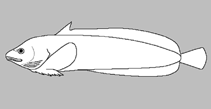 No image available for this species;
drawing shows typical species in Liparidae.
Imagem do Google
drawing shows typical species in Liparidae.
Classificação / Nomes Nomes comuns | Sinônimos | Catalog of Fishes(Gênero, Espécies) | ITIS | CoL | WoRMS | Cloffa
> Perciformes/Cottoidei (Sculpins) > Liparidae (Snailfishes)
Etymology: solovjevae: From the author: "The species has been named for my first ichthyology teacher Natalia Stepanovna". Solovjeva (1911–2005). She was an associate professor and the head of the vertebrate department at Perm State University for more than 20 years. She was a talented teacher and cultivated active interest in fish in her students. Having named a species in honor of her, I expressed my deep gratitude to my teacher, whom I will never forget. June 13, 2011, will be N.S. Solovjeva’s 100th anniversary, and a lot of her students and colleagues will remember with thanks this charming woman, great teacher, and very modest and polite person.".
Eponymy: Natalia Stepanovna Solovjeva (1911–2005) was the author’s first ichthyology teacher. [...] (Ref. 128868), visit book page.
Etymology: solovjevae: From the author: "The species has been named for my first ichthyology teacher Natalia Stepanovna". Solovjeva (1911–2005). She was an associate professor and the head of the vertebrate department at Perm State University for more than 20 years. She was a talented teacher and cultivated active interest in fish in her students. Having named a species in honor of her, I expressed my deep gratitude to my teacher, whom I will never forget. June 13, 2011, will be N.S. Solovjeva’s 100th anniversary, and a lot of her students and colleagues will remember with thanks this charming woman, great teacher, and very modest and polite person.".
Eponymy: Natalia Stepanovna Solovjeva (1911–2005) was the author’s first ichthyology teacher. [...] (Ref. 128868), visit book page.
Meio ambiente: milieu / Zona climática / intervalo de profundidade / faixa de distribuição Ecologia
marinhas batidemersal; intervalo de profundidade 990 - 2012 m (Ref. 89382). Polar
Distribuição Territórios | Áreas da FAO | Ecossistemas | Ocorrências | Mapa de pontos | Introduções | Faunafri
Southern Ocean: both type specimens were caught in the Cooperation Sea when Antarctic toothfish (Dissostichus mawsoni Norman) was long-line fished at the mesobathybenthal depths (990–2012 m) (Ref. 89382).
Tamanho / Peso / Idade
Descrição suscinta Chaves de identificação | Morfologia | Morfometria
Vértebras: 48 - 49. P 35–37, C 14 (2+ 5/6 +1), rad. pect. 4 (3 + 1); three of them are situated on the top and have notch and inter-radial fenestrae. Three pairs of the saber-like pleural ribs. Two asymphytous and distally hypural plates; rudimentary parhypurale. The mouth is terminal. The teeth are simple. The gill slit is oblique and travels to the 10th–13th P ray, its length is 12.8–13.8% SL; the length of the head (c) is 28.9–30.7% SL; the length wise diameter of the disk is 8.7–12.2% SL. The peritoneum is light-colored; the Cooperation Sea Sea, 990–2012 m (Ref. 89382).
Coloration : the living bodies of both holotypes are grey-lilac. This color becomes more saturated at the end of the body or the ends of the dorsal and anal fins. The caudal fin is dark blue. The pectoral fins are lightly colored at the bottom and central parts. Their ends are dark blue (sometimes in a form of wash-outs) both on the external and internal sides. The head is lightly colored. It has a slight yellowish or pinkish film (especially in the paratype) and small light blue spot on the frontal side at the back. The maw and throat before the disk are lilac-grey. The disk is light with the dark blue border around the periphery. The jaws are light blue. The pupil is grey and has a light blue border. The color of the paratype is mainly pink with little contrast between lilac and blue. The peritoneum in both samples is brown with a greenish tint (Ref. 89382).
Ciclo de vida ou comportamento de acasalamento Maturidade | Reprodução | Desova | Ovos | Fecundidade | Larvas
Referência principal
Carregar suas referências | Referências | Coordenador | Colaboradores
Balushkin, A.V., 2012. Volodichthys gen. nov. New Species of the Primitive Snailfish (Liparidae: Scorpaeniformes) of the Southern Hemishpere. Description of New Species V. solovjevae sp. nov. (Cooperation Sea, the Antarctic). J. Ichthyol. 52(1):1-10. (Ref. 89382)
CITES
Not Evaluated
Ameaça para os humanos
Harmless
Uso pelos humanos
FAO - Publication: search | FishSource |
Mais informação
Ecologia Trófica
Itens alimentares (presas)
Composição da dieta
Consumo alimentar
Rações alimentares
Predadores
Itens alimentares (presas)
Composição da dieta
Consumo alimentar
Rações alimentares
Predadores
Ecologia
Ecologia
Ecologia
Dinâmica populacional
Parâmetros de crescimento
Idade máxima / tamanhos
Relação comprimento-peso.
Relação comprimento-comprimento.
Frequências de comprimento
Conversão de massa
Recrutamento
Abundância
Parâmetros de crescimento
Idade máxima / tamanhos
Relação comprimento-peso.
Relação comprimento-comprimento.
Frequências de comprimento
Conversão de massa
Recrutamento
Abundância
Ciclo de vida
Reprodução
Maturidade
Maturidade/Rel. das guelras
Fecundidade
Desova
Agregações de desova
Ovos
Desenvolvimento dos ovos
Larvas
Dinâmica larval
Reprodução
Maturidade
Maturidade/Rel. das guelras
Fecundidade
Desova
Agregações de desova
Ovos
Desenvolvimento dos ovos
Larvas
Dinâmica larval
Anatomia
Área branquial
Cérebro
Otólito
Área branquial
Cérebro
Otólito
Fisiologia
Composição corporal
Nutrientes
Consumo de oxigênio
Tipo de natação
Velocidade de natação
Pigmentos visuais
Som de peixe
Doenças e Parasitas
Toxicidade (LC50s)
Composição corporal
Nutrientes
Consumo de oxigênio
Tipo de natação
Velocidade de natação
Pigmentos visuais
Som de peixe
Doenças e Parasitas
Toxicidade (LC50s)
Genética
genoma
Genética
Heterozigosidade
Hereditariedade
Diversidade genética
genoma
Genética
Heterozigosidade
Hereditariedade
Diversidade genética
Relacionado a humanos
Sistemas de aquicultura
Perfis para aquacultura
Estirpes
Casos de Ciguatera
Selos, moedas, diversos.
Sistemas de aquicultura
Perfis para aquacultura
Estirpes
Casos de Ciguatera
Selos, moedas, diversos.
Ferramentas
Livro eletrônico | Guia de campo | Ferramenta auxiliar de frequências de comprimento | Ferramenta sobre a história de vida | Mapa de pontos |
Catch-MSY |
Relatórios especiais
Checar Manutenção em Aquário | Checar Planilhas de Fatos sobre as Espécies | Checar Planilhas de Fatos sobre Aquicultura
Baixar XML
Fontes da internet
AFORO (otoliths) | Aquatic Commons | BHL | Cloffa | Websites from users | Checar Observador de Peixes (FishWatcher) | CISTI | Catalog of Fishes: Gênero, Espécies | DiscoverLife | ECOTOX | FAO - Publication: search | Faunafri | Fishipedia | Fishtrace | GloBI | Google Books | Google Scholar | Google | IGFA World Record | OneZoom | Open Tree of Life | Otolith Atlas of Taiwan Fishes | PubMed | Reef Life Survey | Socotra Atlas | TreeBase | Árvore da vida | Wikipedia: Ir para, procura | World Records Freshwater Fishing | Zoobank | Registro zoológico
Estimativas baseadas em modelos
Índice de diversidade filogenética (Ref. 82804): PD50 = 0.5625 [Uniqueness, from 0.5 = low to 2.0 = high].
Bayesian length-weight: a=0.00525 (0.00237 - 0.01161), b=3.15 (2.96 - 3.34), in cm total length, based on LWR estimates for this (Sub)family-body shape (Ref. 93245).
Nível Trófico (Ref. 69278): 3.6 ±0.6 se; based on size and trophs of closest relatives
Resiliência (Ref. 120179): médio(a), tempo mínimo de duplicação da população 1,4 - 4,4 anos (Preliminary K or Fecundity.).