



Sundadanio retiarius Conway, Kottelat & Tan, 2011
Uploaden van uw Foto's en video's
Google afbeelding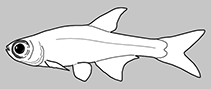 No image available for this species;
drawing shows typical species in Sundadanionidae.
Google afbeelding
drawing shows typical species in Sundadanionidae.
Classificatie / Namen Lokale namen | Synoniemen | Catalog of Fishes(Genus, Soort(en)) | ITIS | CoL | WoRMS | Cloffa
> Cypriniformes (Carps) > Sundadanionidae (Tiny danios)
Etymology: Sundadanio: Sunda: Asiatic island; Danio: from ‘dhani’, local Bengali/Bangla name for small minnows (Ref. 2031); retiarius: From the latin 'retiarius', in ancient Rome means a gladiator armed with a piece of netting and a trident. This is in reference to the reticulated pattern along the dorsal surface. A noun in apposition.
More on authors: Conway, Kottelat & Tan.
Etymology: Sundadanio: Sunda: Asiatic island; Danio: from ‘dhani’, local Bengali/Bangla name for small minnows (Ref. 2031); retiarius: From the latin 'retiarius', in ancient Rome means a gladiator armed with a piece of netting and a trident. This is in reference to the reticulated pattern along the dorsal surface. A noun in apposition.
More on authors: Conway, Kottelat & Tan.
Milieu: milieu / Klimaatzone / Diepte / verspreidingsgebied Ecologie
; zoet water benthopelagisch. Tropical
Verspreiding Gebieden | FAO regio's | Ecosystemen | Voorkomen | Verspreidingskaart | Introducties | Faunafri
Asia: peat swamps and blackwater streams of the southern part of Central Kalimantan, from the Kotawaringin to Kahayan drainages in Indonesia.
Grootte / Gewicht / Leeftijd
Korte beschrijving Determinatiesleutels | Morfologie | Morfometrie
Dorsale zachte stralen (totaal) : 9; Anale zachte stralen: 9; Wervels: 34 - 35. Distinguished from all congeners by its smaller distance between dark lateral stripe and ventral midline in males (distance fitting 2.6 times into body depth at pelvic-fin origin vs. 1.7-2.1 in other species) and horizontal through ventral border of dark lateral stripe extending through
ventral half of eye (vs. extending through dorsal half of eye). Can be further diagnosed from all, except Sundadanio rubellus and S. echinus, by having of a weak reticulate pattern over the dorsal and lateral body surfaces (vs. absence). Differs also by the following combination of characters: large adult body size (largest specimen examined 19.4 mm SL); live males with orangelight green sheen present across dorsal body surface, an intense red-orange secondary lateral stripe, bordering ventral edge of orange-light green sheen from point posterior to opercular opening to point opposite middle of anal fin, and an intense black-red marking across anterior portion of anal fin; preserved males with a well developed dark lateral stripe, deepest anteriorly, covering entire window in body musculature; presence of a secondary lateral stripe of small melanophores running parallel to dark lateral stripe along its ventral margin from posterior to opercular opening to point opposite middle of anal fin, often occluded by ventral edge of dark lateral stripe in mature males; absence of dusky markings on distal tips of dorsal and caudal fins; presence of enlarged scales next to window in body musculature; scales posterior to enlarged scales next to window in body musculature and
anterior to anal-fin origin with a single small tubercle at center; complete covering of scales on
caudal peduncle (Ref. 88800).
Body shape (shape guide): fusiform / normal.
Body shape (shape guide): fusiform / normal.
Inhabits peat swamps and blackwater streams (Ref. 88800).
Levenscyclus en paargedrag Maturiteit | Voortplanting | Paaien | Eieren | Fecunditeit | Larven
Hoofdreferentie
Upload uw referenties | Referenties | Coördinator | Medewerkers
Conway, K.W., M. Kottelat and H.H. Tan, 2011. Review of the Southeast Asian miniature cyprinid genus Sundadanio (Ostariophysi: Cyprinidae) with descriptions of seven new species from Indonesia and Malaysia. Ichthyol. Explor. Freshwat. 22(3):251-288. (Ref. 88800)
Status op de Rode Lijst van het IUCN (Ref. 130435: Version 2025-2 (Global))
Niet bedreigd (LC) ; Date assessed: 04 January 2019
CITES
Not Evaluated
Gevaar voor de mens
Harmless
Gebruik door de mens
Visserij: van geen belang
FAO - Publication: search | FishSource |
Meer informatie
Trofische ecologie
Voedsel (prooien)
Dieetsamenstelling
Voedselconsumptie
Voedselrantsoenen
Predatoren
Voedsel (prooien)
Dieetsamenstelling
Voedselconsumptie
Voedselrantsoenen
Predatoren
Ecologie
Ecologie
Ecologie
Populatiedynamica
Groeiparameters
Max. leeftijden / maten
Lengte-gewicht rel.
Lengte-lengte rel.
Lengtefrequenties
Massaconversie
Rekrutering
Abundantie
Groeiparameters
Max. leeftijden / maten
Lengte-gewicht rel.
Lengte-lengte rel.
Lengtefrequenties
Massaconversie
Rekrutering
Abundantie
Levenscyclus
Voortplanting
Maturiteit
Rijpheid/kieuwen rel.
Fecunditeit
Paaien
Paaibestanden
Eieren
Ontwikkeling van de eieren
Larven
Larvale populatiedynamiek
Voortplanting
Maturiteit
Rijpheid/kieuwen rel.
Fecunditeit
Paaien
Paaibestanden
Eieren
Ontwikkeling van de eieren
Larven
Larvale populatiedynamiek
Anatomie
Kieuwoppervlak
Hersenen
Otoliet
Kieuwoppervlak
Hersenen
Otoliet
Fysiologie
Lichaamssamenstelling
Voedingsstoffen
Zuurstofverbruik
Type zwemmen
Zwemsnelheid
Visuele pigmenten
Vis geluid
Ziekten en parasieten
Toxiciteit (LC50)
Lichaamssamenstelling
Voedingsstoffen
Zuurstofverbruik
Type zwemmen
Zwemsnelheid
Visuele pigmenten
Vis geluid
Ziekten en parasieten
Toxiciteit (LC50)
Genetica
genoom
Genetica
Heterozygositeit
Erfelijkheid
Genetische diversiteit
genoom
Genetica
Heterozygositeit
Erfelijkheid
Genetische diversiteit
Menselijk gerelateerd
Aquacultuursystemen
Aquacultuurprofielen
Kweeklijnen
Ciguatera gevallen
Postzegels, munten, diversen.
Aquacultuursystemen
Aquacultuurprofielen
Kweeklijnen
Ciguatera gevallen
Postzegels, munten, diversen.
Tools
Speciale rapporten
Bekijk gegevens voor het houden in een aquarium | Bekijk Fact Sheets voor de soort | Bekijk Aquacultuur Fact Sheets
Download XML
Internetbronnen
AFORO (otoliths) | Aquatic Commons | BHL | Cloffa | Websites from users | Bekijk FishWatcher | CISTI | Catalog of Fishes: Genus, Soort(en) | DiscoverLife | ECOTOX | FAO - Publication: search | Faunafri | Fishipedia | Fishtrace | GloBI | Google Books | Google Scholar | Google | IGFA World Record | OneZoom | Open Tree of Life | Otolith Atlas of Taiwan Fishes | PubMed | Reef Life Survey | Socotra Atlas | TreeBase | Tree of Life | Wikipedia: ga naar, zoek | World Records Freshwater Fishing | Zoobank | Zoological Record
Schattingen op basis van modellen
Fylogenetische diversiteitsindex (Ref. 82804): PD50 = 0.5059 [Uniqueness, from 0.5 = low to 2.0 = high].
Bayesian length-weight: a=0.01122 (0.00514 - 0.02450), b=3.04 (2.87 - 3.21), in cm total length, based on all LWR estimates for this body shape (Ref. 93245).
Trofisch niveau (Ref. 69278): 3.0 ±0.2 se; based on size and trophs of closest relatives