



Sundadanio echinus Conway, Kottelat & Tan, 2011
Hochladen Photos und videos
Google Bild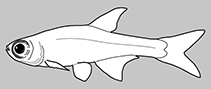 No image available for this species;
drawing shows typical species in Sundadanionidae.
Google Bild
drawing shows typical species in Sundadanionidae.
Klassifizierung / Names Namen | Synonyme | Catalog of Fishes(Gattung, Arten) | ITIS | CoL | WoRMS | Cloffa
> Cypriniformes (Carps) > Sundadanionidae (Tiny danios)
Etymology: Sundadanio: Sunda: Asiatic island; Danio: from ‘dhani’, local Bengali/Bangla name for small minnows (Ref. 2031); echinus: From the Latin 'echinus', meaning hedgehog. This is in reference to the large, spiny tubercles on the lower jaw of Sundadanio, which were first discovered in this species. A noun in apposition.
More on authors: Conway, Kottelat & Tan.
Etymology: Sundadanio: Sunda: Asiatic island; Danio: from ‘dhani’, local Bengali/Bangla name for small minnows (Ref. 2031); echinus: From the Latin 'echinus', meaning hedgehog. This is in reference to the large, spiny tubercles on the lower jaw of Sundadanio, which were first discovered in this species. A noun in apposition.
More on authors: Conway, Kottelat & Tan.
Umwelt: Milieu / Klimazone / Tiefenbereich / Verbreitungsgebiet Ökologie
; süßwasser benthopelagisch. Tropical
Verbreitung Territorien | FAO Gebiete | Ökosysteme | Vorkommen | Punkt Karte | Einführungen | Faunafri
Asia: peat swamp forests of the vicinity of Anjungan and Kepayan in West Kalimantan, Indonesia. Pictures of Sundadanio from western Sarawak that have been tentatively identified as Sundadanio echinus may indicate that this species may have a wider distribution than is known presently.
Größe / Gewicht / Alter
Kurzbeschreibung Bestimmungsschlüssel | Morphologie | Morphometrie
Rückenflossenweichstrahlen (insgesamt) : 9; Afterflossenweichstrahlen: 9; Wirbelzahl: 34 - 35. Distinguished from all congeners by its snout length, 15-19% HL and body depth at pelvic-fin origin, 25-30 % SL. Differs from all other species, except Sundadnio rubellus, by the presence of the secondary lateral stripe in both sexes. Can be further diagnosed by following combination of characters: large adult body size (largest specimen examined 17.8 mm SL); live males with emerald green sheen present across dorsal body surface, an intense red secondary lateral stripe, running along ventral edge of emerald green sheen from posterior to opercular opening to point opposite middle of anal fin, and an intense black marking across anterior portion of anal fin; preserved males with a well developed dark lateral stripe of roughly uniform depth along entire length, horizontal through ventral border of which, when brought forward, extending through dorsal half of eye; presence of a distinctive secondary lateral stripe of small melanophores running parallel to dark lateral stripe along its ventral margin from posterior to opercular opening to point opposite middle of anal fin; presence of reticulate pattern along dorsal body surface posterior to dorsal-fin origin; absence of dusky markings on dorsal and caudal fins; presence of enlarged scales next to window in body musculature; complete covering of scales on caudal peduncle; scales posterior to enlarged scales next to window in body musculature and anterior to anal-fin origin with a single small tubercle at center (Ref. 88800).
Body shape (shape guide): fusiform / normal.
Body shape (shape guide): fusiform / normal.
Inhabits peat swamp forests (Ref. 88800).
Lebenszyklus und Paarungsverhalten Geschlechtsreife | Fortpflanzung | Ablaichen | Eier | Fruchtbarkeit | Larven
Hauptreferenz
Laden Sie Ihre Referenzen hoch | Referenzen | Koordinator | Partner
Conway, K.W., M. Kottelat and H.H. Tan, 2011. Review of the Southeast Asian miniature cyprinid genus Sundadanio (Ostariophysi: Cyprinidae) with descriptions of seven new species from Indonesia and Malaysia. Ichthyol. Explor. Freshwat. 22(3):251-288. (Ref. 88800)
IUCN Rote Liste Status (Ref. 130435: Version 2025-2 (Global))
Verwundbar (VU) (B1ab(i,ii,iii,iv)+2ab(i,ii,iii,iv)); Date assessed: 04 January 2019
CITES
Not Evaluated
Bedrohung für Menschen
Harmless
Nutzung durch Menschen
FAO - Publication: search | FishSource |
Mehr Information
Trophische Ökologie
Lebensmittel (Beutetiere)
Nahrungszusammensetzung
Nahrungsaufnahme
Lebensmittelrationen
Räuber
Lebensmittel (Beutetiere)
Nahrungszusammensetzung
Nahrungsaufnahme
Lebensmittelrationen
Räuber
Ökologie
Ökologie
Ökologie
Populationsdynamik
Wachstumsparameter
Max. Alter/Größen
Länge-Gewicht-Rel.
Länge-Länge-Verhältnis.
Längenhäufigkeiten
Massenkonvertierung
Rekrutierung
Dichte
Wachstumsparameter
Max. Alter/Größen
Länge-Gewicht-Rel.
Länge-Länge-Verhältnis.
Längenhäufigkeiten
Massenkonvertierung
Rekrutierung
Dichte
Lebenszyklus
Fortpflanzung
Geschlechtsreife
Reifung/Kiemen rel.
Fruchtbarkeit
Ablaichen
Laichaggregationen
Eier
Eientwicklung
Larven
Larven Pop.Dyn.
Fortpflanzung
Geschlechtsreife
Reifung/Kiemen rel.
Fruchtbarkeit
Ablaichen
Laichaggregationen
Eier
Eientwicklung
Larven
Larven Pop.Dyn.
Anatomie
Kiemenoberfläche
Gehirn
Otolith
Kiemenoberfläche
Gehirn
Otolith
Physiologie
Körperliche Zusammensetzung
Nährstoffe
Sauerstoffverbrauch
Schwimmart
Schwimmgeschwindigkeit
Visuelle Pigmente
Fischgeräusche
Krankheiten und Parasiten
Toxizität (LC50s)
Körperliche Zusammensetzung
Nährstoffe
Sauerstoffverbrauch
Schwimmart
Schwimmgeschwindigkeit
Visuelle Pigmente
Fischgeräusche
Krankheiten und Parasiten
Toxizität (LC50s)
Genetik
Genom
Genetik
Heterozygotie
Vererbbarkeit
Genetische Vielfalt
Genom
Genetik
Heterozygotie
Vererbbarkeit
Genetische Vielfalt
Menschenbezogen
Aquakultur-Systeme
Aquakultur Profile
Zuchtlinien
Ciguatera-Fälle
Briefmarken, Münzen, Verschiedenes.
Aquakultur-Systeme
Aquakultur Profile
Zuchtlinien
Ciguatera-Fälle
Briefmarken, Münzen, Verschiedenes.
Tools
Zusatzinformationen
Download XML
Zusammenfassung | Punktdaten | Namen | Photos
Internet Quellen
AFORO (otoliths) | Aquatic Commons | BHL | Cloffa | Websites from users | FishWatcher Einträge suchen | CISTI | Catalog of Fishes: Gattung, Arten | DiscoverLife | ECOTOX | FAO - Publication: search | Faunafri | Fishipedia | Fishtrace | GloBI | Google Books | Google Scholar | Google | IGFA World Record | OneZoom | Open Tree of Life | Otolith Atlas of Taiwan Fishes | PubMed | Reef Life Survey | Socotra Atlas | TreeBase | Tree of Life | Wikipedia: Gehe zu, Suchen | World Records Freshwater Fishing | Zoobank | Zoologischer Rekord
Schätzungen auf der Grundlage von Modellen
Phylogenetischer Diversitätsindex (Ref. 82804): PD50 = 0.5059 [Uniqueness, from 0.5 = low to 2.0 = high].
Bayesian length-weight: a=0.01122 (0.00514 - 0.02450), b=3.04 (2.87 - 3.21), in cm total length, based on all LWR estimates for this body shape (Ref. 93245).
Trophische Ebene (Ref. 69278): 3.0 ±0.2 se; based on size and trophs of closest relatives