



Sundadanio gargula Conway, Kottelat & Tan, 2011
Envoyez vos Photos et vidéos
Images Google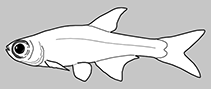 No image available for this species;
drawing shows typical species in Sundadanionidae.
Images Google
drawing shows typical species in Sundadanionidae.
Classification / Noms Noms communs | Synonymes | Catalog of Fishes(Genre, Espèce) | ITIS | CoL | WoRMS | Cloffa
> Cypriniformes (Carps) > Sundadanionidae (Tiny danios)
Etymology: Sundadanio: Sunda: Asiatic island; Danio: from ‘dhani’, local Bengali/Bangla name for small minnows (Ref. 2031); gargula: Derived from gar-, an onomatope common to many ancient European language for boiling water or water flowing through a gullet, and from the Latin 'gula', meaning throat; this gave rise to French gargouille and the English gargoyle; in reference to the somewhat grotesque appearance of the head and throat of tuberculate males of this species. A noun in apposition.
More on authors: Conway, Kottelat & Tan.
Etymology: Sundadanio: Sunda: Asiatic island; Danio: from ‘dhani’, local Bengali/Bangla name for small minnows (Ref. 2031); gargula: Derived from gar-, an onomatope common to many ancient European language for boiling water or water flowing through a gullet, and from the Latin 'gula', meaning throat; this gave rise to French gargouille and the English gargoyle; in reference to the somewhat grotesque appearance of the head and throat of tuberculate males of this species. A noun in apposition.
More on authors: Conway, Kottelat & Tan.
Environnement : milieu / zone climatique / profondeur / gamme de distribution Écologie
; eau douce démersal. Tropical
Distribution Territoires | Zones FAO | Écosystèmes | Occurrences | Carte par point | Introductions | Faunafri
Asia: Bangka Island, Sumatra, Indonesia.
Taille / Poids / Âge
Description synthétique Clés d'identification | Morphologie | Morphométrie
Rayons mous dorsaux (Total) : 9; Rayons mous anaux: 9; Vertèbres: 34. Distinguished all its congeners by the greater distance between the dark lateral stripe and the
ventral midline in males (13.5-14.5 % SL vs. 8.7- 13.6) and by its larger and more numerous tubercles (enlarged scales next to window in body musculature with a vertical row of 3-5 large
conical tubercles vs. 1-3; scales posterior to enlarged scales next to window in body musculature and anterior to anal-fin origin with 2 large, closely situated conical tubercles at center vs. 1 or 2 small, widely spaced tubercles). Can be further distinguished by the following combination of characters: large adult body size (largest specimen examined 19.0 mm SL, smallest tuberculate male 15.2 mm SL); live males with blue to emerald green sheen present across dorsal body surface and an intense red colour across anterior portion of anal fin; preserved males with a highly developed dark lateral stripe of uniform intensity along its entire length, horizontal through ventral border of which, when brought forward, extends through dorsal half of eye; absence of secondary lateral stripe in preserved males; absence of reticulate pattern along dorsal body surface; absence of dusky markings on dorsal and
caudal fins; complete covering of scales on caudal peduncle (Ref. 88800).
Body shape (shape guide): fusiform / normal.
Body shape (shape guide): fusiform / normal.
Inhabits peat swamp forests (Ref. 88800).
Cycle de vie et comportement reproducteur Maturité | Reproduction | Frai | Œufs | Fécondité | Larves
Référence principale
Téléchargez vos références | Références | Coordinateur | Collaborateurs
Conway, K.W., M. Kottelat and H.H. Tan, 2011. Review of the Southeast Asian miniature cyprinid genus Sundadanio (Ostariophysi: Cyprinidae) with descriptions of seven new species from Indonesia and Malaysia. Ichthyol. Explor. Freshwat. 22(3):251-288. (Ref. 88800)
Statut dans la liste rouge de l'IUCN (Ref. 130435: Version 2025-2 (Global))
Vulnérable (VU) (B1ab(i,ii,iii)+2ab(i,ii,iii)); Date assessed: 04 January 2019
CITES
Not Evaluated
Menace pour l'homme
Harmless
Utilisations par l'homme
Pêcheries: sans intérêt
FAO - Publication: search | FishSource |
Plus d'informations
Écologie trophique
Aliments (proies)
Composition du régime alimentaire
Consommation alimentaire
Rations alimentaires
Prédateurs
Aliments (proies)
Composition du régime alimentaire
Consommation alimentaire
Rations alimentaires
Prédateurs
Écologie
Écologie
Écologie
Dynamique des populations
Paramètres de croissance
Âges / tailles maximales
Longueur-poids rel.
Rel. longueur-longueur.
Fréquences de longueurs
Conversion de masse
Recrutement
Abondance
Paramètres de croissance
Âges / tailles maximales
Longueur-poids rel.
Rel. longueur-longueur.
Fréquences de longueurs
Conversion de masse
Recrutement
Abondance
Cycle de vie
Reproduction
Maturité
Maturité/épines rel.
Fécondité
Frai
Agrégats de frai
Œufs
Développement de l'œuf
Larves
Dynamique des populations larvaires
Reproduction
Maturité
Maturité/épines rel.
Fécondité
Frai
Agrégats de frai
Œufs
Développement de l'œuf
Larves
Dynamique des populations larvaires
Anatomie
Surface branchiale
Cerveau
Otolithe
Surface branchiale
Cerveau
Otolithe
Physiologie
Composition corporelle
Nutriments
Consommation d'oxygène
Type de natation
Vitesse de nage
Pigments visuels
Son de poisson
Maladies et parasites
Toxicité (CL50)
Composition corporelle
Nutriments
Consommation d'oxygène
Type de natation
Vitesse de nage
Pigments visuels
Son de poisson
Maladies et parasites
Toxicité (CL50)
Génétique
génôme
Génétique
Hétérozygotie
Héritabilité
Diversité génétique
génôme
Génétique
Hétérozygotie
Héritabilité
Diversité génétique
Liées à l'homme
Systèmes d'aquaculture
Profils d'aquaculture
Souches
Cas de ciguatera
Timbres, pièces de monnaie, divers
Systèmes d'aquaculture
Profils d'aquaculture
Souches
Cas de ciguatera
Timbres, pièces de monnaie, divers
Outils
E-book | Guide de terrain | Générateur de fréquences de longueur | Outil de dynamique de population | Carte par point |
Capture-MSY |
Articles particuliers
Télécharger en XML
Sources Internet
AFORO (otoliths) | Aquatic Commons | BHL | Cloffa | Websites from users | FishWatcher | CISTI | Catalog of Fishes: Genre, Espèce | DiscoverLife | ECOTOX | FAO - Publication: search | Faunafri | Fishipedia | Fishtrace | GloBI | Google Books | Google Scholar | Google | IGFA World Record | OneZoom | Open Tree of Life | Otolith Atlas of Taiwan Fishes | PubMed | Reef Life Survey | Socotra Atlas | TreeBase | Arbre de Vie | Wikipedia: aller à, chercher | World Records Freshwater Fishing | Zoobank | Zoological Record
Estimations basées sur des modèles
Indice de diversité phylogénétique (Réf. 82804): PD50 = 0.5059 [Uniqueness, from 0.5 = low to 2.0 = high].
Bayesian length-weight: a=0.01122 (0.00514 - 0.02450), b=3.04 (2.87 - 3.21), in cm total length, based on all LWR estimates for this body shape (Ref. 93245).
Niveau trophique (Réf. 69278): 3.0 ±0.2 se; based on size and trophs of closest relatives