



Homatula laxiclathra Gu & Zhang, 2012
Carregue seu(sua) Fotos e vídeos
Imagem do Google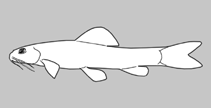 No image available for this species;
drawing shows typical species in Nemacheilidae.
Imagem do Google
drawing shows typical species in Nemacheilidae.
Classificação / Nomes Nomes comuns | Sinônimos | Catalog of Fishes(Gênero, Espécies) | ITIS | CoL | WoRMS | Cloffa
> Cypriniformes (Carps) > Nemacheilidae (Brook loaches)
Etymology: Homatula: Greek, homos, homoios = similar + Greek, atylos, atylotos = without callosities; laxiclathra: Name from the combination of Latin words laxus (wide) and clathrus (barred), alluding the presence of wider vertical bars on each side of body; an adjective.
Etymology: Homatula: Greek, homos, homoios = similar + Greek, atylos, atylotos = without callosities; laxiclathra: Name from the combination of Latin words laxus (wide) and clathrus (barred), alluding the presence of wider vertical bars on each side of body; an adjective.
Meio ambiente: milieu / Zona climática / intervalo de profundidade / faixa de distribuição Ecologia
; Água doce demersal. Subtropical
Distribuição Territórios | Áreas da FAO | Ecossistemas | Ocorrências | Mapa de pontos | Introduções | Faunafri
Asia: China.
Tamanho / Peso / Idade
Descrição suscinta Chaves de identificação | Morfologia | Morfometria
Homatula laxiclathra is similar to H. variegate, H. berezowskii, and H. longidorsalis in the shared presence of slender bodies with uniform depth [9.3–15.8% (mean 12.5) SL], a character distinguishing them from all remaining species of this genus where they have deeper bodies [13.6–23.9% (mean 16.6) SL] and their body depth evenly decreases posterior to the posterior end of the dorsal-fin base. The new species differs from H. variegata, H. berezowskii, and H. longidorsalis in having vertical brown bars on the caudal peduncle twice as wide as (vs. much narrower or slightly wider than) their interspaces. This new species, along with H. berezowskii, is further distinguished from H. variegata and H. longidorsalis by the presence of a shorter head (length 15.6–21.1% SL vs. 18.3–25.3), a shallower caudal peduncle (depth 8.4–11.4% SL vs. 9.6–13.6), a shorter adipose crest along the dorsal midline of the caudal peduncle anteriorly not extending to the midway of the analfin base (vs. extending beyond the vertical through the anal-fin origin), a scaleless (vs. partially scaled) predorsal body, and an intestine with (vs. without) a loop or bend behind the stomach. It is further distinct from H. berezowskii in having an oblique (vs. truncate) posterior margin of the caudal fin, and a narrower interorbital space [width 19.9–24.9 (average 22.5)% HL vs. 24.1–29.7 (average 27.0)]. The new species has an intestine with a loop anteriorly reaching the posterior surface of the U-shaped stomach, whereas the other related species do not have a loop at this portion of the intestine (Ref. 88693).
Body shape (shape guide): elongated.
Body shape (shape guide): elongated.
Ciclo de vida ou comportamento de acasalamento Maturidade | Reprodução | Desova | Ovos | Fecundidade | Larvas
Referência principal
Carregar suas referências | Referências | Coordenador | Colaboradores
Gu, J.-H. and E. Zhang, 2012. Homatula laxiclathra (Teleostei: Balitoridae), a new species of nemacheiline loach from the Yellow River drainagein Shaanxi Province, northern China. Environ. Biol. Fishes 94:591-599. (Ref. 88693)
Status na Lista Vermelha da UICN (Ref. 130435: Version 2025-2 (Global))
Vulnerável (VU) (B1ab(iii)); Date assessed: 12 November 2024
CITES
Not Evaluated
Ameaça para os humanos
Harmless
Uso pelos humanos
FAO - Publication: search | FishSource |
Mais informação
Ecologia Trófica
Itens alimentares (presas)
Composição da dieta
Consumo alimentar
Rações alimentares
Predadores
Itens alimentares (presas)
Composição da dieta
Consumo alimentar
Rações alimentares
Predadores
Ecologia
Ecologia
Ecologia
Dinâmica populacional
Parâmetros de crescimento
Idade máxima / tamanhos
Relação comprimento-peso.
Relação comprimento-comprimento.
Frequências de comprimento
Conversão de massa
Recrutamento
Abundância
Parâmetros de crescimento
Idade máxima / tamanhos
Relação comprimento-peso.
Relação comprimento-comprimento.
Frequências de comprimento
Conversão de massa
Recrutamento
Abundância
Ciclo de vida
Reprodução
Maturidade
Maturidade/Rel. das guelras
Fecundidade
Desova
Agregações de desova
Ovos
Desenvolvimento dos ovos
Larvas
Dinâmica larval
Reprodução
Maturidade
Maturidade/Rel. das guelras
Fecundidade
Desova
Agregações de desova
Ovos
Desenvolvimento dos ovos
Larvas
Dinâmica larval
Anatomia
Área branquial
Cérebro
Otólito
Área branquial
Cérebro
Otólito
Fisiologia
Composição corporal
Nutrientes
Consumo de oxigênio
Tipo de natação
Velocidade de natação
Pigmentos visuais
Som de peixe
Doenças e Parasitas
Toxicidade (LC50s)
Composição corporal
Nutrientes
Consumo de oxigênio
Tipo de natação
Velocidade de natação
Pigmentos visuais
Som de peixe
Doenças e Parasitas
Toxicidade (LC50s)
Genética
genoma
Genética
Heterozigosidade
Hereditariedade
Diversidade genética
genoma
Genética
Heterozigosidade
Hereditariedade
Diversidade genética
Relacionado a humanos
Sistemas de aquicultura
Perfis para aquacultura
Estirpes
Casos de Ciguatera
Selos, moedas, diversos.
Sistemas de aquicultura
Perfis para aquacultura
Estirpes
Casos de Ciguatera
Selos, moedas, diversos.
Ferramentas
Livro eletrônico | Guia de campo | Ferramenta auxiliar de frequências de comprimento | Ferramenta sobre a história de vida | Mapa de pontos |
Catch-MSY |
Relatórios especiais
Checar Manutenção em Aquário | Checar Planilhas de Fatos sobre as Espécies | Checar Planilhas de Fatos sobre Aquicultura
Baixar XML
Fontes da internet
AFORO (otoliths) | Aquatic Commons | BHL | Cloffa | Websites from users | Checar Observador de Peixes (FishWatcher) | CISTI | Catalog of Fishes: Gênero, Espécies | DiscoverLife | ECOTOX | FAO - Publication: search | Faunafri | Fishipedia | Fishtrace | GloBI | Google Books | Google Scholar | Google | IGFA World Record | OneZoom | Open Tree of Life | Otolith Atlas of Taiwan Fishes | PubMed | Reef Life Survey | Socotra Atlas | TreeBase | Árvore da vida | Wikipedia: Ir para, procura | World Records Freshwater Fishing | Zoobank | Registro zoológico
Estimativas baseadas em modelos
Índice de diversidade filogenética (Ref. 82804): PD50 = 0.5000 [Uniqueness, from 0.5 = low to 2.0 = high].
Bayesian length-weight: a=0.00724 (0.00352 - 0.01491), b=3.01 (2.84 - 3.18), in cm total length, based on LWR estimates for this (Sub)family-body shape (Ref. 93245).
Nível Trófico (Ref. 69278): 2.7 ±0.3 se; based on size and trophs of closest relatives
Resiliência (Ref. 120179): médio(a), tempo mínimo de duplicação da população 1,4 - 4,4 anos (Preliminary K or Fecundity.).