Sargocentron rubrum, Redcoat : fisheries, aquarium

Sargocentron rubrum (Forsskål, 1775)

Redcoat
Beobachtung melden im Fish Watcher
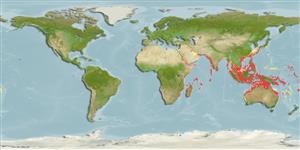
Native range | All suitable habitat | Point map | Year 2050
This map was computer-generated and has not yet been reviewed.
Sargocentron rubrum   AquaMaps   Data sources: GBIF OBIS
Hochladen Photos und videos
Bilder | videos | Google Bild

Klassifizierung / Names Namen | Synonyme | Catalog of Fishes(Gattung, Arten) | ITIS | CoL | WoRMS | Cloffa

> Holocentriformes (Squirrelfishes, soldierfishes) > Holocentridae (Squirrelfishes, soldierfishes) > Holocentrinae
Etymology: Sargocentron: Greek, sargos = sargus + Greek, kentron = sting (Ref. 45335).
More on author: Forsskål.

Umwelt: Milieu / Klimazone / Tiefenbereich / Verbreitungsgebiet Ökologie

seewasser riff-verbunden; tiefenbereich 1 - 84 m (Ref. 27370). Subtropical; 35°N - 35°S, 32°E - 173°W (Ref. 27370)

Verbreitung Territorien | FAO Gebiete | Ökosysteme | Vorkommen | Punkt Karte | Einführungen | Faunafri

Indo-West Pacific: Red Sea to the western Pacific where it ranges from southern Japan to New Caledonia, Vanuatu and New South Wales, Australia. Recently recorded from Tonga (Ref. 53797). Not yet recorded from any oceanic island in the western Indian Ocean. Invaded eastern Mediterranean via the Suez Canal.

Länge bei der ersten Reifung / Größe / Gewicht / Alter

Geschlechtsreife: Lm 14.7  range ? - ? cm
Max length : 32.0 cm TL Männchen/unbestimmt; (Ref. 5213); common length : 27.0 cm TL Männchen/unbestimmt; (Ref. 43448)

Kurzbeschreibung Bestimmungsschlüssel | Morphologie | Morphometrie

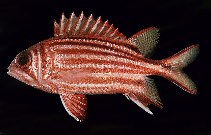
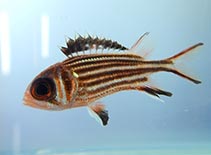
Rückenflossenstacheln (insgesamt) : 11; Rückenflossenweichstrahlen (insgesamt) : 12 - 14; Afterflossenstacheln: 4; Afterflossenweichstrahlen: 8 - 10. Body with subequal stripes of brownish red and silvery white; spinous dorsal dark red with a large, quadrangular, whitish blotch in middle of each membrane (except the first) forming a median band; dorsal membrane tips white, except posteriorly (Ref. 4201). Five oblique scale rows on cheek; body depth 2.5-2.8 in SL; head length (HL) 2.65-2.85 in SL; short and blunt snout, its length 4.25-4.7 in HL; interorbital width 4.5 in HL; mouth terminal to slightly inferior, maxilla usually extending nearly to or a short distance beyond a vertical through center of eye, upper jaw length 2.5-2.75 in HL; premaxillary groove often ending above anterior edge of orbit; anterior end of nasal bone with a blunt spine; surface or medial edge of nasal bone spineless; nasal fossa usually without spinules on its edge; upper edge of 1st suborbital bone with a slightly retrorse lateral spine a short distance posterior to a vertical at front edge of eye, followed by a ridge of recumbent spinules; preopercular spine usually about 2/3 orbit diameter, 3.2-5.3 in HL; 3rd-5th dorsal spines subequal, longest in adults 1.9-2.3 in HL; 3rd anal spine 1.35-1.6 in HL (Ref. 27370).
Body shape (shape guide): fusiform / normal; Cross section: compressed.

Biologie     Fachlexikon (Englisch) (z.B. epibenthic)

Found in coastal reefs (Ref. 9710); silty reefs or wrecks in lagoons, bays, or harbors (Ref. 27370), may occur in aggregations; also found hidden in caves and cracks of rocks during the day (Ref. 12382, 48635), usually in areas subject to strong currents (Ref. 48635). Intertidal observations were also reported (Ref. 49162). Feed mainly on benthic crabs and shrimps (Ref. 2334), also preys on small fishes (Ref. 12382). Eggs and larvae are pelagic (Ref. 6746). Spine of preopercle venomous (Ref. 2334). Solitary or in groups (Ref 90102).

Lebenszyklus und Paarungsverhalten Geschlechtsreife | Fortpflanzung | Ablaichen | Eier | Fruchtbarkeit | Larven

Hauptreferenz Laden Sie Ihre Referenzen hoch | Referenzen | Koordinator : Randall, John E. | Partner

Randall, J.E., 1998. Revision of the Indo-Pacific squirrelfishes (Beryciformes: Holocentridae: Holocentrinae) of the genus Sargocentron, with descriptions of four new species. Indo-Pac. Fish. (27):105 p. (Ref. 27370)

IUCN Rote Liste Status (Ref. 130435: Version 2025-2 (Global))

  nicht bedroht (LC) ; Date assessed: 04 March 2015

CITES

Not Evaluated

CMS (Ref. 116361)

Not Evaluated

Bedrohung für Menschen

  Venomous (Ref. 2334)


Nutzung durch Menschen

Fischereien: weniger kommerziell; Aquarium: Öffentliche Aquarien
FAO - Publication: search | FishSource |

Mehr Information

Trophische Ökologie
Lebensmittel (Beutetiere)
Nahrungszusammensetzung
Nahrungsaufnahme
Lebensmittelrationen
Räuber
Ökologie
Ökologie
Populationsdynamik
Wachstumsparameter
Max. Alter/Größen
Länge-Gewicht-Rel.
Länge-Länge-Verhältnis.
Längenhäufigkeiten
Massenkonvertierung
Rekrutierung
Dichte
Lebenszyklus
Fortpflanzung
Geschlechtsreife
Reifung/Kiemen rel.
Fruchtbarkeit
Ablaichen
Laichaggregationen
Eier
Eientwicklung
Larven
Larven Pop.Dyn.
Anatomie
Kiemenoberfläche
Gehirn
Otolith
Physiologie
Körperliche Zusammensetzung
Nährstoffe
Sauerstoffverbrauch
Schwimmart
Schwimmgeschwindigkeit
Visuelle Pigmente
Fischgeräusche
Krankheiten und Parasiten
Toxizität (LC50s)
Genetik
Genom
Genetik
Heterozygotie
Vererbbarkeit
Genetische Vielfalt
Menschenbezogen
Aquakultur-Systeme
Aquakultur Profile
Zuchtlinien
Ciguatera-Fälle
Briefmarken, Münzen, Verschiedenes.
Aufsuchen
Partner
Referenzen
Referenzen

Tools

Zusatzinformationen

Download XML

Internet Quellen

Schätzungen auf der Grundlage von Modellen

Bevorzugte Temperatur (Ref. 123201): 25 - 29, mean 28.1 °C (based on 1372 cells).
Phylogenetischer Diversitätsindex (Ref. 82804):  PD50 = 0.5000   [Uniqueness, from 0.5 = low to 2.0 = high].
Bayesian length-weight: a=0.01778 (0.01463 - 0.02161), b=2.95 (2.90 - 3.00), in cm total length, based on LWR estimates for this species (Ref. 93245).
Trophische Ebene (Ref. 69278):  3.6   ±0.3 se; based on diet studies.
Widerstandsfähigkeit (Ref. 120179):  hoch, Verdopplung der Population dauert weniger als 15 Monate. (Preliminary K or Fecundity.).
Anfälligkeit der Fischerei (Ref. 59153):  Low vulnerability (17 of 100). 🛈
Preiskategorie (Ref. 80766):   Medium.
Nährstoffe (Ref. 124155):  Calcium = 37.1 [12.8, 126.2] mg/100g; Iron = 0.583 [0.214, 1.854] mg/100g; Protein = 19.5 [18.2, 20.7] %; Omega3 = 0.234 [0.086, 0.593] g/100g; Selenium = 22.1 [10.4, 47.6] μg/100g; VitaminA = 26.4 [8.1, 94.8] μg/100g; Zinc = 1.15 [0.45, 2.29] mg/100g (wet weight);