



Paraliparis vipera Chernova & Prut'ko, 2011
Carica il tuo foto e Video
Google image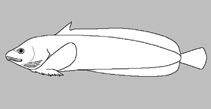 No image available for this species;
drawing shows typical species in Liparidae.
Google image
drawing shows typical species in Liparidae.
Classificazione / Nomi Nomi Comuni | Sinonimi | Catalog of Fishes(Genere, Specie) | ITIS | CoL | WoRMS | Cloffa
> Perciformes/Cottoidei (Sculpins) > Liparidae (Snailfishes)
Etymology: Paraliparis: Greek, para = the side of + Greek, liparis = fat (Ref. 45335); vipera: Name derived from Latin vipera for snake, for the head of this species is flattened, as in the snake (Ref. 87306).
More on authors: Chernova & Prut'ko.
Etymology: Paraliparis: Greek, para = the side of + Greek, liparis = fat (Ref. 45335); vipera: Name derived from Latin vipera for snake, for the head of this species is flattened, as in the snake (Ref. 87306).
More on authors: Chernova & Prut'ko.
Ambiente: milieu / zona climatica / distribuzione batimetrica / gamma di distribuzione Ecologia
marino batidemersale, usually 1727 - ? m (Ref. 87306). Polar; 75°S - 76°S, 170°W - 171°W
Distribuzione Territories | Aree FAO | Ecosistemi | Presenze | Mappa dei ritrovamenti | Introduzioni | Faunafri
Antarctic Pacific: Ross Sea.
Dimensione / Peso / Età
Maturità: Lm ? range ? - ? cm
Max length : 3.7 cm TL (female)
Max length : 3.7 cm TL (female)
Breve descrizione Chiavi di identificazione | Morfologia | Morfometria
Diagnosis: head is flattened, and its width (84% of c) noticeably exceeds its depth (58%). Rad. pect. 3 (2 + 0 +1), vert. 70, vert. abd. 11; P 19, C 7. Teeth are uniserial, except the region of symphysis. Snout is 42% of c., and interorbital space is 33% of c. Gill opening is 18% of c and not longer than eye diameter. Preanal distance is 39% of SL. Lower lobe of pectoral fin is short, 10% of SL (Ref. 87306).
Description. Head is small, 6.3 times in SL and is noticeably flattened: head width (84% of c) considerably exceeds its depth (58%). Teeth on jaws are simple, small, cone shaped, and mainly uniserial. On the upper jaw, distally there is a row of 26 teeth, 5 short rows are added anteriorly. On the lower jaw, distally in a row there are approximately 70 teeth of even size; anteriorly there are 3–4 short rows. Lower jaw is of common appearance and not massive. Oral cleft reaches vertical of anterior margin of orbit. Respiratory membranes are wide: palatine and lower jaw membranes are 3 and 2 times wider than dental plates by a factor of three and two, respectively. Oral cavity lining is almost smooth; papillae on its surface are few. Orobuccal fold bears one fingerlike projection located on 1/6 of its length. Gill rakers 12; they are strongly conical and sharpened; spinules at their apices are hardly noticeable. Chin pores, judging from the location of their tubules, are closely set. Body is elongated and compressed from the sides. Preanal distance is 39% of SL (Ref. 87306).
X ray. Vert. 70 (11 + 59), D 61, A 56, C 7. It was impossible to determine the position of the first dorsal ray pterygiophore on the specimen. The first ray of A is under the seventh abdominal vertebra. Pterygiophore of the last dorsal fin ray is between processes of preural vertebrae 1 and 2; pterygiophore of the last dorsal fin ray is between processes of preural vertebrae 3 and 4 (Ref. 87306).
Pectoral girdle. Pectoral radials 3 (2 + 0 + 1); they are round and big; interradial fenestrae are absent. Scapula has a short, wide helve; coracoideum has a long helve, without lateral ribs. P 20 (15 + 2 + 3); rays of notch are not rudimentary. The length of notch rays is 30% of the upper lope length and length of lower lobe rays is 97%. Upper ray of pectoral fin is at the level of the lower third of the orbit; its lower ray is at the vertical of its anterior third. Anus opens under the gill opening. Pyloric caeca 6 (Ref. 87306).
Coloration. Skin on the head and body is lacking; its fragments on the abdomen are pinkish. Lips are blackish. Gill and oral cavities are smoky gray. Stomach is entirely light. Peritoneum is black (Ref. 87306).
Body shape (shape guide): elongated; Cross section: compressed.
Body shape (shape guide): elongated; Cross section: compressed.
A single specimen of P. vipera was found in the stomach of toothfish caught at the continental slope of the southeastern part of the Ross Sea at a depth of 1,727m (Ref. 87306).
Ciclo vitale e comportamento di accoppiamento Maturità | Riproduzione | Deposizione | Uova | Fecondità | Larve
Riferimento principale
Caricare le referenze | Bibliografia | Coordinatore | Collaboratori
Chernova, N.V. and V.G. Prut’ko, 2011. Two new species of Paraliparis(Scorpaeniformes: Liparidae) from the Ross Sea (Antarctica). J. Ichthyol. 51(5):363-372. (Ref. 87306)
CITES
Not Evaluated
Minaccia per l'uomo
Harmless
Usi umani
Pesca: di nessun interesse
FAO - Publication: search | FishSource |
Informazioni ulteriori
Ecologia trofica
Articoli alimentari (prede)
Alimentazione
Consumo di cibo
Razioni alimentari
Predatori
Articoli alimentari (prede)
Alimentazione
Consumo di cibo
Razioni alimentari
Predatori
Ecologia
Ecologia
Ecologia
Dinamica della popolazione
Parametri di crescita
Età massima / dimensioni massime
Rapporto lunghezza-peso.
Lunghezza-lunghezza rel.
Lunghezza-frequenze
Conversione di massa
Reclutamento
Abbondanza
Parametri di crescita
Età massima / dimensioni massime
Rapporto lunghezza-peso.
Lunghezza-lunghezza rel.
Lunghezza-frequenze
Conversione di massa
Reclutamento
Abbondanza
Ciclo di vita
Riproduzione
Maturità
Maturità/Gli occhielli sono relativi.
Fecondità
Deposizione
Aggregazioni riproduttive
Uova
Sviluppo delle uova
Larve
Dinamica popolazioni larvali
Riproduzione
Maturità
Maturità/Gli occhielli sono relativi.
Fecondità
Deposizione
Aggregazioni riproduttive
Uova
Sviluppo delle uova
Larve
Dinamica popolazioni larvali
Anatomia
Area branchiale
Cervello
Otolite
Area branchiale
Cervello
Otolite
Fisiologia
Composizione corporea
Nutrienti
Consumo di ossigeno
Tipo di nuoto
Velocità di nuoto
Pigmenti visivi
Suono del pesce
Malattie e parassiti
Tossicità (LC50)
Composizione corporea
Nutrienti
Consumo di ossigeno
Tipo di nuoto
Velocità di nuoto
Pigmenti visivi
Suono del pesce
Malattie e parassiti
Tossicità (LC50)
Genetica
Genome
Genetica
Eterozigosi
Ereditarietà
Diversità genetica
Genome
Genetica
Eterozigosi
Ereditarietà
Diversità genetica
Legato all'uomo
Sistemi di acquacoltura
Profili di acquacoltura
Varietà
Casi di Ciguatera
Francobolli, monete, materiale vario.
Sistemi di acquacoltura
Profili di acquacoltura
Varietà
Casi di Ciguatera
Francobolli, monete, materiale vario.
Strumenti
Libro elettronico | Giuda pratica | Generatore frequenze di lunghezza | Strumento Parametri Biologici | Mappa dei ritrovamenti |
Cattura-MSY |
Rapporti speciali
Controllo della manutenzione dell'acquario | Verificare la presenza di schede informative sulle specie | Verifica delle schede informative sull'acquacoltura
Scarica XML
Fonti Internet
AFORO (otoliths) | Aquatic Commons | BHL | Cloffa | Websites from users | Check FishWatcher | CISTI | Catalog of Fishes: Genere, Specie | DiscoverLife | ECOTOX | FAO - Publication: search | Faunafri | Fishipedia | Fishtrace | GloBI | Google Books | Google Scholar | Google | IGFA World Record | OneZoom | Open Tree of Life | Otolith Atlas of Taiwan Fishes | PubMed | Reef Life Survey | Socotra Atlas | TreeBase | Tree of Life | Wikipedia: Go, ricerca | World Records Freshwater Fishing | Zoobank | Record zoologico
Stime basate su modelli
Indice di diversità filogenetica (Fonte Biblio. 82804): PD50 = 0.5000 [Uniqueness, from 0.5 = low to 2.0 = high].
Bayesian length-weight: a=0.00525 (0.00237 - 0.01161), b=3.15 (2.96 - 3.34), in cm total length, based on LWR estimates for this (Sub)family-body shape (Ref. 93245).
Livello trofico (Fonte Biblio. 69278): 3.1 ±0.4 se; based on size and trophs of closest relatives
Resilienza (Fonte Biblio. 120179): Alto, tempo minimo di raddoppiamento della popolazione meno di 15 mesi (Preliminary K or Fecundity.).