



Plesiotrygon nana Carvalho & Ragno, 2011
อัพโหลดของคุณ ภาพถ่าย และ วิดีโอ
Google image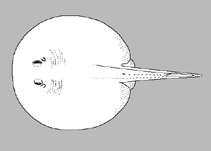 No image available for this species;
drawing shows typical species in Potamotrygonidae.
Google image
drawing shows typical species in Potamotrygonidae.
การจำแนกประเภท / ชื่อ ชื่อสามัญ | ชื่อพ้อง | Catalog of Fishes(สกุล, ชนิด) | ITIS | CoL | WoRMS | Cloffa
sub class Elasmobranchii (ฉลามและกระเบน) (sharks and rays) > Myliobatiformes (Stingrays) > Potamotrygonidae (River stingrays) > Potamotrygoninae
Etymology: Plesiotrygon: Greek, plesios = near + Greek, trygon = a sting ray (Ref. 45335); nana: The specific epithet nana is in reference to its dwarf size (from the Latin nanus). Gender feminine (Ref. 86912).
Etymology: Plesiotrygon: Greek, plesios = near + Greek, trygon = a sting ray (Ref. 45335); nana: The specific epithet nana is in reference to its dwarf size (from the Latin nanus). Gender feminine (Ref. 86912).
สิ่งแวดล้อม : สิ่งแวดล้อม / เขตภูมิอากาศ / ระดับความลึก / ระยะการกระจายสินค้า นิเวศวิทยา
; น้ำจืด สัตว์น้ำหน้าดิน. Tropical; 9°S - 10°S
การแพร่กระจาย อาณาเขต | พื้นที่จำแนกตาม FAO | ระบบนิเวศหลายระบบ | การปรากฏขึ้น,การเกิดขึ้น,พบ | ตำแหน่งบนแผนที่ | การแนะนำ | Faunafri
South America: Peru. Río Pachitea, tributary of Río Ucayali, up-river from town of Puerto Inca, Puerto Inca Province, Huánuco Department (Ref. 86912).
ขนาด / น้ำหนัก / อายุ
คำอธิบายสั้นๆ เครื่องมือที่ใช้ในการแยกชนิดสัตว์,สิ่งมีชีวิตออกจากกัน | สัณฐานวิทยา | ความยาวต่างๆ
A species of Plesiotrygon diagnosed by the following unique characters: (1) dorsal color pattern composed of a dark gray to dark brown background color, with tan to yellow highly curved, slender and convoluted stripes or small spots forming rosette-like pattern over dorsal disc, or with creamy white to yellowish irregularly shaped, scattered spots and ocelli, smaller than interorbital distance (pale gray or brown dorsal background color in P. iwamae, composed of faint, incomplete markings outlined by small spots, or small irregular blotches and creamy, faint spots); (2) disc circular in preadults and adults, about as wide as long (markedly oval in P. iwamae in all sizes); (3) broadly rounded anterior disc (anterior disc sharply oval in P. iwamae); (4) spiracles only faintly rhomboidal, very small, ranging from 2.8 to 3.5% DW in adult and preadult specimens (spiracle strongly rhomboidal, with mean spiracle length 6.8% DW in P. iwamae); (5) snout very short, mean preorbital length 21.2% DW, mean prenasal length 15.2% DW, and mean preoral length 18.7% DW (snout proportionally much more elongate in P. iwamae, with mean preoral length 27.4% DW, mean prenasal length 19.5% DW, and mean preoral length 25% DW); (6) mouth and nostrils very slender especially in adult and preadult specimens, with mean mouth and internarial width 6.3% DW (mouth and internarial distance much greater in P. iwamae, with mean mouth width 10.9% DW, and mean internarial distance 8.7% DW); (7) denticles on dorsal tail relatively small, scattered, not forming row of greatly enlarged spines (P. iwamae usually with a single irregular row of enlarged spines on dorsal tail region); (8) adult and preadult specimens with few (20‑21/19) tooth rows (adult specimens of P. iwamae have numerous tooth rows, ranging from about 40‑60/42‑64); (9) caudal vertebrae ranging from 86‑88, with a modal count of 86 (93‑98, with a modal count of 94 caudal vertebrae in P. iwamae); (10) total pectoral radials in adult and preadult specimens 90‑91 (in P. iwamae, total pectopectoral radials varied from 77‑84); (11) overall size very small (probably not surpassing 250 mm DL or DW), males sexually maturing probably between 180 and 220 mm DL, and 175 and 225 mm DW (P. iwamae attains great sizes, upwards of 650 mm DL or DW, reaching sexual maturity only at about 420 mm DL or DW); (12) distal coloration of tail, as of caudal stings, usually a dark purplish brown, remaining this color to extremity of whip (in P. iwamae, tail as of caudal stings creamy white ventrally and light gray dorsally, with creamy white distal whip); (13) ventral lateral-line canals with the following unique characters: hyomandibular canal very narrow, with external and internal components close together; infraorbital and supraorbital canals not undulated; supraorbital and infraorbital loops small and narrow, without wavy contours; supraorbital loop of anterior infraorbital canal very short, not extending posteriorly to level of mouth; jugular and posterior infraorbital canals short, not extending posteriorly to close to gill slits; subpleural loop very narrow posteriorly; anterior and posterior subpleural tubules of hyomandibular canal absent (for comparison with ventral lateral-line canals in P. iwamae and other anatomical differences between both species (Ref. 86912).
Body shape (shape guide): other.
Body shape (shape guide): other.
วงจรชีวิตและพฤติกรรมการผสมพันธุ์ วัยเจริญพันธุ์ | การสืบพันธุ์ | การวางไข่ | เซลสืบพันธ์ของเพศเมีย(ไข่) | ความดกของไข่ | ตัวอ่อน
อ้างอิงหลัก
อัพโหลดข้อมูลอ้างอิงของคุณ | อ้างอิง | ผู้ประสานงาน : Carvalho, Marcelo | ผู้ร่วมมือ
De Carvalho, M.R. and M.P. Ragno, 2011. An unusual, dwarf species of neotropical freshwater stingray, Plesiotrygon nana sp. nov., from the upper and mid Amazon basin: the second species of Plesiotrygon (Chondrichthyes: Potamotrygonidae). Papéis Avulsos de Zoologia (São Paulo), 51 (7): 101-138 (Ref. 86912)
สถานะบัญชีแดงของ IUCN (Ref. 130435: Version 2025-2 (Global))
Near Threatened (NT) (A2cd); Date assessed: 09 March 2023
CITES
Not Evaluated
ภัยคุกคามต่อมนุษย์
Harmless
การใช้ของมนุษย์
FAO - Publication: search | FishSource |
ข้อมูลเพิ่มเติม
นิเวศวิทยาเขตร้อน
รายการอาหาร (เหยื่อ)
องค์ประอบของอาหาร
การบริโภคอาหาร
การจัดสรรอาหาร
ผู้ล่า
รายการอาหาร (เหยื่อ)
องค์ประอบของอาหาร
การบริโภคอาหาร
การจัดสรรอาหาร
ผู้ล่า
นิเวศวิทยา
นิเวศวิทยา
นิเวศวิทยา
พลวัตของประชากร
พารามิเตอร์การเจริญเติบโต
อายุสูงสุด / ขนาด
ความยาว-น้ำหนักสัมพันธ์
ความยาว-ความยาวสัมพันธ์
ความยาว-ความถี่
การแปลงมวล
การทดแทนที่
อุดมสมบรูณ์
พารามิเตอร์การเจริญเติบโต
อายุสูงสุด / ขนาด
ความยาว-น้ำหนักสัมพันธ์
ความยาว-ความยาวสัมพันธ์
ความยาว-ความถี่
การแปลงมวล
การทดแทนที่
อุดมสมบรูณ์
วงจรชีวิต
การสืบพันธุ์
วัยเจริญพันธุ์
ความสมบูรณ์พันธุ์/เหงือกที่เกี่ยวข้อง
ความดกของไข่
การวางไข่
การรวมตัวของสปอน
เซลสืบพันธ์ของเพศเมีย(ไข่)
การพัฒนาไข่
ตัวอ่อน
พลวัตของสัตว์น้ำวัยอ่อน
การสืบพันธุ์
วัยเจริญพันธุ์
ความสมบูรณ์พันธุ์/เหงือกที่เกี่ยวข้อง
ความดกของไข่
การวางไข่
การรวมตัวของสปอน
เซลสืบพันธ์ของเพศเมีย(ไข่)
การพัฒนาไข่
ตัวอ่อน
พลวัตของสัตว์น้ำวัยอ่อน
การแพร่กระจาย
อาณาเขต
พื้นที่จำแนกตาม FAO
ระบบนิเวศหลายระบบ
การปรากฏขึ้น,การเกิดขึ้น,พบ
การแนะนำ
BRUVS - วิดีโอ
อาณาเขต
พื้นที่จำแนกตาม FAO
ระบบนิเวศหลายระบบ
การปรากฏขึ้น,การเกิดขึ้น,พบ
การแนะนำ
BRUVS - วิดีโอ
กายวิภาคศาสตร์
พื้นที่เหงือก
สมอง
หินโสต
พื้นที่เหงือก
สมอง
หินโสต
สรีรวิทยา
องค์ประกอบของร่างกาย
สารอาหาร
การใช้ออกซิเจน
ประเภทการว่ายน้ำ
ระดับความเร็วในการว่ายน้ำ
เม็ดสีที่มองเห็นได้
เสียงปลา
โรคและปรสิต
ความเป็นพิษ (LC50s)
องค์ประกอบของร่างกาย
สารอาหาร
การใช้ออกซิเจน
ประเภทการว่ายน้ำ
ระดับความเร็วในการว่ายน้ำ
เม็ดสีที่มองเห็นได้
เสียงปลา
โรคและปรสิต
ความเป็นพิษ (LC50s)
พันธุศาสตร์
จีโนม
พันธุศาสตร์
ความไม่สมดุลทางเชื้อชาติ
อัตราพันธุกรรม
ความหลากหลายทางพันธุกรรม
จีโนม
พันธุศาสตร์
ความไม่สมดุลทางเชื้อชาติ
อัตราพันธุกรรม
ความหลากหลายทางพันธุกรรม
เกี่ยวข้องกับมนุษย์
ระบบการเพาะเลี้ยงสัตว์น้ำ
ประวัติการเพาะเลี้ยงสัตว์น้ำ
สายพันธุ์
กรณีซิเกวเทอรา
แสตมป์ เหรียญ อื่นๆ
ระบบการเพาะเลี้ยงสัตว์น้ำ
ประวัติการเพาะเลี้ยงสัตว์น้ำ
สายพันธุ์
กรณีซิเกวเทอรา
แสตมป์ เหรียญ อื่นๆ
เครื่องมือ
หนังสืออิเล็กทรอนิกส์ | คู่มือภาคสนาม | ผู้มีความชำนาญในเรื่องความถี่ของความยาว | เครื่องมือในการศึกษาชีวประวัติ | ตำแหน่งบนแผนที่ |
จับ-MSY |
รายงานพิเศษ
ตรวจสอบการบำรุงรักษาตู้ปลา | ตรวจสอบเอกสารข้อเท็จจริงเกี่ยวกับสายพันธุ์ | ตรวจสอบเอกสารข้อเท็จจริงเกี่ยวกับการเพาะเลี้ยงสัตว์น้ำ
ดาวน์โหลด XML
หน้าสรุป | ข้อมูลสำคัญ | ชื่อสามัญ | ภาพถ่าย
แหล่งที่มาจากอินเตอร์เน็ต
AFORO (otoliths) | Aquatic Commons | BHL | Cloffa | Websites from users | Check FishWatcher | CISTI | Catalog of Fishes: สกุล, ชนิด | DiscoverLife | ECOTOX | FAO - Publication: search | Faunafri | Fishipedia | Fishtrace | GloBI | Google Books | Google Scholar | Google | IGFA World Record | OneZoom | Open Tree of Life | Otolith Atlas of Taiwan Fishes | PubMed | Reef Life Survey | Socotra Atlas | TreeBase | แผนภูมิชีวิตแบบต้นไม้ | Wikipedia: Go, ค้นหา | World Records Freshwater Fishing | Zoobank | บันทึกทางด้านสัตววิทยา
การประมาณค่าตามแบบจำลอง
ดัชนีความหลากหลายทางวิวัฒนาการ (อ้างอิง 82804): PD50 = 0.7500 [Uniqueness, from 0.5 = low to 2.0 = high].
Bayesian length-weight: a=0.01000 (0.00244 - 0.04107), b=3.04 (2.81 - 3.27), in cm total length, based on all LWR estimates for this body shape (Ref. 93245).
ระดับชั้นอาหาร (อ้างอิง 69278): 3.2 ±0.4 se; based on size and trophs of closest relatives