



Ernogrammus zhirmunskii Markevich & Kharin, 2011
Seven-lined prickleback
Загрузить свой Фото и Видео
изображения | Изображение на Google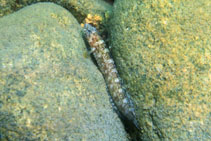 Ernogrammus zhirmunskii
Изображение сделано Markevich, A.I.
изображения | Изображение на Google
Изображение сделано Markevich, A.I.
Классификация / Имена народные названия | синонимы | Catalog of Fishes(род, виды) | ITIS | CoL | WoRMS | Cloffa
> Perciformes/Zoarcoidei (Eelpouts and pricklebacks) > Stichaeidae (Pricklebacks) > Stichaeinae
Etymology: Ernogrammus: Greek, ernos, -eos, -ous = bud, shoot, descendenat + Greek, gramma = letter, mark, signal (Ref. 45335); zhirmunskii: Named for Alexey V. Zhirmunsky (1921-2000) of the Russian Academy of Sciences, founder and director of the Institute of Marine Biology (Far Eastern Branch of the Russian Academy of Sciences, Vladivostok), and the initiator of the Far Eastern Marine Biosphere Reserve.
Eponymy: Alexei Viktorovich Zhirmunsky (1921–2000) of the Russian Academy of Sciences was the founder and Director of the Institute of Marine Biology (Far Eastern Branch of the Russian Academy of Sciences, Vladivostok). (Ref. 128868), visit book page.
Etymology: Ernogrammus: Greek, ernos, -eos, -ous = bud, shoot, descendenat + Greek, gramma = letter, mark, signal (Ref. 45335); zhirmunskii: Named for Alexey V. Zhirmunsky (1921-2000) of the Russian Academy of Sciences, founder and director of the Institute of Marine Biology (Far Eastern Branch of the Russian Academy of Sciences, Vladivostok), and the initiator of the Far Eastern Marine Biosphere Reserve.
Eponymy: Alexei Viktorovich Zhirmunsky (1921–2000) of the Russian Academy of Sciences was the founder and Director of the Institute of Marine Biology (Far Eastern Branch of the Russian Academy of Sciences, Vladivostok). (Ref. 128868), visit book page.
Окружающая среда: среда / климатическая зона / пределы глубины / диапазон распространения экология
морской демерсальный; пределы глубины 2 - 11 m (Ref. 86739). Temperate
распространение Территории | регионы FAO | Экосистемы | места находок | карта точек | интродукции | Faunafri
Northwest Pacific: Russia, Sea of Japan.
Размер / Вес / Возраст
половая зрелость: Lm ? range ? - ? cm
Max length : 6.4 cm SL самец/пол неопределен; (Ref. 86739); 7.5 cm SL (female)
Max length : 6.4 cm SL самец/пол неопределен; (Ref. 86739); 7.5 cm SL (female)
Краткое описание определительные ключи | морфология | морфометрия
колючие лучи спинного плавника (общее число) : 41 - 42; колючие лучи анального плавника: 2; членистые (мягкие) лучи анального плавника: 28 - 30; позвонки: 44 - 47. This species is distinguished from its congeners in having 7 body sensory canals, including one short canal in the middle of belly; anal fin rays with one short rigid spine posteriormost (I 28-30 I); with one narrow white stripe between two wide black ones on the base of pelvic fin, and one dark blotch on the dorsal fin anteriorly (Ref. 86739).
Body shape (shape guide): elongated; Cross section: compressed.
Body shape (shape guide): elongated; Cross section: compressed.
This species, from visual underwater observations, occurs in rocky substrate, 2.5-11.3 m, at water temperature from 14ºC to 21ºC during July to September. It is a secretive species, and under ordinary condition it seldom leave their shelters under boulders in the daytime and usually with only the anterior part of the body exposed. During the collection, 1-3 fish were usually found under one boulder 0.3 × 0.3 m in size, the common density reached 8 fish/m2. The species is inactive at night, unlike E. hexagrammus which commonly occurs in the same rocky habitat. Specimens of the type series had average body weight 1.425 g (1.100-1.900 g), the smallest collected fish (FEMBSNR 748 juvenile SL 34 mm) had body weight of 0.350 g. Stomachs of collected specimens contained remains of shells of small mollusk Falsicingula mundana (Gastropoda: Discopoda: Falsicingulidae), remains of unidentified fish and lumps of tiny fish eggs (Ref. 86739).
Жизненный цикл и брачное поведение половая зрелость | размножение | нерест | икра | Плодовитость | личинки
Основная ссылка
Загрузите свои рекомендации | ссылки | координатор | соавторы
Markevich, A.I. and V.E. Kharin, 2011. A new species of prickleback Ernogrammus zhirmunskii (Acanthopterygii: Perciformes: Stichaeidae) from the Sea of Japan, Russia. Zootaxa 2814:59-66. (Ref. 86739)
CITES
Not Evaluated
Угроза для людей
Harmless
Использование человеком
FAO - Publication: search | FishSource |
дополнительная информация
Трофическая экология
Пищевые предметы (добыча)
состав пищи
потребление пищи
Продовольственные пайки
хищники
Пищевые предметы (добыча)
состав пищи
потребление пищи
Продовольственные пайки
хищники
экология
экология
экология
Динамика численности населения
Параметры роста
Макс. возраст / размер
Отношение длины к весу.
Отношение длины к длине.
Размерный состав
Преобразование массы
пополнение
численность
Параметры роста
Макс. возраст / размер
Отношение длины к весу.
Отношение длины к длине.
Размерный состав
Преобразование массы
пополнение
численность
Жизненный цикл
размножение
половая зрелость
Зрелость/Жиры относительно.
Плодовитость
нерест
Нерестовые скопления
икра
Развитие икры
личинки
динамика численности личинок
размножение
половая зрелость
Зрелость/Жиры относительно.
Плодовитость
нерест
Нерестовые скопления
икра
Развитие икры
личинки
динамика численности личинок
Анатомия
жаберная область
Мозг
Отолит
жаберная область
Мозг
Отолит
Физиология
Состав тела
Питательные вещества
Потребление кислорода
Тип плавания
Скорость плавания
Зрительные пигменты
Звук рыбы
Болезни и паразиты
Токсичность (LC50s)
Состав тела
Питательные вещества
Потребление кислорода
Тип плавания
Скорость плавания
Зрительные пигменты
Звук рыбы
Болезни и паразиты
Токсичность (LC50s)
генетика
Геном
генетика
Гетерозиготность
наследуемость
Генетическое разнообразие
Геном
генетика
Гетерозиготность
наследуемость
Генетическое разнообразие
Связанные с человеком
Системы аквакультуры
особенности рыбоводства
степень растяжения
Случаи заболевания сигуатерой
Марки, монеты и прочее.
Системы аквакультуры
особенности рыбоводства
степень растяжения
Случаи заболевания сигуатерой
Марки, монеты и прочее.
инструменты
Специальные отчеты
Проверить содержание в аквариумах | Проверить опубликованные видовые данные | Проверить опубликованные данные по аквакультуре
Скачать в формате XML
ресурсы в Интернет
AFORO (otoliths) | Aquatic Commons | BHL | Cloffa | Websites from users | Проверить FishWatcher | CISTI | Catalog of Fishes: род, виды | DiscoverLife | ECOTOX | FAO - Publication: search | Faunafri | Fishipedia | Fishtrace | GloBI | Google Books | Google Scholar | Google | IGFA World Record | OneZoom | Open Tree of Life | Otolith Atlas of Taiwan Fishes | PubMed | Reef Life Survey | Socotra Atlas | TreeBase | Tree of Life | Wikipedia: Вперёд, поиск | | Zoobank | Зоологическая летопись
Оценки, основанные на моделях
|
Индекс филогенетического разнообразия (ссылка 82804) |
PD50 = 0.6250 [Uniqueness, from 0.5 = low to 2.0 = high]. |
| Bayesian length-weight | a=0.00380 (0.00166 - 0.00868), b=3.16 (2.96 - 3.36), in cm total length, based on LWR estimates for this (Sub)family-body shape (Ref. 93245). |
|
Трофический уровень (ссылка 69278) |
3.2 ±0.5 se; based on size and trophs of closest relatives |
|
устойчивость к внешним воздействиям (ссылка 120179) |
средний (среднего размера), минимальное время удвоения популяции 1.4-4.4 года (Preliminary K or Fecundity.). |
|
Уязвимость рыбной ловли (Ref. 59153) |
Low to moderate vulnerability (31 of 100). 🛈 |