



Kathetostoma binigrasella Gomon & Roberts, 2011
Aggiungete la vostra osservazione in Fish Watcher
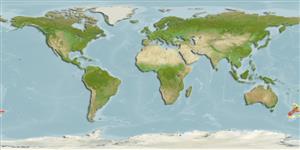
| Native range | All suitable habitat | Point map | Year 2050 |
|
| This map was computer-generated and has not yet been reviewed. |
| Kathetostoma binigrasella AquaMaps Data sources: GBIF OBIS |
Carica il tuo foto e Video
Google image No image available for this species;
drawing shows typical species in Uranoscopidae.
Google image
drawing shows typical species in Uranoscopidae.
Classificazione / Nomi Nomi Comuni | Sinonimi | Catalog of Fishes(Genere, Specie) | ITIS | CoL | WoRMS | Cloffa
> Perciformes/Uranoscopoidei (Sand dwellers) > Uranoscopidae (Stargazers)
Etymology: Kathetostoma: Greek, kathetos, -on = lime + Greek, stoma = mouth (Ref. 45335); binigrasella: The specific name binigrasella, from the Latin bi for ‘two’, nigra for ‘dark’ and sella for ‘saddle’ refers to the broad dark brown saddle-like bands dorsally on the body that are obvious features distinguishing this species from its New Zealand congener.
Etymology: Kathetostoma: Greek, kathetos, -on = lime + Greek, stoma = mouth (Ref. 45335); binigrasella: The specific name binigrasella, from the Latin bi for ‘two’, nigra for ‘dark’ and sella for ‘saddle’ refers to the broad dark brown saddle-like bands dorsally on the body that are obvious features distinguishing this species from its New Zealand congener.
Ambiente: milieu / zona climatica / distribuzione batimetrica / gamma di distribuzione Ecologia
marino benthopelagico; distribuzione batimetrica 10 - 500 m (Ref. 86516), usually 100 - 300 m (Ref. 86516). Temperate
Distribuzione Territories | Aree FAO | Ecosistemi | Presenze | Mappa dei ritrovamenti | Introduzioni | Faunafri
Pacific Ocean: endemic to New Zealand.
Dimensione / Peso / Età
Breve descrizione Chiavi di identificazione | Morfologia | Morfometria
Raggi dorsali molli (totale) : 15 - 17; Raggi anali molli: 14 - 16; Vertebre: 30 - 31. Head and body broad, head width 1.2-1.7 times its length, covered with tiny blunt knobs in juveniles to almost smooth in adults; mouth with several prominent canines between smaller canines; chin smooth; ventral margin of preopercle with four spine-like processes; anterior end of isthmus with a pair of prominent forward directed spines; prominent cleithral spine sheathed with skin above pectoral fin base; 17-19 gill rakers on first arch in the form of patches of fine teeth, patches broad, about six to ten teeth across patches, not in distinct rows, innermost teeth rather short; dorsal fin of moderate length, its base 43-66% of predorsal length; pelvic fins large, their length 23-28% SL; body whitish below usually with two broad, vertical, dark-brown, variously distinct bands or saddles across back, most distinct in juveniles and small adults (Ref. 86516).
Found on sand or mud bottoms (Ref. 86516).
Ciclo vitale e comportamento di accoppiamento Maturità | Riproduzione | Deposizione | Uova | Fecondità | Larve
Riferimento principale
Caricare le referenze | Bibliografia | Coordinatore | Collaboratori
Gomon, M.F. and C.D. Roberts, 2011. A second New Zealand species of the stargazer genus Kathetostoma (Trachinoidei: Uranoscopidae). Zootaxa 2776:1-12. (Ref. 86516)
CITES
Not Evaluated
Minaccia per l'uomo
Harmless
Usi umani
FAO - Publication: search | FishSource |
Informazioni ulteriori
Ecologia trofica
Articoli alimentari (prede)
Alimentazione
Consumo di cibo
Razioni alimentari
Predatori
Articoli alimentari (prede)
Alimentazione
Consumo di cibo
Razioni alimentari
Predatori
Dinamica della popolazione
Parametri di crescita
Età massima / dimensioni massime
Rapporto lunghezza-peso.
Lunghezza-lunghezza rel.
Lunghezza-frequenze
Conversione di massa
Reclutamento
Abbondanza
Parametri di crescita
Età massima / dimensioni massime
Rapporto lunghezza-peso.
Lunghezza-lunghezza rel.
Lunghezza-frequenze
Conversione di massa
Reclutamento
Abbondanza
Ciclo di vita
Riproduzione
Maturità
Maturità/Gli occhielli sono relativi.
Fecondità
Deposizione
Aggregazioni riproduttive
Uova
Sviluppo delle uova
Larve
Dinamica popolazioni larvali
Riproduzione
Maturità
Maturità/Gli occhielli sono relativi.
Fecondità
Deposizione
Aggregazioni riproduttive
Uova
Sviluppo delle uova
Larve
Dinamica popolazioni larvali
Anatomia
Area branchiale
Cervello
Otolite
Area branchiale
Cervello
Otolite
Fisiologia
Composizione corporea
Nutrienti
Consumo di ossigeno
Tipo di nuoto
Velocità di nuoto
Pigmenti visivi
Suono del pesce
Malattie e parassiti
Tossicità (LC50)
Composizione corporea
Nutrienti
Consumo di ossigeno
Tipo di nuoto
Velocità di nuoto
Pigmenti visivi
Suono del pesce
Malattie e parassiti
Tossicità (LC50)
Genetica
Genome
Genetica
Eterozigosi
Ereditarietà
Diversità genetica
Genome
Genetica
Eterozigosi
Ereditarietà
Diversità genetica
Legato all'uomo
Sistemi di acquacoltura
Profili di acquacoltura
Varietà
Casi di Ciguatera
Francobolli, monete, materiale vario.
Sistemi di acquacoltura
Profili di acquacoltura
Varietà
Casi di Ciguatera
Francobolli, monete, materiale vario.
Strumenti
Libro elettronico | Giuda pratica | Generatore frequenze di lunghezza | Strumento Parametri Biologici | Mappa dei ritrovamenti |
Cattura-MSY |
Rapporti speciali
Controllo della manutenzione dell'acquario | Verificare la presenza di schede informative sulle specie | Verifica delle schede informative sull'acquacoltura
Scarica XML
Fonti Internet
AFORO (otoliths) | Aquatic Commons | BHL | Cloffa | Websites from users | Check FishWatcher | CISTI | Catalog of Fishes: Genere, Specie | DiscoverLife | ECOTOX | FAO - Publication: search | Faunafri | Fishipedia | Fishtrace | GloBI | Google Books | Google Scholar | Google | IGFA World Record | OneZoom | Open Tree of Life | Otolith Atlas of Taiwan Fishes | PubMed | Reef Life Survey | Socotra Atlas | TreeBase | Tree of Life | Wikipedia: Go, ricerca | World Records Freshwater Fishing | Zoobank | Record zoologico
Stime basate su modelli
Temperatura preferita (Fonte Biblio. 123201): 10.2 - 14.5, mean 13 °C (based on 27 cells).
Indice di diversità filogenetica (Fonte Biblio. 82804): PD50 = 0.5020 [Uniqueness, from 0.5 = low to 2.0 = high].
Bayesian length-weight: a=0.00631 (0.00265 - 0.01501), b=3.11 (2.90 - 3.32), in cm total length, based on LWR estimates for this (Sub)family-body shape (Ref. 93245).
Livello trofico (Fonte Biblio. 69278): 4.4 ±0.7 se; based on size and trophs of closest relatives
Resilienza (Fonte Biblio. 120179): Basso, tempo minimo di raddoppiamento della popolazione 4.5 - 14 anni (Preliminary K or Fecundity.).